Follow the recorded NVDA experiment
This completed genetic experiment is intentionally selected to teach the workflow. Its profitable winner missed the original intraday requirements. Published historical dates are available for reproduction; they are not an untouched test for a new reader.
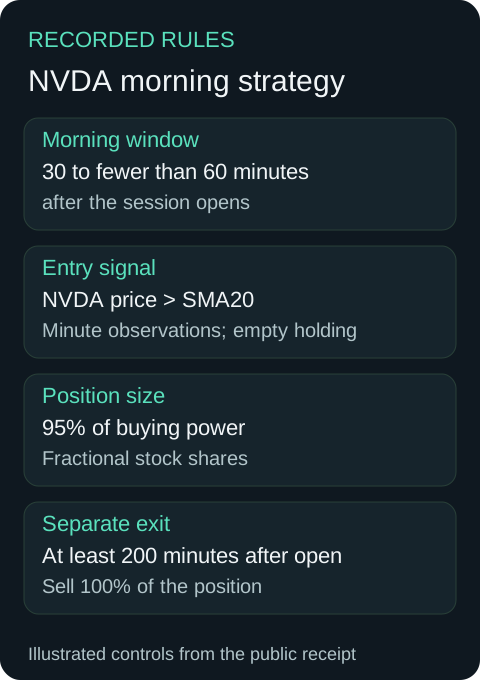
Start with the actual morning rules
NVDA enters from 30 to fewer than 60 minutes after open, above SMA20, with an empty holding. A separate midday exit sells the full position. Read the complete draft before searching.
Two rules with explicit entry, exit and sizing. Reviewing this draft does not save it or submit a test.
Set the search before seeing its winner
The completed Parameter genetic search used six candidates per generation and three generations. It changed timing, comparisons, sizing and exits. It was broader than a three-value moving-average sweep.
Inspect all recorded candidate rules- Development dates
- Jan 2 to Mar 28, 2024
- Population / generations
- 6 / 3
- Training / windows
- 75% / 1
- Final leaderboard
- 6 candidates; unique-trial count unavailable
A saved search plan, every final candidate and an inspection of what changed in the chosen rules.
Choose the lines to compare
Read the later result and the failed goal
On April 1 to June 28, the winner bought once, never sold and stayed invested across sessions. Its return was positive, but four of five requirements failed. The original morning rules also weakened on these later dates.
Read the exact later-test receipt- Genetic winner / NVDA
- 22.06% / 36.00%
- Original later return
- -10.19%
- Winner drawdown / limit
- 12.73% / 10%
- Closed round trips / minimum
- 0 / 10
- Winner fees paid
- $2.98
- Acceptance
- 1 passed; 4 failed
Keep the failed result. Inspect the full selected exit before calling this an intraday strategy.
Open the fully configured request
Aurora receives the complete seed, search settings, costs, later dates and acceptance rules. Review and edit the request. Ask for a plan and cost before deciding whether to run your own reproduction.
- Capital / observations
- $10,000 / Minute
- Shares / dividends
- Fractional / cash
- Stock fee per fill
- 0.05%
- Current task
- Review and plan; do not launch
A review of the supplied rules and a research plan. Engine validation requires a later approved authoring step; this request stops before saving or starting research.
Start with the question you want to test
Start with the question you want to test
Write one hypothesis, a tradable universe and an explicit entry, exit and size rule. Choose a benchmark, costs and observation interval. A trend idea, a reported-company filter and a disclosure-following idea need different evidence, even when they trade the same stock.
Create a strategy using technical indicators
Turn price, moving averages and oscillators into explicit trading rules, test variants and inspect recorded signals.
Open pageCreate a strategy using fundamental indicators
Build trading rules from reported company metrics, inspect the source period and test clear entry and exit conditions.
Open pageCreate a strategy using economic indicators
Use macroeconomic conditions in strategy rules, inspect units and releases, and compare fixed regime thresholds.
Open pageCreate a strategy from congressional trading disclosures
Use publicly disclosed congressional purchases as a trading signal with explicit member, instrument and trailing-window scope.
Open pageCreate a strategy from insider trading disclosures
Build rules from disclosed insider purchases, specify officer or director scope and inspect the filing behind each signal.
Open pageCreate a strategy from institutional holdings
Use public Form 13F holdings changes, select manager scope and inspect successive disclosed quarters.
Open pageCreate a strategy with mixed indicators
Combine price trends and company metrics, define complementary exits and compare each component with the combined rule.
Open pageAsk Aurora to inspect the backtest corpus first
Ask Aurora to inspect the backtest corpus first
Start with existing experiments. Compare the whole rule and its test inputs, including weaker examples, before choosing a signal. Save the dates you inspected in your research notes so you can reserve a later test.
Before creating a trading strategy, inspect the existing backtest corpus. Search for completed prior examples using these indicator types: Price, SimpleMovingAverage, Fundamental, with comparable tickers, cadence and asset class. Examine both stronger and weaker completed examples and their actual rules, dates, capital, fees, turnover and benchmark. Screen the corpus for a more specific cohort or named strategy when needed. Show the returned records and any filters you widened. Explain which ideas recur and which trades account for the results. Record the historical periods you inspected. Propose three bounded variants and a development period; keep a later unseen test outside the selection. Stop at the research plan.Choose the periods before comparing variants
Choose the periods before comparing variants
This calendar illustrates a research plan. Use dates suited to your data and record any periods already inspected through corpus research, charts or earlier experiments.
Scroll sideways to compare all columns. Select a heading to sort.
| Development | 2022-01-01 through 2023-12-31 | Create variants, inspect trades and revise rules here. |
| Unseen test | 2024-01-01 through 2024-12-31 | Evaluate the frozen candidate once after choosing the objective. |
| Optional final lockbox | 2025-01-01 through 2025-12-31 | Reserve an additional untouched window before all selection. |
| Paper observation | Later dates after the design is frozen | Observe signals, scheduling, orders and positions as they occur. |
No matching rows. Clear the filter to see all records.
Create variants and keep a trial ledger
Create variants and keep a trial ledger
Begin with a small set of changes that test the hypothesis. Record the exact rule, dates, starting capital, fees, benchmark, result and decision for every attempt. Use development trades to explain what changed. Once you have selected a candidate, freeze it before opening the unseen period.
Scroll sideways to compare all columns. Select a heading to sort.
| Corpus research | Comparable records, rules and dates already inspected |
| Variants | A bounded list with a reason for each change |
| Development | Saved results and a choice made using a preselected objective |
| Unseen evaluation | The unchanged selected rule and its later-period result |
| Optional lockbox | An additional untouched assessment of the final selection |
| Paper trading | A dated observation log of signals, orders and positions |
| Live trading | A selected broker, reviewed allocation and explicit automation setting |
No matching rows. Clear the filter to see all records.
Give Aurora the whole research sequence
Give Aurora the whole research sequence
First inspect comparable completed records from the backtest corpus. Show rules, dates, fees, benchmark, stronger and weaker examples, and periods already exposed. Propose three variants for my hypothesis. Agree one development period and a later unseen test before launching anything. Iterate only on development dates and keep a trial ledger. Freeze the selected configuration and objective, then test the unseen period unchanged. Reserve an optional final lockbox if requested. Prepare paper observation steps and a separate live deployment review; show the exact target and automation settings.Explore completed examples
Explore completed examples
Use the options and crypto examples to practice reading a full curve, a signal and its recorded orders. Crypto pages include SPY and BTC buy-and-hold lines over the same period.