TL;DR
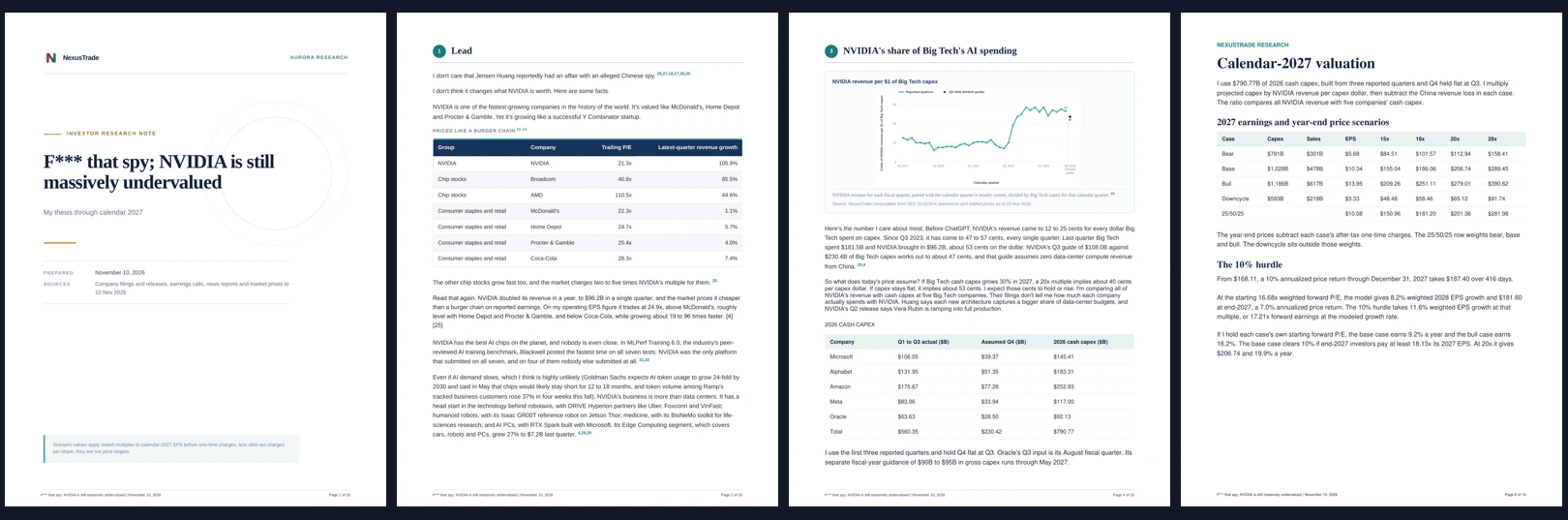
I think NVIDIA is massively undervalued, and I’m betting the growth matters more than the headline. Using the cash-capex model, my base case gives $206.74 at 20x 2027 earnings. If I hold today’s weighted forward multiple, I get 7.0% annualized price appreciation through 2027.
The downside is real. At 20x my bear case is worth $112.94. At 15x my downcycle is worth $48.48.
The affair news hit NVIDIA, and most of the slide came with the sector
Daily moves from NexusTrade daily price history, 1 Oct to 9 Nov 2026, and the 10 Nov intraday price. On 30 Oct the chip index fell 7.0%.
NVIDIA fell less than the chip index the day after the first report, and most of the rest of the slide came with the whole sector. In my research on 2.27 million company-days of news, positive and negative news showed no reliable difference in returns over the next day, week, month, quarter or year (Does news sentiment predict stock returns?).
NVIDIA valuation vs. peers (AMD, Broadcom, Big Tech)
Market-data trailing P/E on 10 Nov 2026, with NVIDIA at the $168.11 model price. Alphabet's trailing earnings include a one-time gain, and one quarter's growth flatters a company near a cycle peak. Trailing P/E, then P/E ÷ growth: NVIDIA 21.3x, 0.20; Broadcom 40.8x, 0.48; AMD 110.5x, 2.48; Oracle 18.8x, 0.64; Meta 21.9x, 0.84; Alphabet 15.0x, 0.61; Microsoft 28.5x, 1.52; Amazon 21.6x, 1.79; Apple 39.1x, 3.34; Coca-Cola 28.3x, 3.82; Walmart 45.5x, 7.71; Home Depot 24.7x, 4.33; Procter & Gamble 25.4x, 6.35 (growth 4.0%); McDonald's 22.3x, 20.27.
NVIDIA doubled its revenue in a year, to $96.2B in a single quarter, and the market prices it cheaper than a burger chain on reported earnings. On my trailing operating EPS of $6.75, it trades at 24.9x while growing about 19 to 96 times faster than McDonald's, Home Depot, Procter & Gamble and Coca-Cola.
What $168.11 implies
The chart uses the base case's 73% gross margin, $46B operating expenses, China haircut and one-time charge. Each bar solves for the ratio that matches the reference price before discounting.
At 20x, $168.11 implies about 40 cents of NVIDIA revenue per capex dollar if cash capex grows 30% in 2027. I expect those cents to hold or rise.
Big Tech capex keeps climbing
The 2026 estimate totals $790.77B of cash purchases across the five companies, assuming Q4 matches Q3. Oracle's reported quarter runs through August. Oracle separately guided to $90B to $95B of gross capex for the fiscal year ending May 2027.
I use $790.77B of 2026 cash capex, built from three reported quarters and Q4 held flat at Q3. I multiply projected capex by NVIDIA revenue per capex dollar, then subtract the China revenue loss in each case. The ratio compares all NVIDIA revenue with five companies' cash capex.
Alphabet expects capex to "increase significantly" in 2027. Morgan Stanley projects $1.58T for a broader group including leases. My base case assumes 30% cash-capex growth. Broadcom's AI chip forecast was reported by Reuters.
Broadcom’s $115B fiscal 2027 AI chip revenue forecast is about 11.2 cents per base-case capex dollar.
NVIDIA 2027 stock price scenarios: bear, base and bull
End-2027 scenario prices use a multiple of calendar-2027 EPS before one-time charges, with those charges subtracted after tax. Returns use the $168.11 reference price from 09:57 CT on November 10, 2026.
- Bear
- $5.68 EPS on $301B revenueCash capex $791B · 42¢ · China lost · 70% gross margin · $44B opex · $10B fine plus $10B commitment charge
- Base
- $10.34 EPS on $478B revenueCash capex $1,028B · 48¢ · China halved · 73% gross margin · $46B opex · $1.2B fine
- Bull
- $13.95 EPS on $617B revenueCash capex $1,186B · 52¢ · China kept · 74% gross margin · $48B opex · no charges
- Revenue consensus using my margins and costs
- $15.78 EPS on $692B revenue57-analyst fiscal-2028 revenue estimate, with my margin and opex
Read the explanation
Weighting bear, base and bull 25/50/25 gives $201.36 at 20x.
From $168.11, a 10% annualized price return through December 31, 2027 takes $187.40 over 416 days.
At the starting 16.68x weighted forward P/E, the model gives 8.2% weighted 2028 EPS growth and $181.60 at end-2027, a 7.0% annualized price return. The 10% hurdle takes 11.6% weighted EPS growth at that multiple, or 17.21x forward earnings at the modeled growth rate.
If I hold each case's own starting forward P/E, the base case earns 9.2% a year and the bull case earns 16.2%. The base case clears 10% if end-2027 investors pay at least 18.13x its 2027 EPS. At 20x it gives $206.74 and 19.9% a year.
In August, NVIDIA expected about 70% FY2028 revenue growth and 72% to 73% gross margin. FY2028 roughly matches calendar 2027. Applying that growth rate to reported first-half sales, the Q3 guide and modeled Q4 sales gives $664.42B to $698.42B of FY2028 sales. The cash-capex cases all fall below that range. NVIDIA earnings call
At the midpoint I get $15.43 of operating EPS, using $46B opex, 17% tax and 24.3B shares. At 15x that gives $231.44 at end-2027, or $207.62 discounted at 10%. This is my calculation from management's preliminary outlook. It leaves FY2029 growth open.
TIKR’s November 2 sales consensus was $692B for FY2028 and $903B for FY2029, about 30% growth across the two estimates. Coverage fell from 57 analysts to 38 between those years. The numbers are sales estimates. The forward return hurdle uses EPS. TIKR consensus snapshot
The downside, sized
End-2027 values on the cash-capex basis. The succession stress assumes weaker execution alongside the CEO change.
In my downcycle, cash capex falls 25% to $593B and EPS drops to $3.33. Giving the downcycle 15% weight lowers the 20x weighted annualized price return to 6.7%.
Cheaper AI means more AI
Before the gin, separating one pound of cotton from its seed took 10 hours of hand labor; Whitney's gin did 50 pounds in a day. The National Archives calls the growth of slavery the gin's most significant effect. Production went from 2 million pounds to almost 50 million.
AI token prices have fallen about 50% from their peaks this year (Axios), and the bear argument says cheaper AI means fewer GPUs. Cheaper cotton meant far more cotton, which is the Jevons paradox. Goldman Sachs expects AI token usage to grow 24-fold by 2030 even as cost per token falls 60% to 70% a year (Goldman Sachs Research), and NVIDIA gets paid out of capex, which Goldman puts at $1.1 trillion for the largest hyperscalers in 2027.
The Jensen Huang and Alice Huang (Megaspeed) investigation
Huang told employees he had been "unfaithful" to his wife, without naming anyone (OfficeChai, summarizing the FT). My bear case already carries a $10B fine and a $10B commitment charge and loses all China revenue, and I found no source showing a cancelled order beyond Megaspeed (Moneycontrol).
Securities complaint filed November 9
- 29 Oct
- The NYT reports US officials determined that Alice Huang was allegedly passing information to Beijing.
- Later
- The FT reports a memo by US officials said Huang had been romantically involved with Alice Huang (Huang Le), a senior Megaspeed executive. The intelligence links have not been publicly established.
- 8 Nov
- The board opens an investigation led by independent directors with outside counsel and expresses confidence in Huang before any findings.
- 9 Nov
- A securities class-action complaint was filed against NVIDIA and Huang on 9 Nov.
- 17 Nov
- NVIDIA reports earnings.
- 18 Nov
- House committee leaders requested a closed-door briefing with Huang.
- Megaspeed purchases
- More than $4.8B of NVIDIA hardware between June 2024 and February 2026, roughly $2.7B to $2.9B a year, about 0.6% of my base-case revenue.
Where the cash goes
Free cash flow is $69.9B. Gains and receivables explain nearly all of the $48.1B gap to GAAP earnings. Net debt proceeds are Q2 only.
At the end of Q2, NVIDIA held about $99B in equity stakes, roughly 2.4% of its $4.09T market value at $168.11. That includes $42.8B of marketable equity, $51.2B of non-marketable equity and another $5.0B of locked-up public equity in other assets.
On the first half's pace, free cash flow is about 3.4% of NVIDIA's market value, and about 1.7% after the stakes. NVIDIA returned $45.3B and borrowed $24.9B in Q2 to cover the difference, while diluted shares fell 1.0% in a year. That's the honest bear case: NVIDIA looks cheap on earnings and a lot less cheap on the cash it keeps.
The $108.5B of guarantees
Lease and power payment guarantees disclosed in NVIDIA's Form 10-Q for the quarter ended 26 Jul 2026. The OpenAI affiliate's buildout is 4.25 gigawatts at SB Energy's campus in Ohio.
- When they start
- The fiscal 2029 start applies to the first phase of the $105B SB Energy guarantee for the OpenAI affiliate. The other $3.5B in guarantees has separate terms.
- When NVIDIA pays
- Only if the tenant defaults, on defined portions of the lease and power payments
- How they shrink
- Over each 20-year lease, and they end if OpenAI earns a satisfactory credit rating
- What NVIDIA gets
- The site will host NVIDIA AI infrastructure exclusively, subject to limited exceptions.
That's about 2.7% of NVIDIA's market value, mostly tied to one customer (NVIDIA Form 10-Q). It's a $105B bet on one customer's credit tied to a 4.25-gigawatt buildout.
The multiple has fallen the whole time
Annual medians of reported trailing P/E, with the 10 Nov 2026 SEC-based reading at $168.11. The daily median from Nov 2023 to Nov 2026 is 50.8x. The 2025 median is 49.0x, the 2026 median covers Jan to 9 Nov, and today's 10 Nov reading at $168.11 is 21.0x.
At 21.0x, the trailing P/E is lower than every daily reading of the past three years, and NVIDIA trades at 16.3x my 2027 base-case EPS of $10.34. NVIDIA's revenue has held at 47 to 57 cents per Big Tech capex dollar since Q3 2023, and that capex is still climbing, which is why I don't think this is the top of the cycle.
I get $6.75 in trailing operating EPS by taxing $197.58B of trailing operating income at 17% and dividing by 24.3B shares.
Conclusion
NVIDIA's revenue still equals about half of what Big Tech spends on capex, and that spending is still rising. The catch is the cash it keeps after buying stakes, about 1.7% of its value, and up to $108.5B of guarantees that start in fiscal 2029. [1] I believe in the bull case. I'm betting the growth matters more than the headline; this is not financial advice.
This paper was generated with NexusTrade's Aurora.
[1] The fiscal 2029 start applies to the first phase of the $105B SB Energy guarantee for the OpenAI affiliate. The other $3.5B in guarantees has separate terms. NVIDIA Form 10-Q
References
Prices and market data are as of 10 Nov 2026. NVIDIA closed at $178.67 on 9 Nov; the $168.11 model price is an intraday snapshot at 09:57 CT.
No comments yet.