TL;DR
Selling options means you sell to open a contract, so the buyer pays you its price, called the premium, up front.
On November 25, 2026 I sold one SNDK $60 put for $380, and I keep all of it if SNDK ends at or above $60, the strike, on December 18, 2026. If SNDK ends below $56.20, the strike minus my $3.80 premium per share, I lose $100 for every $1 it falls below that.
My SNDK short put: one $60 put sold for $380
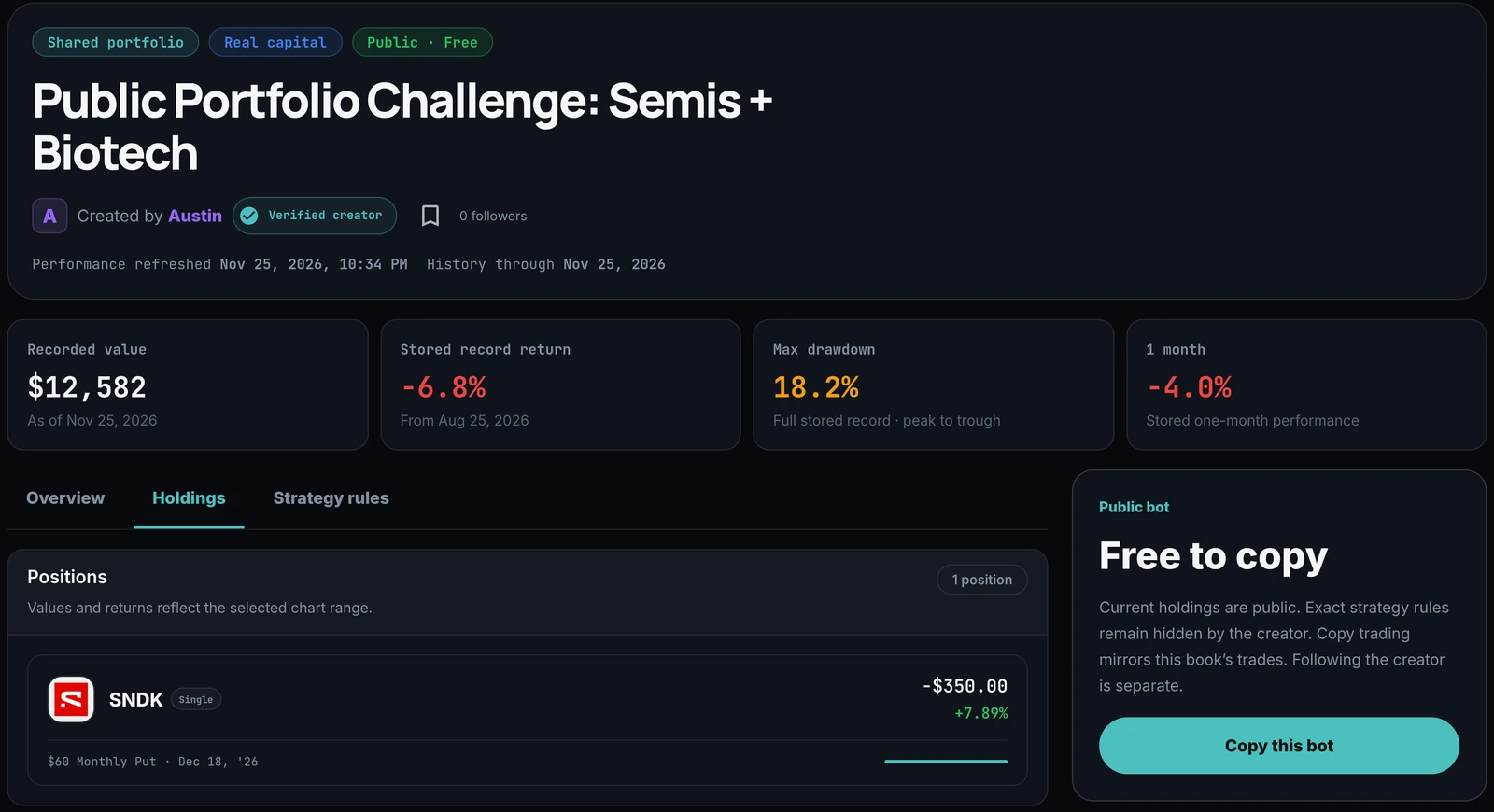
The put I sold has a $60 strike, the price at which I agree to buy 100 SNDK shares if the buyer decides to sell them. Its expiration, December 18, 2026, is the last day that promise holds. The buyer paid me $3.80 a share, or $380, because one contract covers 100 shares.
As of November 25, 2026, my Holdings tab shows the put at -$350.00, the cost to buy it back. I sold it for $380, so the tab shows the trade at +7.89%, a gain measured as a percent of the premium. You can follow it to its December 18, 2026 expiration on my public portfolio.
The SNDK options chain I sold from
Shaded quotes are in the money
Dec 18, 2026 · 23 days
| Strike | Bid | Ask | Mark | IV | Delta | OI |
|---|---|---|---|---|---|---|
| $60I sold this for $3.80 | 3.40 | 3.60 | 3.50 | 131.0% | −0.21 | 2,414 |
| $61.25 | 3.80 | 3.90 | 3.85 | 129.8% | −0.23 | 1,121 |
| $62.50 | 4.20 | 4.30 | 4.25 | 129.1% | −0.25 | 21,672 |
| $63.75 | 4.60 | 4.70 | 4.65 | 128.0% | −0.27 | 1,911 |
| SNDK $73.49 | ||||||
| $73.75 | 8.80 | 9.00 | 8.90 | 121.0% | −0.44 | 1,836 |
SNDK puts expiring December 18, 2026, read from NexusTrade market data at 22:09 UTC on November 25, 2026, after the close. The snapshot shows the $60 to $63.75 strikes plus the $73.75 strike next to the stock price. Each row's mark is its mid price, halfway between the bid and the ask.
This chain shows SNDK puts at 22:09 UTC on the day I sold. The bid is the price buyers offered, and the ask is the price sellers wanted. My put was out of the money: SNDK was $73.49, above the $60 strike, so at that price the put would expire worth $0.
Delta is how much an option's price moves when the stock moves $1. This put's delta was -0.21, so a $1 drop in SNDK adds about $0.21 a share to its price, about $21 against me.
At expiration I keep the full $380 anywhere at or above $60. Break-even, the price where the trade makes exactly $0, is $56.20. If SNDK ends at $50, I lose $620.
The other side of the trade: my SNDK put, then buyer and seller on 27 NVDA calls
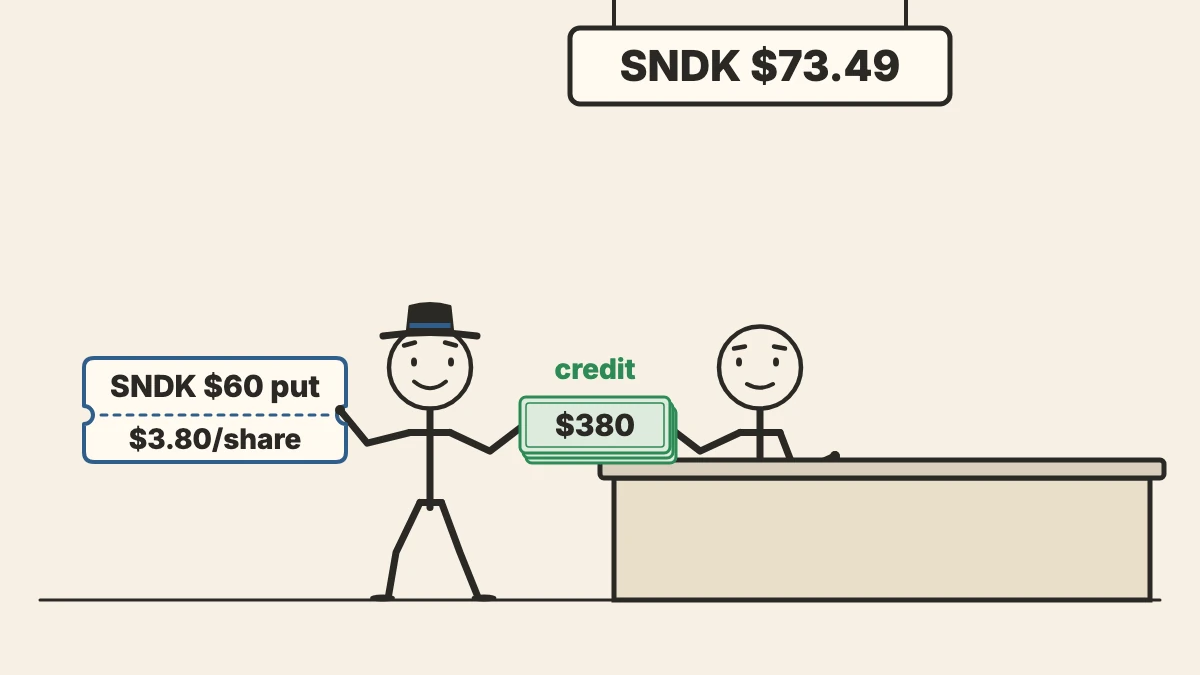
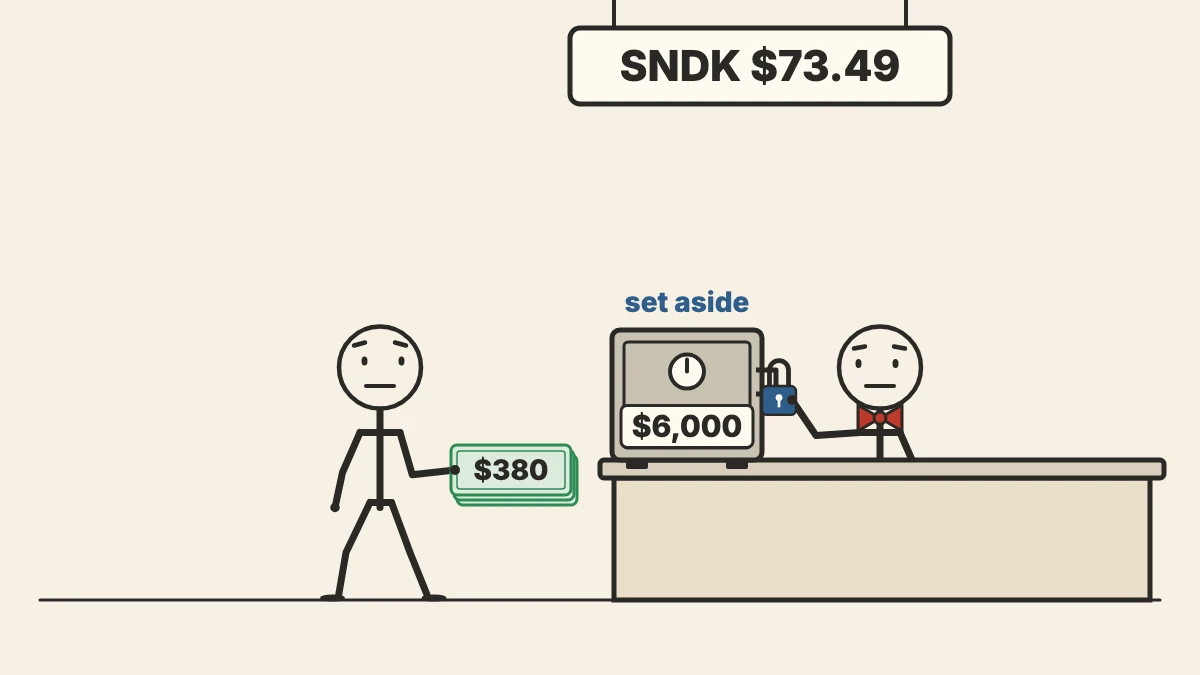
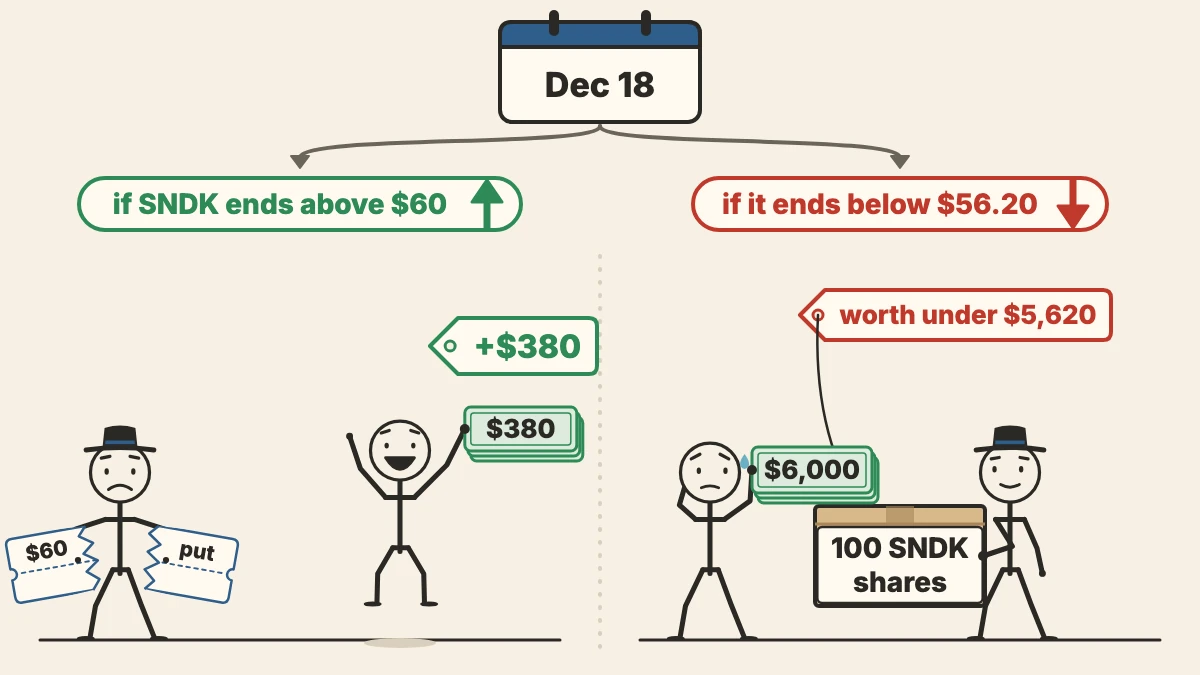
Every option has a buyer and a seller, and before fees the seller's result is the buyer's with the sign flipped. The buyer pays the premium and needs a big move. The seller keeps the premium unless that move comes.
A seller of the 27 cheap NVDA calls from the strike price lesson would have won 25 months and lost 2, finishing +$1,455.89 before fees.
NexusTrade refuses to sell a call with no shares behind it, so no seller backtest exists.
Selling puts for premium income: 28 NVDA months backtested
A put seller is paid up front for agreeing to buy the stock at a lower price. This backtest sold one 0.30-delta NVDA put each month, with a strike a median 5.6% below NVDA's price at the sale.
It made money in 24 of 28 months, for +$7,176.82 after fees. NVDA fell in all 4 losing months. The worst was November 2025, which lost $857.87, more than twice the $391.85 average winning month.
Selling calls: covered by 100 shares, or naked with no ceiling
Selling a call pays you a premium in exchange for any rise above the strike. If you own 100 shares, they cover the call: above the strike, the shares gain what the call loses. With no shares the call is naked, and its loss grows with every dollar the stock climbs past the strike.
For example, the covered call backtest sold an NVDA $185 call on April 1, 2026 for $3.412 a share, with NVDA at $175.68. By the April 30 open NVDA was $209.93, and the 100 shares had gained $3,425.00, more than the $2,060.10 the call lost.
Covered calls
The lesson compares 28 months of NVDA covered calls with the same 100 shares held alone.
Naked calls
NexusTrade refused all 262 attempts to sell an NVDA call without shares, and the lesson shows why.
How the three NVDA backtests on this page were run
The buyer and seller results use the 27 cheap calls bought in the deep out-of-the-money run, the put results use the 28 monthly put sales, and the call example uses one month of the covered call run. All three used daily NVDA data from July 1, 2024 to October 30, 2026, $100,000 of starting cash and one contract per trade.
Each opened a new option in the first 7 days of a month when none was open and closed it 1 day before expiration. Each option fill came from a recorded quote, at least halfway from the midpoint toward the worse side of the quote. Fees were $0.65 per contract on every fill.
Run it yourself: backtest selling puts on any stock
Backtest selling a put every month
Cash-secured put, monthly
Create this options portfolio on NVDA and backtest it with daily data from 2025-10-31 to 2026-10-30, $100,000 starting cash: in the first 7 days of each month when no option is open, sell one cash-secured put at 0.30 delta expiring 28 to 42 days out, and buy it back 1 day before expiration. Show me every trade and the account curve.
Exact request settings
{
  "name": "Options for beginners I3-roll: NVDA cash-secured put (delta 0.30), closed 1 day before expiration, 28 to 42 days to expiration",
  "strategies": [
    {
      "name": "Sell one NVDA 0.30-delta cash-secured put each month",
      "action": {
        "type": "OpenOption",
        "builder": {
          "legs": [
            {
              "direction": "short",
              "optionType": "put",
              "strikeSelector": {
                "distance": 0.3,
                "distanceType": "delta"
              },
              "expirationSelector": {
                "preference": "nearest",
                "maxDaysToExpiration": 42,
                "minDaysToExpiration": 28
              },
              "fallbackStrikeSelector": {
                "distance": 5,
                "distanceType": "percent"
              }
            }
          ],
          "underlyingSymbol": "NVDA"
        },
        "allocation": {
          "type": "contracts",
          "amount": 1
        }
      },
      "condition": {
        "type": "And",
        "conditions": [
          {
            "lhs": {
              "type": "OptionPositionCount",
              "underlying": "NVDA"
            },
            "rhs": {
              "type": "Value",
              "value": 0
            },
            "type": "Base",
            "comparison": "equal"
          },
          {
            "lhs": {
              "type": "Date"
            },
            "rhs": {
              "type": "Value",
              "value": 7
            },
            "type": "Base",
            "comparison": "lessThanOrEqual"
          },
          {
            "lhs": {
              "type": "DaysSinceStrategyFired"
            },
            "rhs": {
              "type": "Value",
              "value": 20
            },
            "type": "Base",
            "comparison": "greaterThanOrEqual"
          }
        ]
      }
    },
    {
      "name": "Sell NVDA options 1 day before expiration",
      "action": {
        "type": "CloseOption",
        "quantity": {
          "type": "all"
        },
        "triggers": [
          {
            "type": "dte",
            "maxDte": 1
          }
        ],
        "underlyings": [
          "NVDA"
        ]
      },
      "condition": {
        "lhs": {
          "type": "OptionPositionCount",
          "underlying": "NVDA"
        },
        "rhs": {
          "type": "Value",
          "value": 1
        },
        "type": "Base",
        "comparison": "greaterThanOrEqual"
      }
    }
  ],
  "initialValue": 100000
}Free accounts can run one daily options backtest a month, up to a year long, so the default dates are the last 12 months of this run.
Pick a stock, the dates, a strike and an expiration. The defaults are the monthly put sale from this page with your stock in place of NVDA. Run it here, or open it in Aurora to edit it first.
No comments yet.