TL;DR
The strike price is the price an option lets you buy or sell at, and choosing one trades cost against odds. A deep in-the-money call, with its strike far below the stock price, costs a lot and moves almost like the stock. A deep out-of-the-money call, with its strike far above, costs little, and in most months it lost nearly all of its premium, the price paid for it.
In the 23 NVDA months where both were bought on the same day, the deep in-the-money call made money 13 times and the deep out-of-the-money call 2 times. NVDA passed the cheap call's strike in 2 of the 23 months.
In the money vs out of the money: four real NVDA months
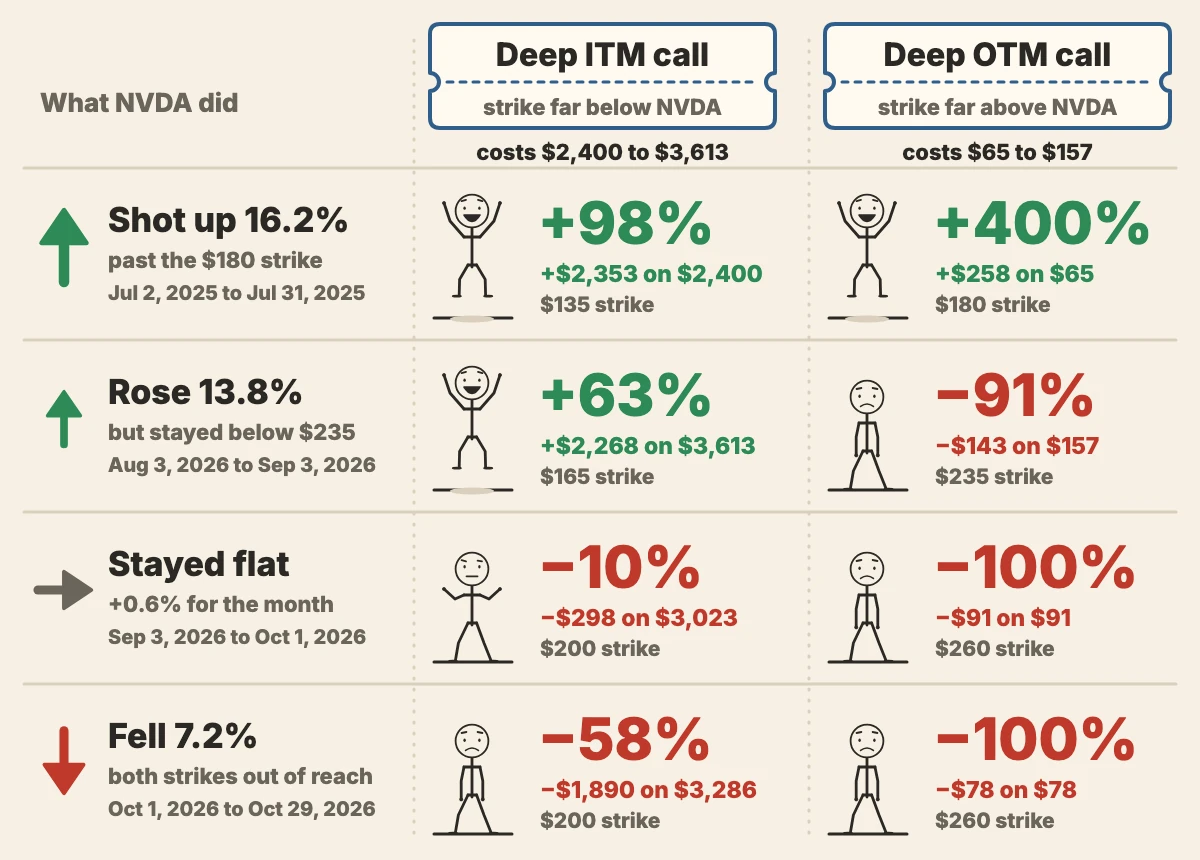
A deep out-of-the-money call is a small, cheap bet. It usually goes to zero and pays big only when the stock makes a large move past its strike. A deep in-the-money call costs much more and moves almost like owning the stock: at 0.90 delta, it moves about 90 cents for each $1 NVDA moves.
The strike NVDA never reached: August 2026
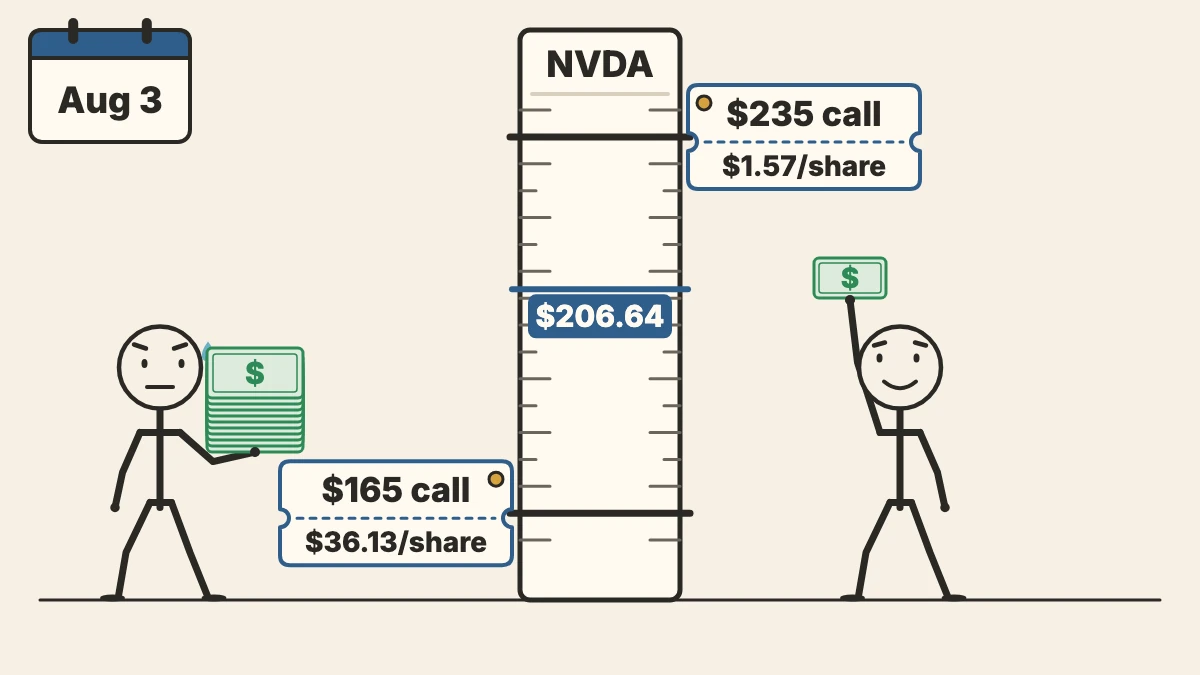
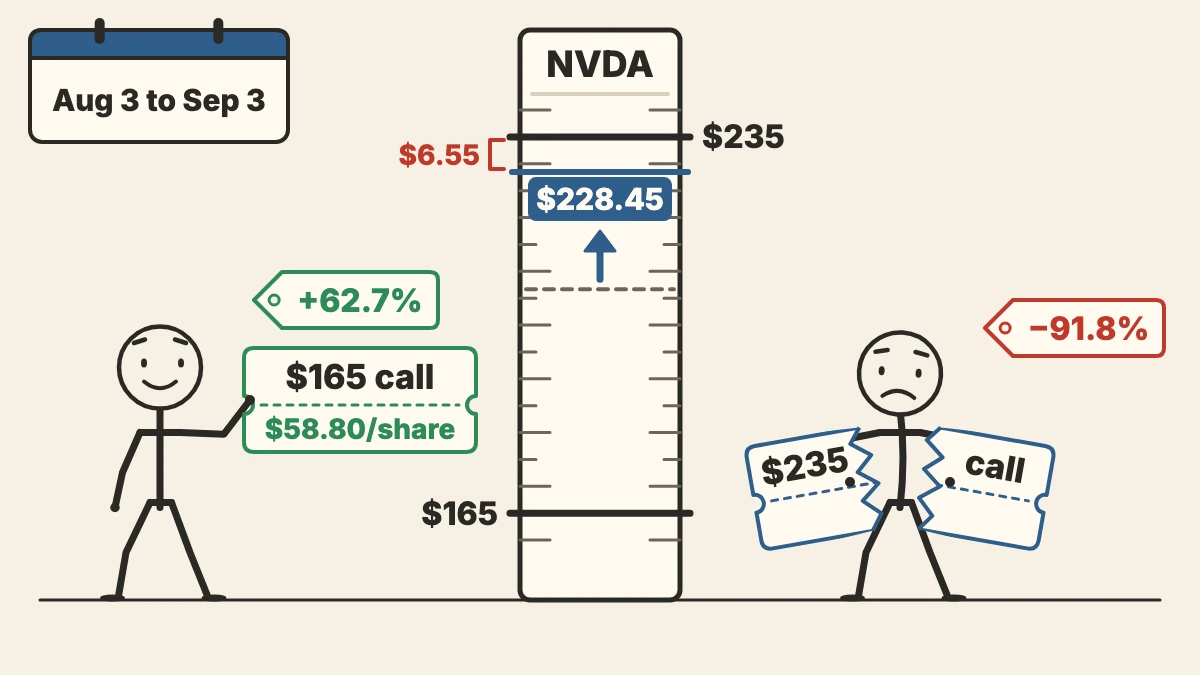
Each call's value in August 2026, as a change from the price paid
- $165 call (deep ITM) 2026-09-03
- 62.8%
- $235 call (deep OTM) 2026-09-03
- -90.9%
Strike price and break-even: deep ITM vs deep OTM calls on July 2, 2025
Shaded quotes are in the money
Aug 1, 2025 · 30 days
| Bid | Ask | Mark | Strike |
|---|---|---|---|
| 23.50 | 24.00 | 23.75 | $135Deep ITM, bought for $24.00 |
| 11.20 | 11.35 | 11.28 | $150 |
| 7.95 | 8.10 | 8.03 | $155 |
| NVDA $157.25 | |||
| 6.55 | 6.70 | 6.63 | $157.50 |
| 5.35 | 5.40 | 5.38 | $160 |
| 0.62 | 0.64 | 0.63 | $180Deep OTM, bought for $0.65 |
These are the closing bids and asks on July 2, 2025 for NVDA calls expiring August 1, 2025. Shaded rows are in the money.
The $135 call cost $24.00 a share, or $2,400.43 for the contract, and broke even at $159.00, 1.0% above NVDA's price. The $180 call cost $0.65 a share, or $64.54, and needed NVDA to reach $180.65, 14.8% above its price.
In the chain, each higher strike costs less and moves the break-even further away.
How these two NVDA backtests were run
Each backtest started with $100,000 and ran from July 1, 2024 to October 30, 2026. In the first 7 days of each month with no call open, it bought one call that expired 28 to 42 days out. The deep ITM run made 28 trades and the deep OTM run made 27. The TL;DR compares only the 23 months where both bought on the same day.
Fees were $0.65 per contract, and every fill came from a recorded quote, priced at least halfway from the midpoint toward the worse side of the quote (110 fills, 0 estimated). All of the deep ITM calls were sold before they expired, 2 of them on expiration day itself and the rest the session before. All of the deep OTM calls were sold before they expired, 3 of them on expiration day itself and the rest the session before.
Backtest a strike price on any stock
Backtest a call at the strike you choose
Create this options portfolio on NVDA and backtest it with daily data from 2025-10-31 to 2026-10-30, $100,000 starting cash: in the first 7 days of each month, when no option is open, buy one call at about 0.90 delta that expires 28 to 42 days out, and sell it 1 day before expiration. Show me every trade and the account curve.
Exact request settings
{
  "name": "Options for beginners B2-itm: NVDA deep ITM call (delta 0.90), monthly, 28 to 42 days to expiration",
  "strategies": [
    {
      "name": "Buy one NVDA 0.90-delta call each month",
      "action": {
        "type": "OpenOption",
        "builder": {
          "legs": [
            {
              "direction": "long",
              "optionType": "call",
              "strikeSelector": {
                "distance": 0.9,
                "distanceType": "delta"
              },
              "expirationSelector": {
                "preference": "nearest",
                "maxDaysToExpiration": 42,
                "minDaysToExpiration": 28
              },
              "fallbackStrikeSelector": {
                "distance": -15,
                "distanceType": "percent"
              }
            }
          ],
          "underlyingSymbol": "NVDA"
        },
        "allocation": {
          "type": "contracts",
          "amount": 1
        }
      },
      "condition": {
        "type": "And",
        "conditions": [
          {
            "lhs": {
              "type": "OptionPositionCount",
              "underlying": "NVDA"
            },
            "rhs": {
              "type": "Value",
              "value": 0
            },
            "type": "Base",
            "comparison": "equal"
          },
          {
            "lhs": {
              "type": "Date"
            },
            "rhs": {
              "type": "Value",
              "value": 7
            },
            "type": "Base",
            "comparison": "lessThanOrEqual"
          },
          {
            "lhs": {
              "type": "DaysSinceStrategyFired"
            },
            "rhs": {
              "type": "Value",
              "value": 20
            },
            "type": "Base",
            "comparison": "greaterThanOrEqual"
          }
        ]
      }
    },
    {
      "name": "Sell NVDA options 1 day before expiration",
      "action": {
        "type": "CloseOption",
        "quantity": {
          "type": "all"
        },
        "triggers": [
          {
            "type": "dte",
            "maxDte": 1
          }
        ],
        "underlyings": [
          "NVDA"
        ]
      },
      "condition": {
        "lhs": {
          "type": "OptionPositionCount",
          "underlying": "NVDA"
        },
        "rhs": {
          "type": "Value",
          "value": 1
        },
        "type": "Base",
        "comparison": "greaterThanOrEqual"
      }
    }
  ],
  "initialValue": 100000
}A free account can run one daily options backtest a month, up to a year long, so the dates start with the last 12 months of the recorded run.
Pick a strike distance, a stock, the dates and an expiration. The defaults run the exact recorded portfolio from these lessons with your stock in place of NVDA. The at-the-money choice is the call account from Lesson 1.
No comments yet.