TL;DR
Algorithmic options trading means writing a trade as rules and testing those rules on past prices before you risk money. In November 2026 I used Claude Code and NexusTrade backtests to test my own NVIDIA calls through a CEO scandal: whether puts would protect me, when to buy more and whether to roll.
The tests kept me out of puts that made money in 1 of 18 past drops, and they also led me into a roll that trailed doing nothing by $464 as of November 25, 2026.
My account was about 90% NVIDIA calls when the CEO news hit
I personally believe NVIDIA is the best stock in the history of the world in terms of the fundamentals, and I explain why in the introduction to my algorithmic trading course. So in November 2026 almost my whole account sat in NVIDIA calls, options that gain value when the stock rises.
Then the news hit. On November 8, CNBC reported that Jensen Huang had admitted to an extramarital affair, and NVIDIA's board opened an investigation into the relationship. On November 11, The Wall Street Journal reported that the board was preparing to oust him, according to CBS News. On November 17, the board's new chairman told investors the board had accepted Huang's resignation and did not intend to bring him back, according to CNBC and Yahoo Finance.
Each time the stock fell, I asked AI a question and had it answer with backtests priced from recorded option quotes. Below are four of those tests, what each one found, and what NVIDIA did next.
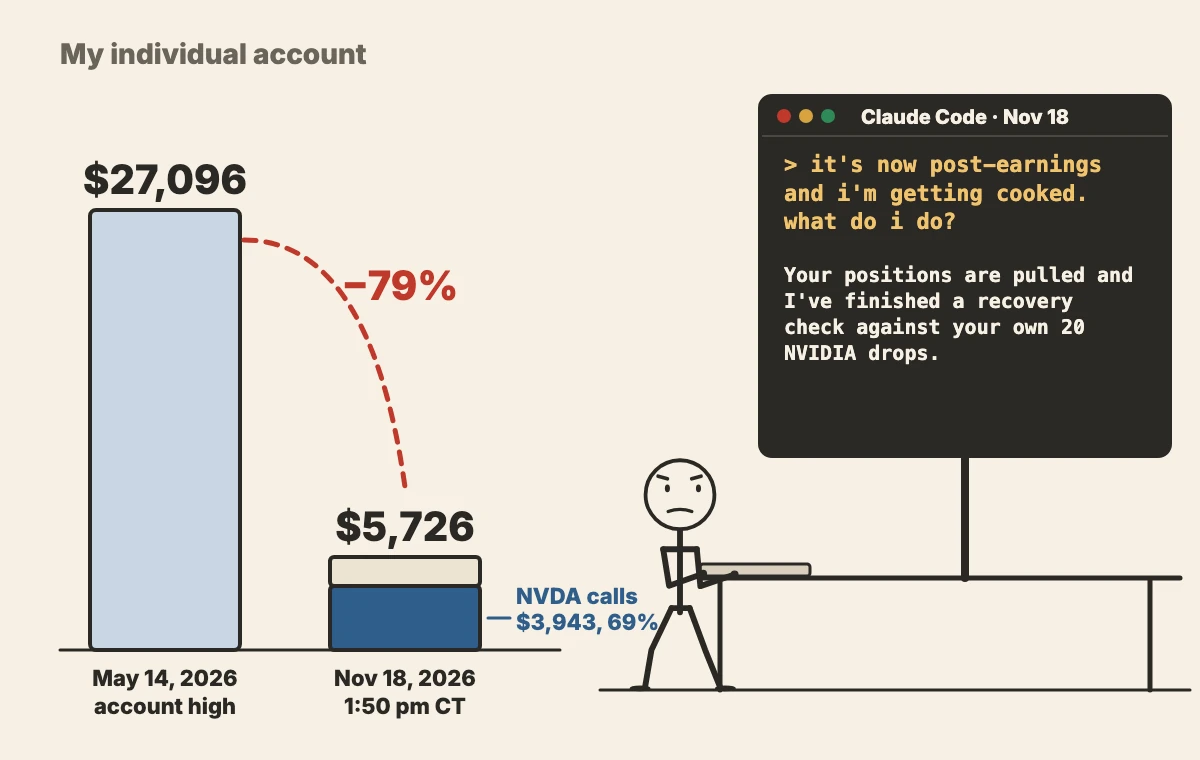
After my roll on November 19, only about $470 sat outside the calls. When the AI pointed that out, I told it: "i'm not mad 90% of the whole account is nvidia calls. i'm mad it's not 100"
Test 1: should I hedge my NVIDIA calls with puts?
A put is an option that gains when the stock falls, so buying one after bad news is the textbook hedge, a second position that pays when the first one loses. On November 9 NVIDIA was falling before the open, and my hunch was that puts would not help. I told Claude: "my hunch is no, but i need real research."
It took NVIDIA's 10 worst days since March 2022 and its 10 most recent drops of 4% to 6%, then priced each choice from recorded option quotes: keep the calls alone, or add a put at one of three strikes.
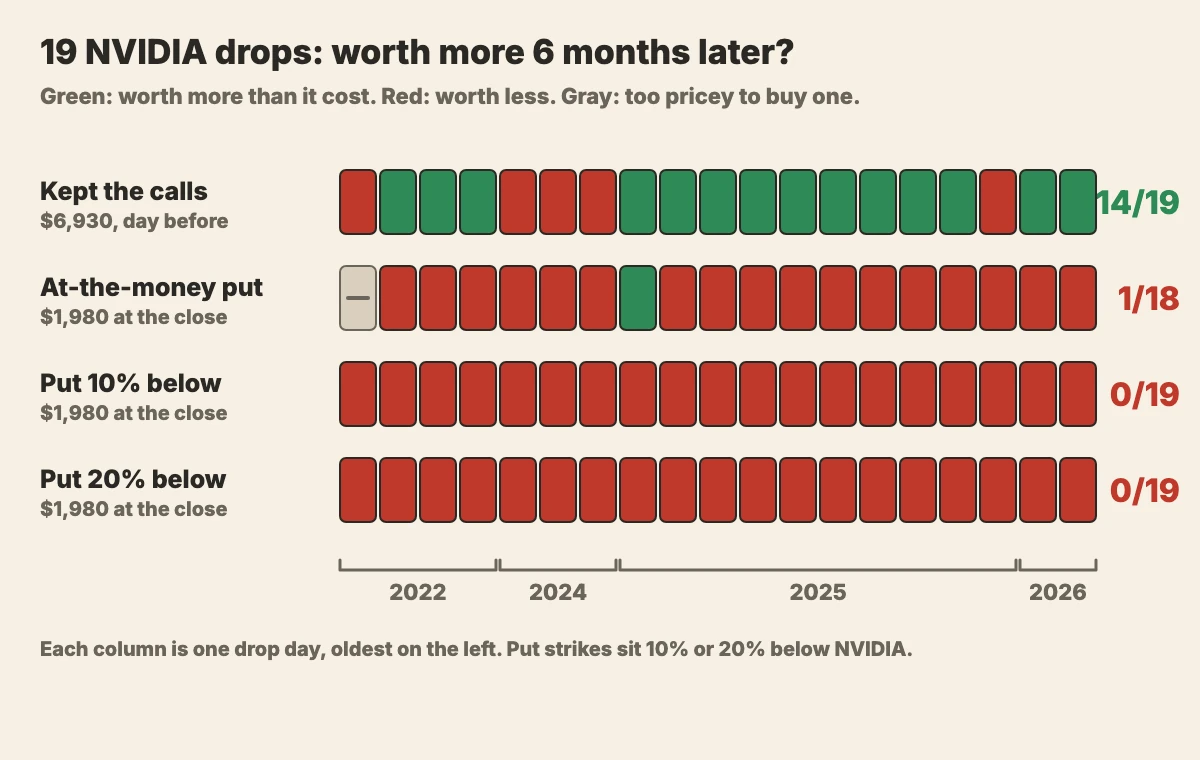
So I kept my calls and skipped the puts. Before trusting that answer, I had the AI check whether it held on stocks other than the one I owned.
The same test on 12 chip stocks: did NVIDIA's answer hold?
NVIDIA was the stock I owned, and it was also the stock that had won. A rule that only works on the winner can be luck, so the AI ran the same test on other chip stocks with the same calls, the same put and the same drop rules.
It did not pick them by hand. It took every company NexusTrade's related-companies data listed for NVIDIA on November 6, 2026, a list built from what each company's filings say it does. That gave 12 chip stocks, and 11 of them had drops the test could price from recorded quotes.
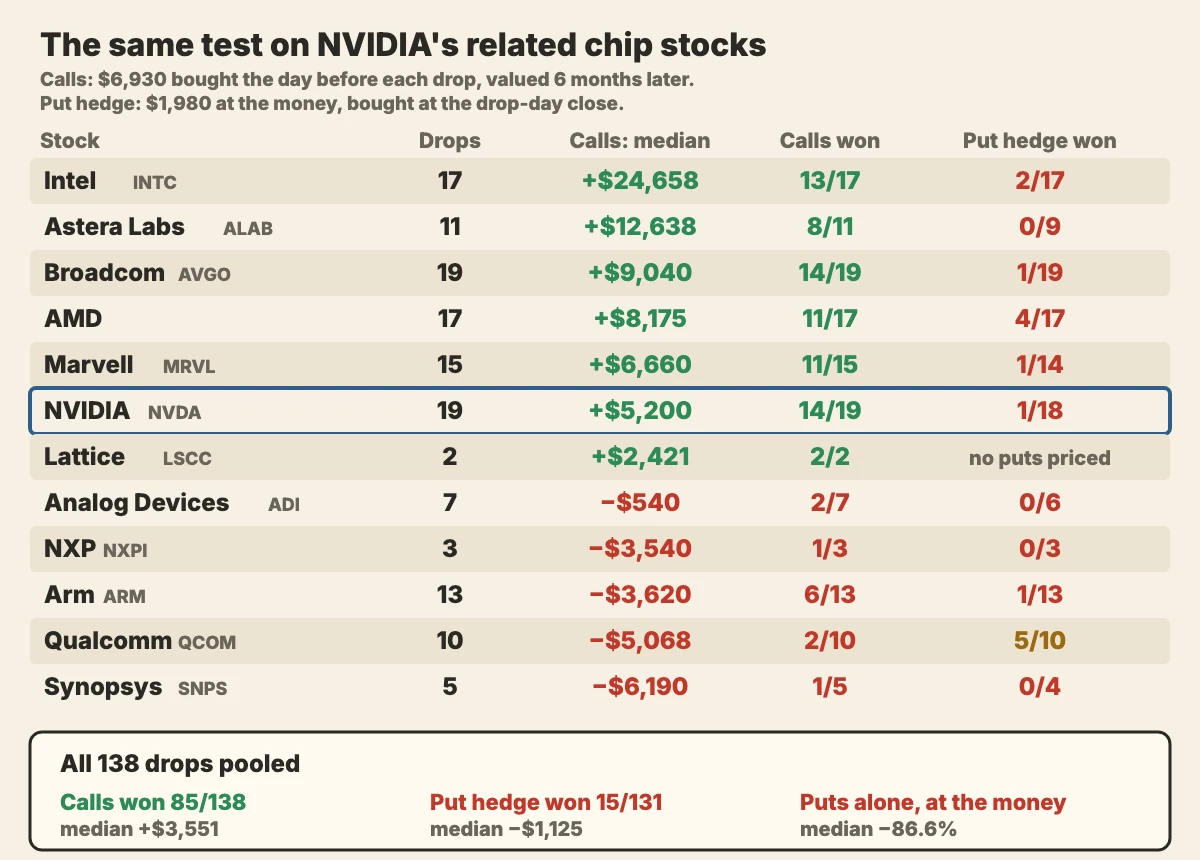
The put answer held up on other stocks. The buy-the-dip answer did not: holding after a drop paid on 5 of these chip stocks and lost on 5. A rule that buys every dip needs a reason to own that particular stock, and mine was what I believe about NVIDIA's fundamentals.
Test 2: when to buy more NVIDIA calls after a drop
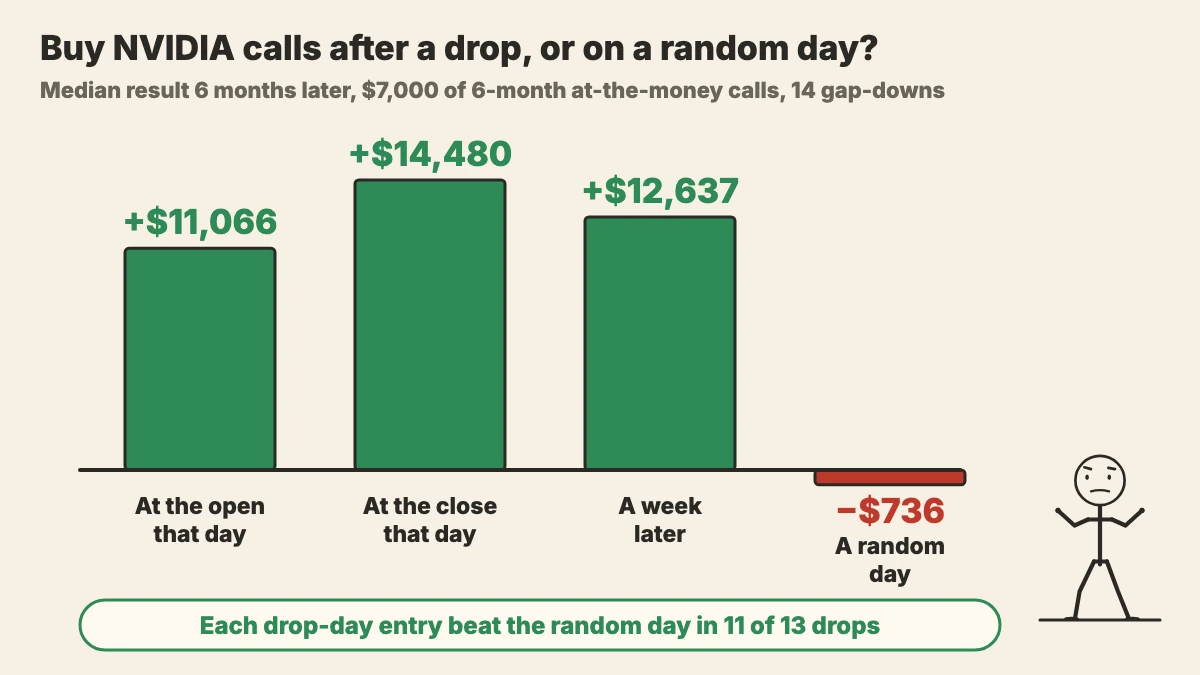
Doubling down means buying more of a position that already fell. Before I added, I asked the AI when to do it, and that week it ran 1,040 backtests on that one question.
It tested what to wait for before buying, how earnings change the answer, what time of day to buy, and what to do if the stock fell again. Where a result covers chip stocks, they are the same related chip stocks as the test above.
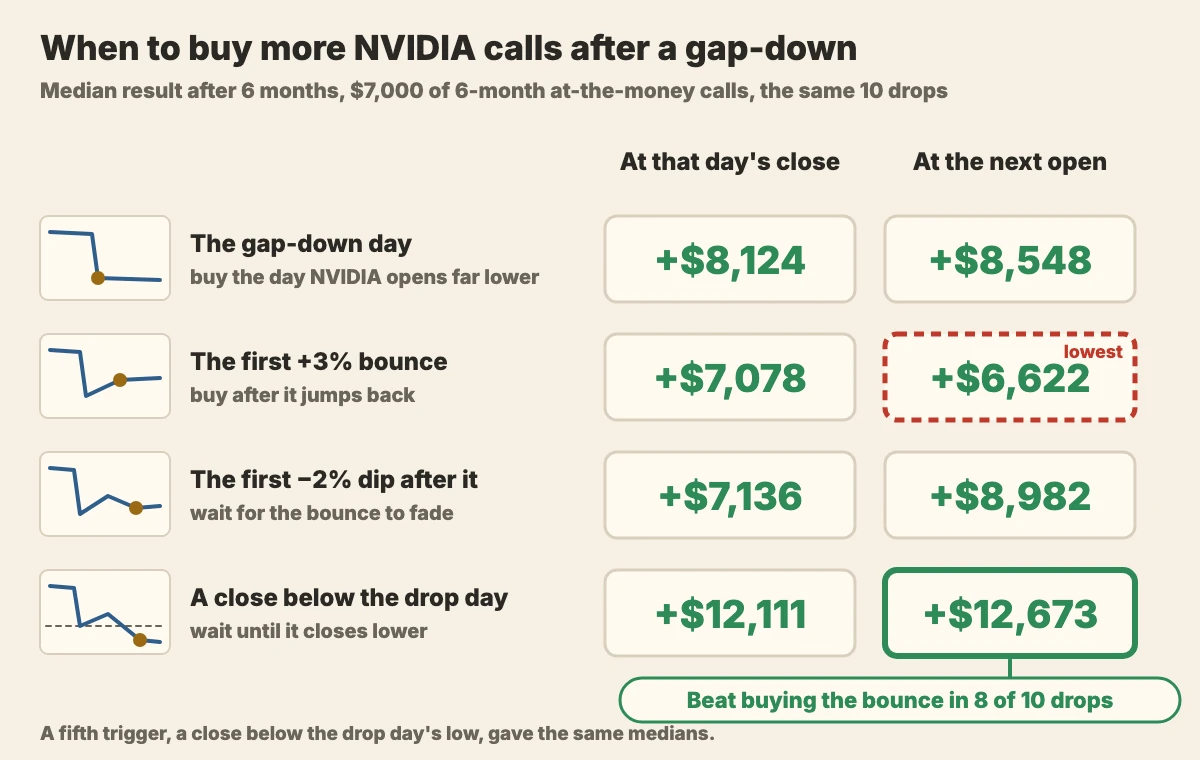
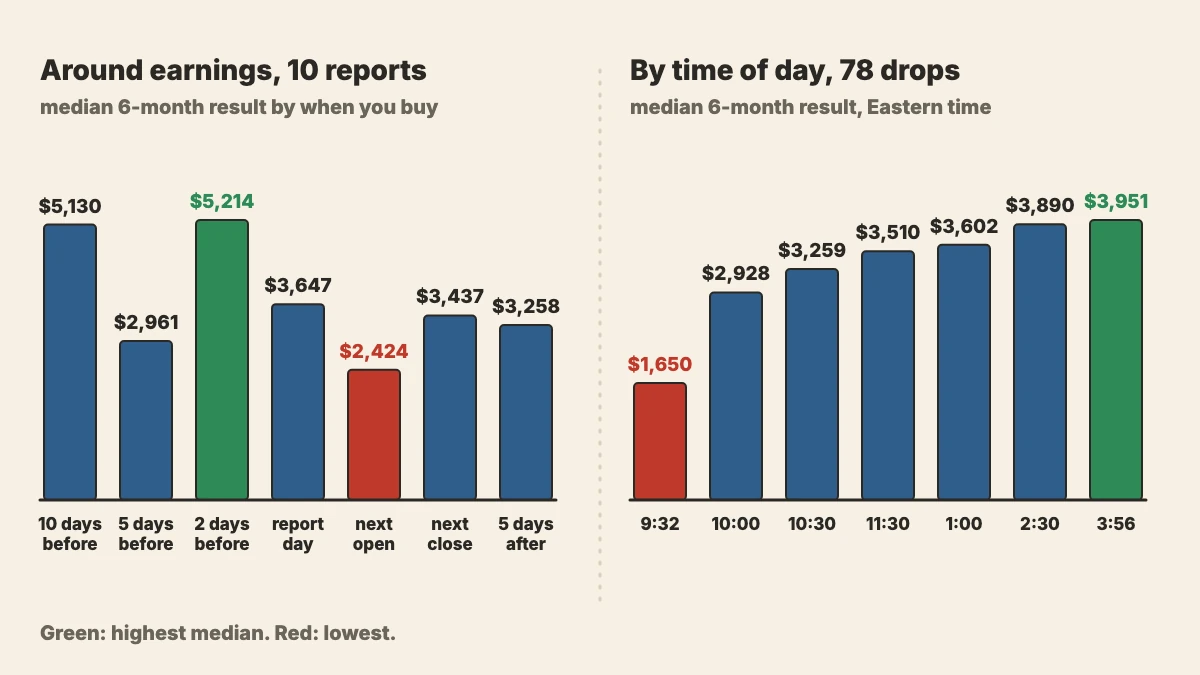
Doubling down itself also tested well on NVIDIA. Across 13 drops, a $7,000 account that added another $7,000 of calls at the close had a median 6-month result of +$15,653, against +$4,425 for only holding. Across every chip stock tested, 68 of 288 accounts that added ended down 50% or more.
The plan I wrote from these tests: buy one more call mid-morning, not at the open, then wait for earnings. If NVIDIA made a new low after earnings, buy weekly calls, options that expire within a week, at the close and sell at a 50% gain. That rule made money in 9 of 10 past new lows that followed a bounce. On November 12 I bought one more March 2027 $180 call for $1,398.
Test 3: I'm getting cooked. Should I roll my NVIDIA calls?
On November 17, NVIDIA beat earnings estimates, $2.68 a share against $2.47 expected, according to CNBC, and the stock kept falling. I asked Claude: "it's now post-earnings and i'm getting cooked. what do i do?"
Rolling means selling an option you own and buying another with a later expiration or a different strike. The AI pulled my positions from Robinhood, then tested five choices on 22 past NVIDIA drops with calls shaped like mine: sell, hold, roll down to a lower strike, roll out to a later date, or buy weeklies to win the loss back.
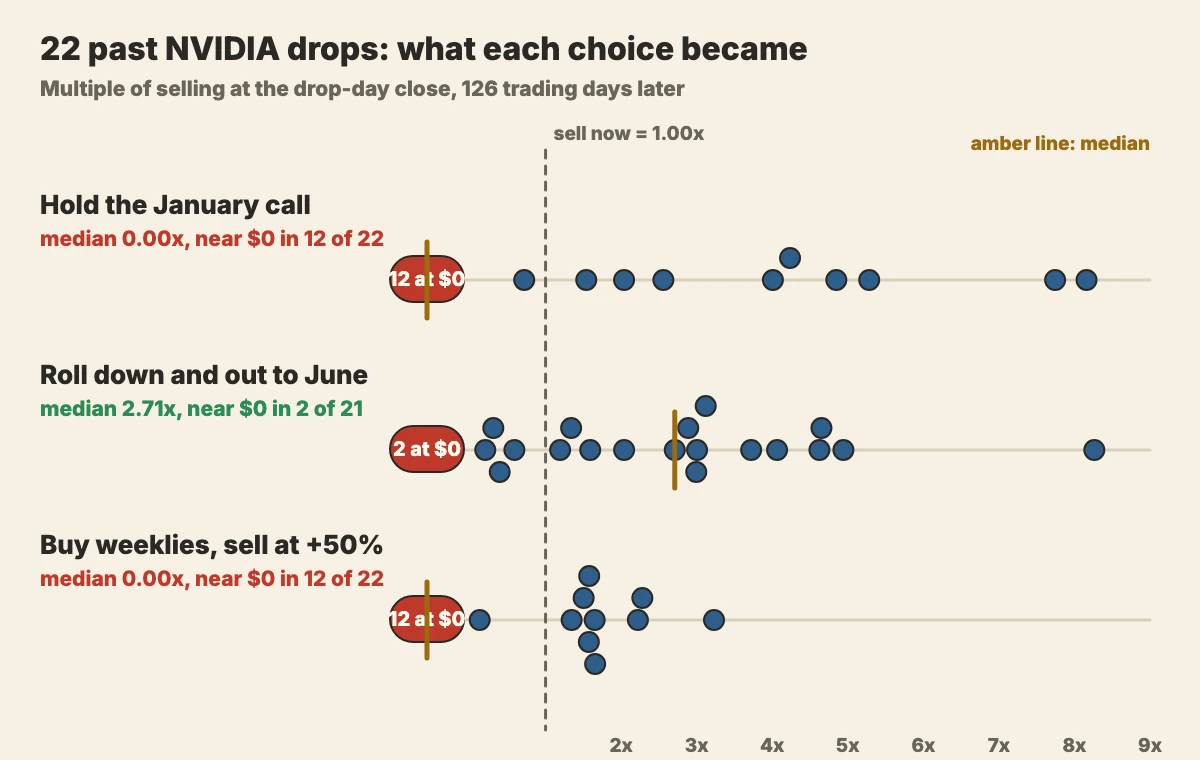
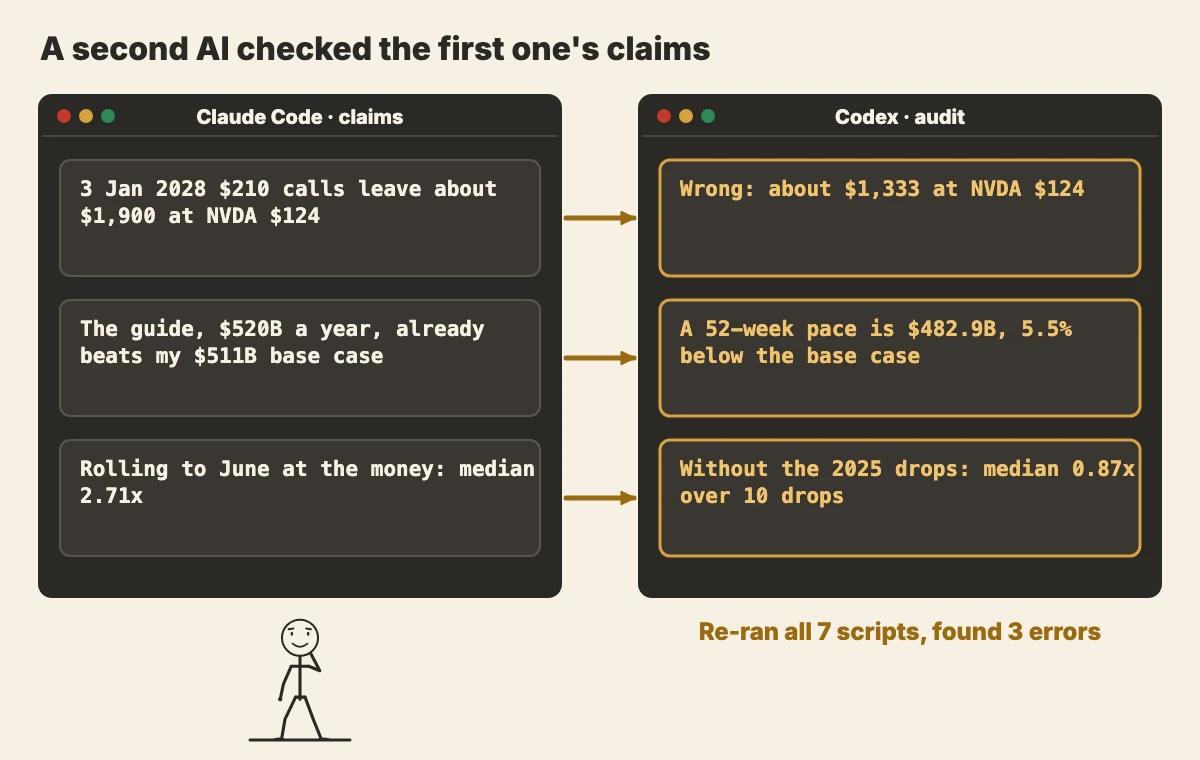
No roll made getting my money back likely. Of the 28 rolls the AI priced, the best had a 10.51% chance of recovering the $14,045 I had paid, at the 45% volatility options were trading at. Its last advice also said: "Skip the weekly-call trade this time, even if NVIDIA closes below $148.80."
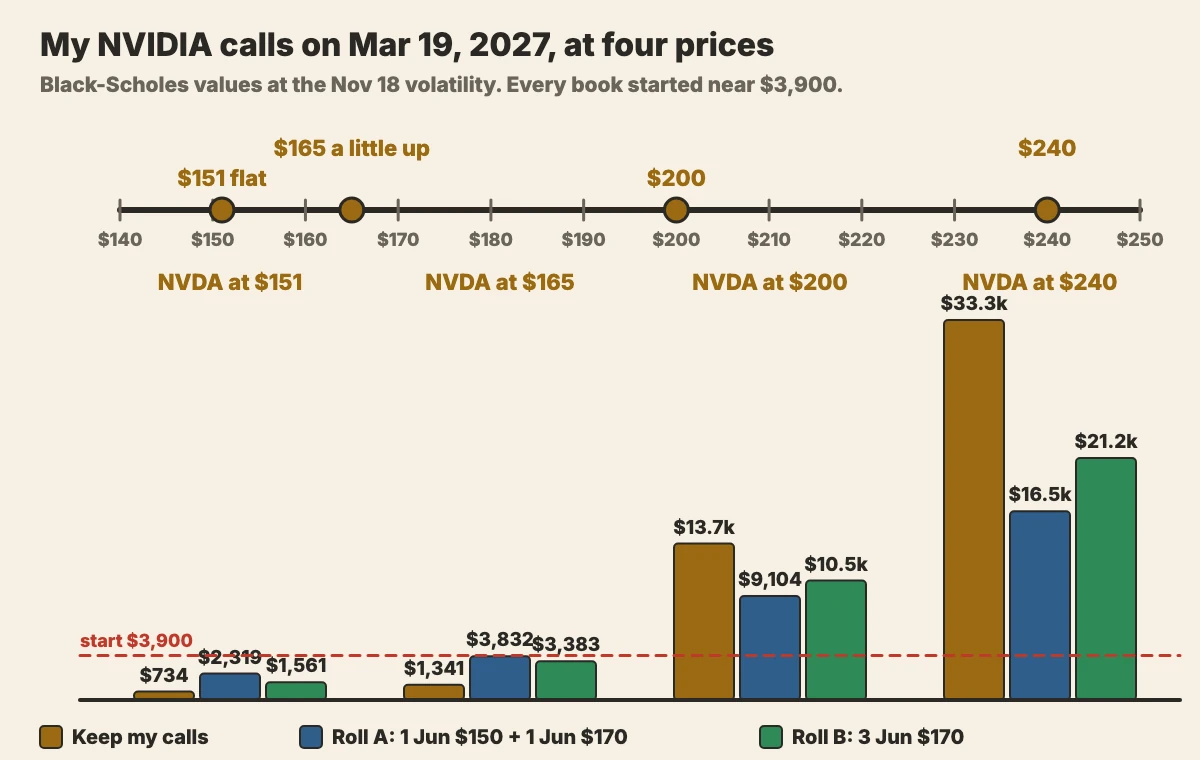
On November 19 I rolled in one three-leg order. I sold 2 January 2027 $170 calls at $5.27 and 2 March 2027 $180 calls at $7.37, bought 2 January 2028 $190 calls at $19.21, and kept my June 2027 $170 call. The net cost was $6.57 per spread, $1,314 in all.
What NVIDIA did next, and how my roll held up
On Friday, November 20, NVIDIA fell 14% in a day. That was the new low my weekly-call rule waited for, and I skipped it because the last advice said to. On Monday, NVIDIA's board unanimously reinstated Huang as CEO, Yahoo Finance reported, and the stock traded about 31% higher before the open. I wrote: "i should've bought the ... call!!!! I knew they'd re-instate him as CEO."
I told the AI: "i kinda did tho... after their earnings (which were outstanding), i said i'd buy a weekly; Friday close was my chance" It went back through my sessions and found the mismatch. My rule waited for a new low after a bounce, the setup that had won 9 of 10 times, while the test that told me to skip it had bought weeklies on any drop day.
Then I asked it to grade the rolls and told it: "don't sugar coat it." It added up 3 rolls that cost $3,930 in debits and said: "Calling them "rolls" made $3,930 of additional buying look like position management." It also found: "The money went into the two additions, not the rolls."
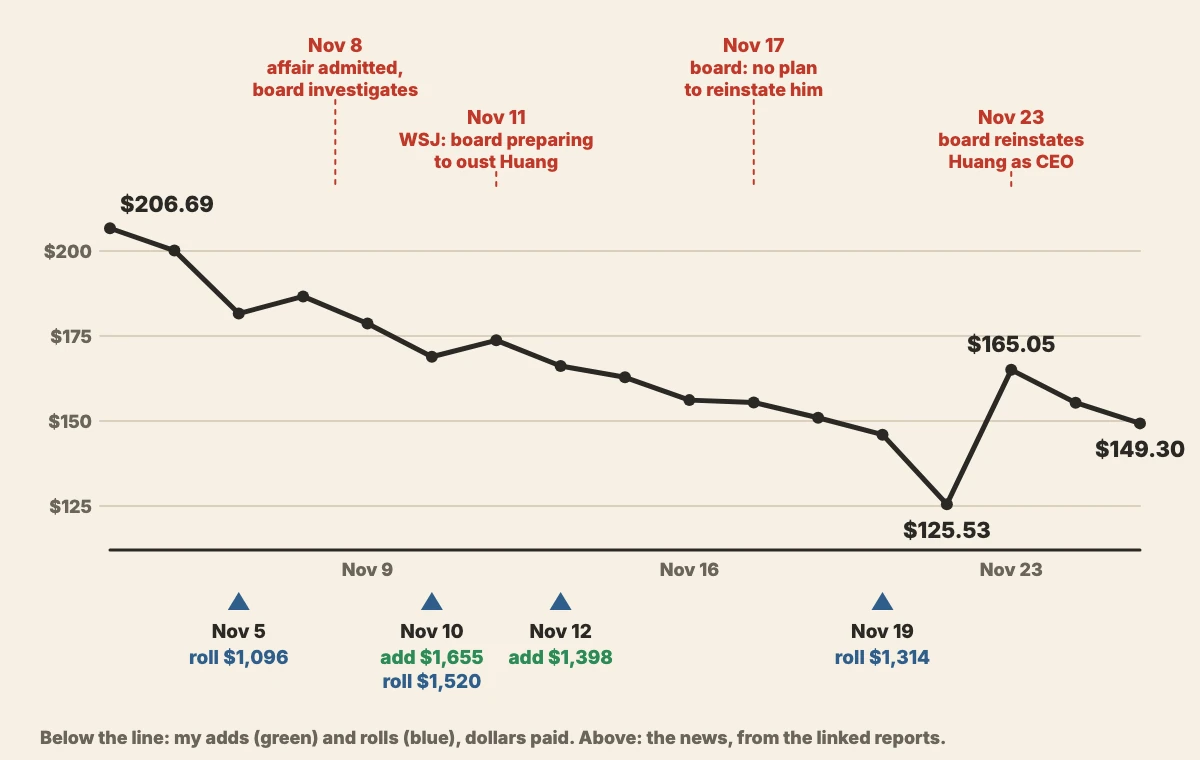
Values use NexusTrade's recorded closing marks. The June 2027 $170 call is in both books, so it is left out.
At the November 23 close, the roll was $1,179 behind not rolling. The post-mortem that morning judged it on a one-day spike, and its estimate before the open put the gap near $300. Since then NVIDIA has fallen about 10%, and by the November 25 close the gap was $464.
The roll bought time. My January 2028 calls have more than a year left, while the January 2027 calls I sold expire in two months, and the post-mortem put the rolled book's time decay at about $15 a day against $44 for the old one. A slower recovery favors the roll and a fast one favors the old calls, and the bars show the gap closing as the rally faded.
Test 4: a walk-forward test on NVIDIA options
A walk-forward test picks the best settings on one stretch of history, freezes them, then runs them on later dates the search never saw. In October I asked Codex to test a strategy from a TikTok this way on NVIDIA options: buy a call or a put when NVIDIA breaks out of its usual intraday range, and sell before the close.
When the frozen version made one trade all year, I asked: "Why did it only make one trade in 2026? ... this doesn't pass the common sense test"
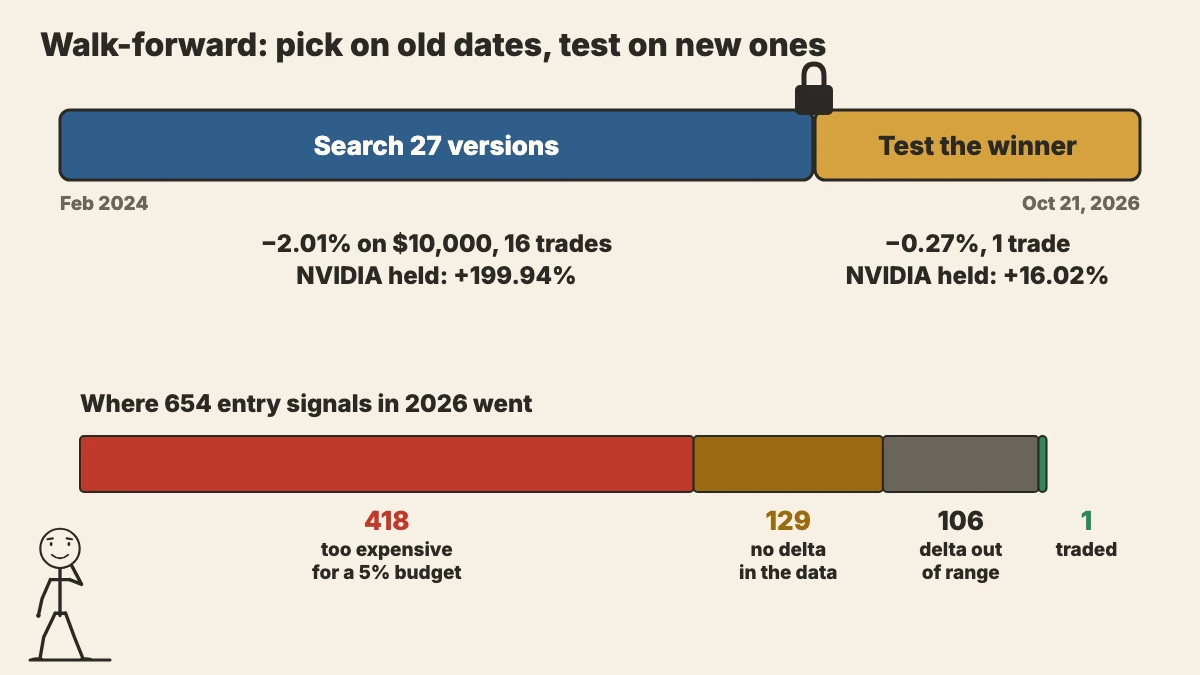
The diagnosis found the search had loaded an incomplete set of expirations, so the optimization was invalid, and its own score of +0.78% on 5 trades did not reproduce. The frozen test did its job: it exposed a data problem before any money was at risk, and it says nothing yet about the strategy itself.
The sample sizes behind these NVIDIA tests
Most NVIDIA results here rest on 10 to 14 events, and the roll test on 22. Most of the sample is a bull market: 72% of the raw gap-downs came in 2025 and 2026. NVIDIA was tested because it won, rising about 8x during the sample, and the best rules were picked from dozens of variants.
No past drop had the CEO leave, and the scenario values hold volatility at one level. Across all the chip stocks, weeklies sold at a 50% gain won about two-thirds of the time, well below NVIDIA's 9 of 10.
How to test your own options trades with AI
Every test above ran the same loop, and you can run it in Aurora, NexusTrade's AI agent, on any stock you follow. Start with a question you would actually trade on, and write it down before the news makes the decision for you.
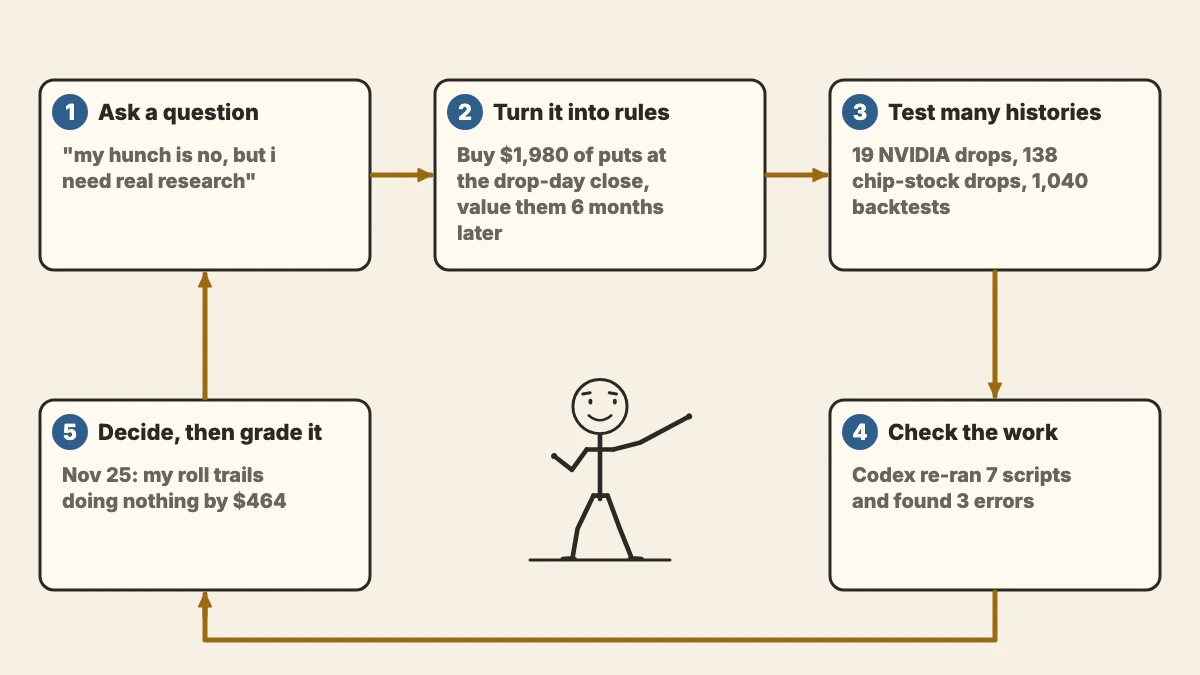
Then check the test before you trust it. Run the same rule on other stocks and other years, ask a second model to re-run the work, and write down what the test did not cover. After you trade, compare the test with what happened, the way I graded my roll.
No comments yet.