TL;DR
A vertical spread buys one option and sells another of the same type and expiration at a different strike, so the most you can make and the most you can lose are both fixed the day you open it. In a debit spread you pay to open, and in a credit spread you are paid to open.
In NVDA backtests with one spread a month from July 1, 2024 to October 30, 2026, the two spreads that bet on a rise made money (bull put +$1,713.36, bull call +$320.64) and the two that bet against one lost (bear call -$1,843.84, bear put -$2,486.31).
Bull call spread vs deep ITM and OTM calls in the same four NVDA months
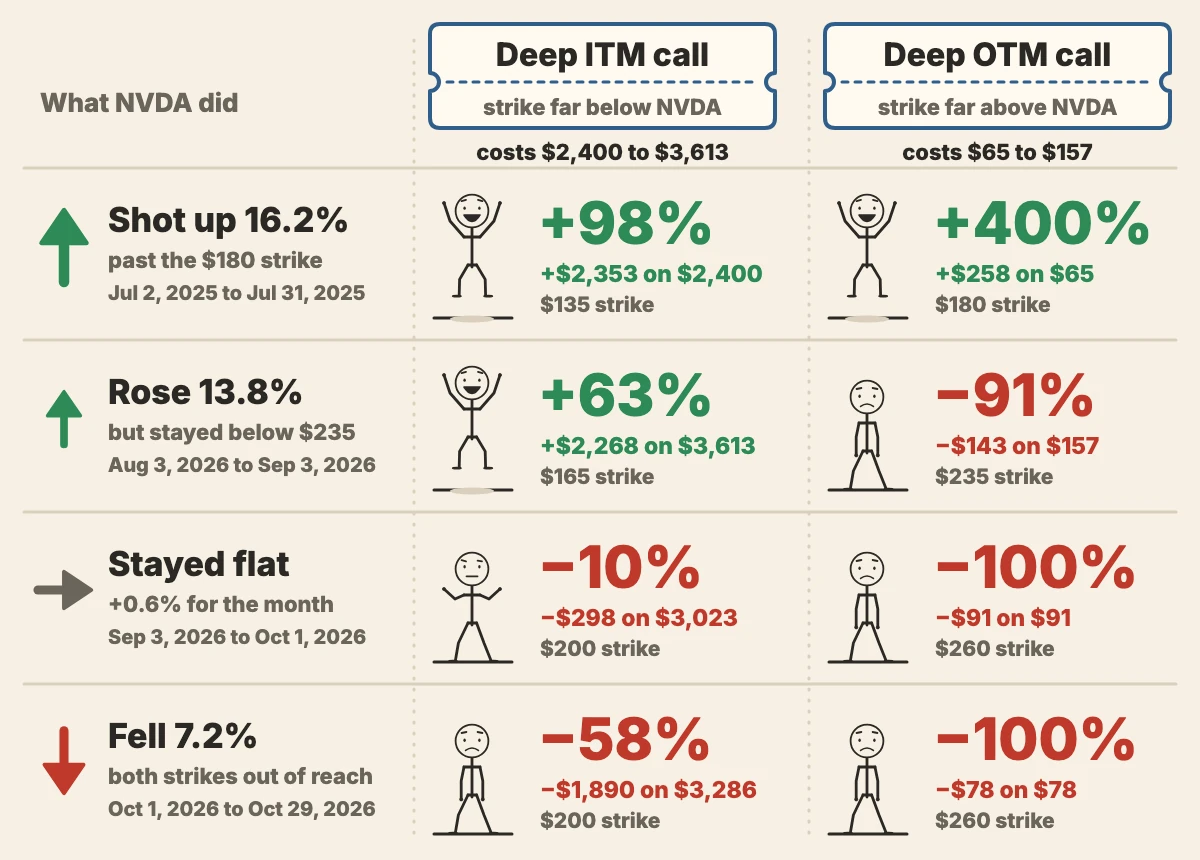
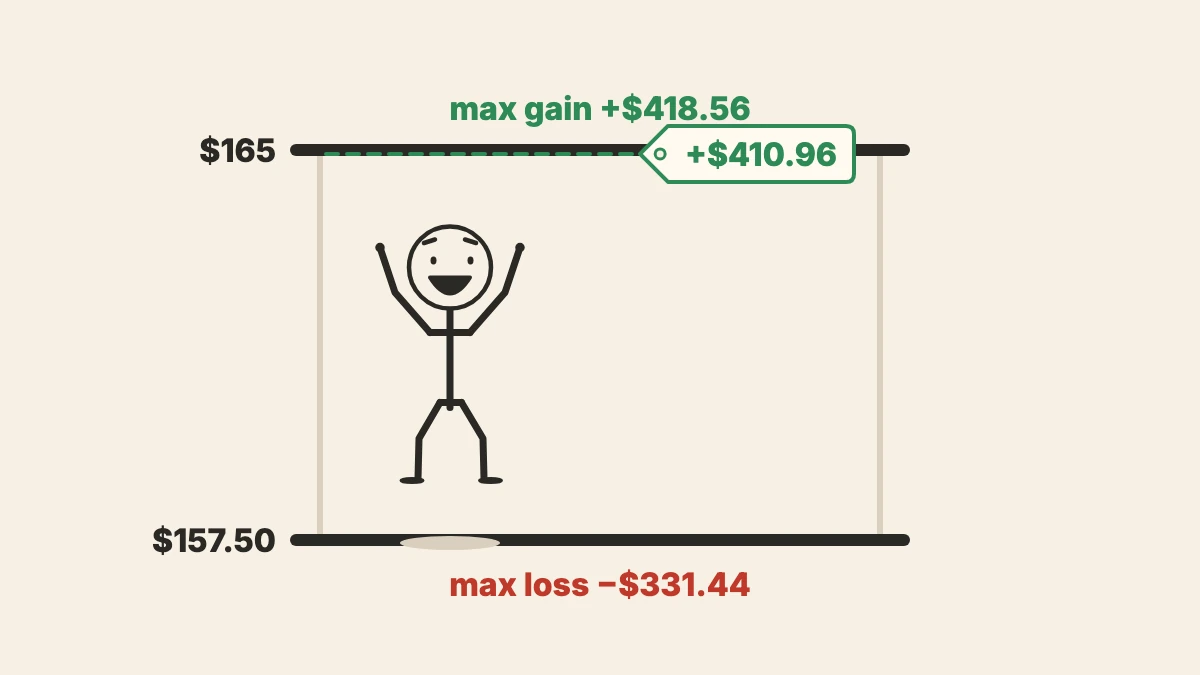
The picture repeats the four NVDA months from the strike price lesson. On each of those days the engine also opened a bull call spread: it bought the call at the stock price and sold one about 5% higher. The returns in this section are after fees. When NVDA shot up, the spread made 124.0% of what it cost, more than the 98.0% of the deep in-the-money call but far less than the 397.6% of the deep out-of-the-money call, because the call it sold capped the gain at $418.56. When NVDA rose but stayed below the deep out-of-the-money call's $235 strike, the spread made 116.9%, the best of the three.
When NVDA fell, the spread lost its whole $598.76 cost plus fees, $601.11 in all. The deep in-the-money call lost a smaller share of a much bigger premium: 57.6%, or $1,891.54.
How the engine builds a bull call spread from one sentence
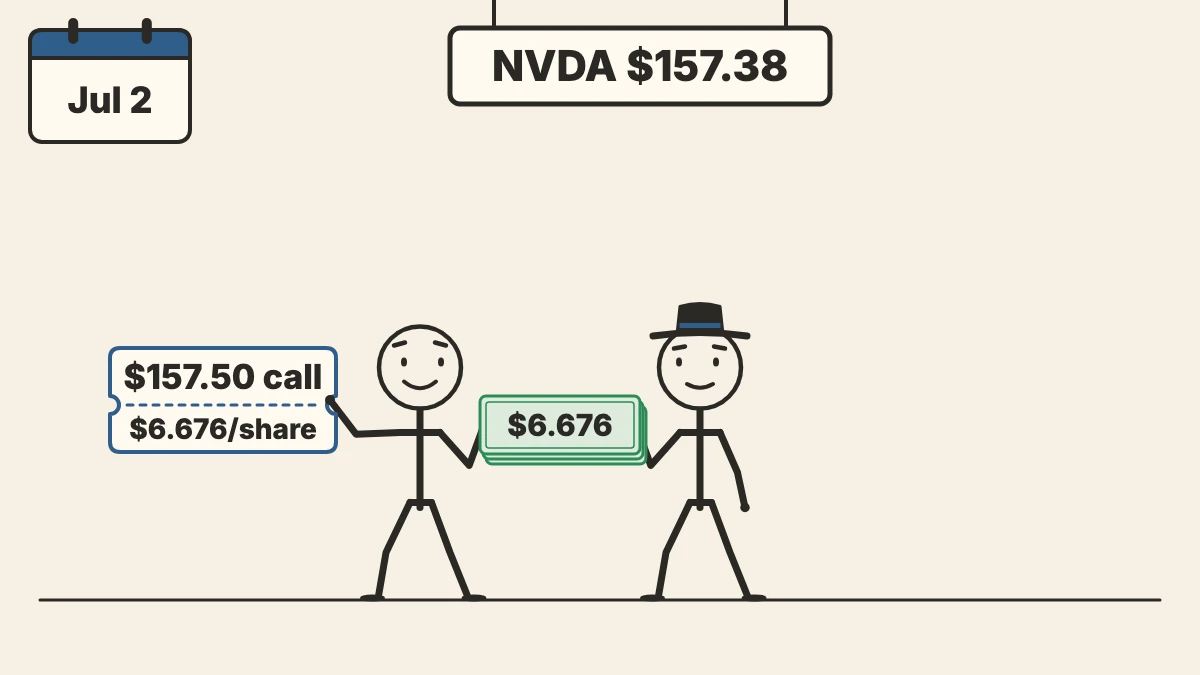
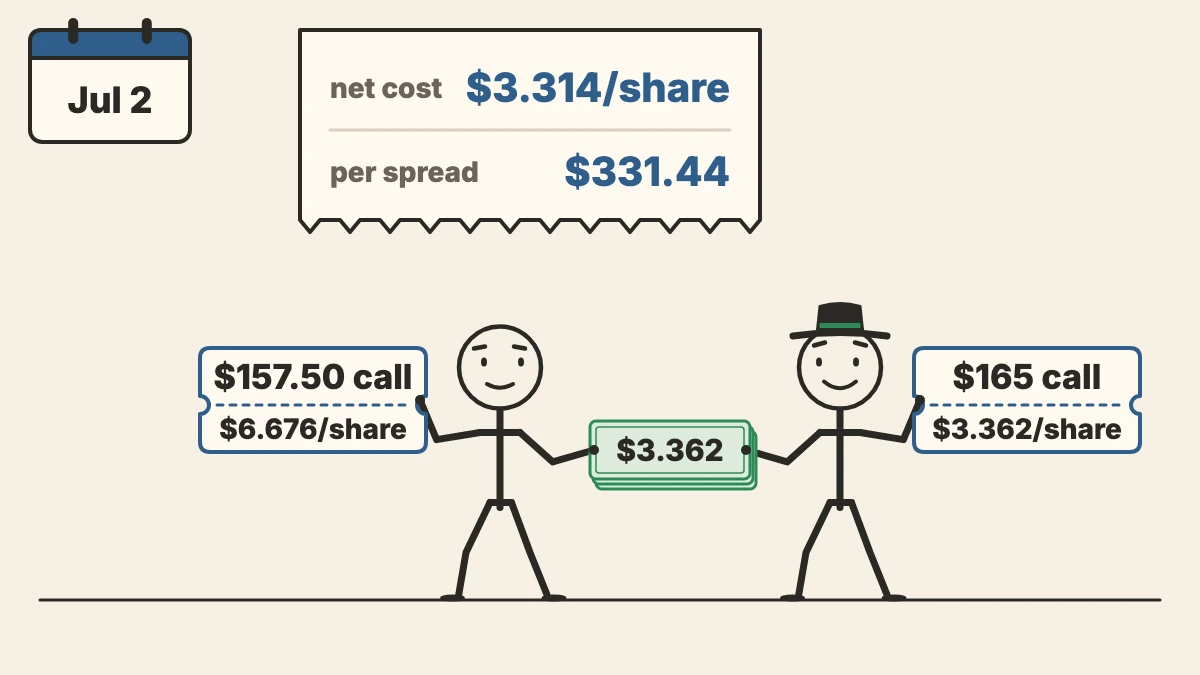
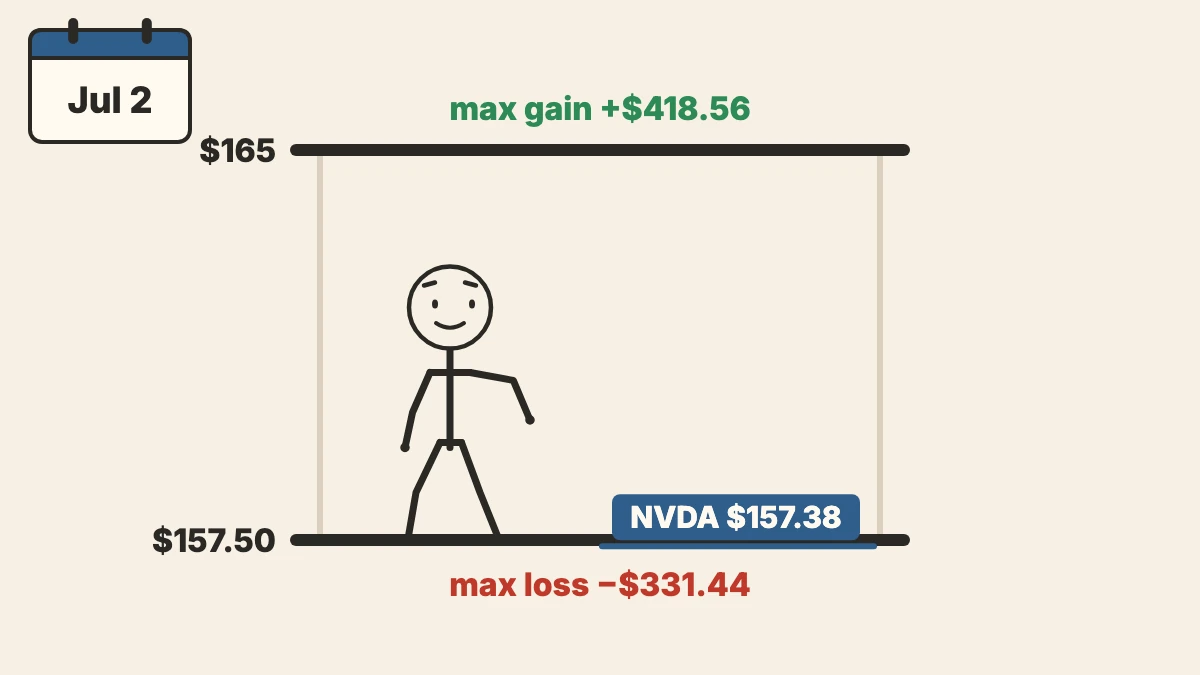
In the first 7 days of each month, if the portfolio holds no option, open one bull call spread: buy one call at the stock price and sell one call 5% above it, both expiring 28 to 42 days out. Close it 1 day before expiration.
Debit spread vs credit spread: all four vertical spreads on NVDA
Show the table · 4 rows, 7 columns
Scroll sideways to compare all columns. Select a heading to sort.
| Bull call spread | Rise | Debit | Buy a call at the stock price, then sell a call 5% above it | Width minus the debit, x 100 | The debit, x 100 | +$320.64 over 28 trades (14 won) |
| Bear call spread | Stay below the sold call | Credit | Sell a call 5% above the stock price, then buy a call 10% above it | The credit, x 100 | Width minus the credit, x 100 | -$1,843.84 over 28 trades (15 won) |
| Bear put spread | Fall | Debit | Buy a put at the stock price, then sell a put 5% below it | Width minus the debit, x 100 | The debit, x 100 | -$2,486.31 over 28 trades (9 won) |
| Bull put spread | Stay above the sold put | Credit | Sell a put 5% below the stock price, then buy a put 10% below it | The credit, x 100 | Width minus the credit, x 100 | +$1,713.36 over 28 trades (23 won) |
No matching rows. Clear the filter to see all records.
The four vertical spreads, as recorded. Width is the gap between the two strikes.
A debit spread costs money to open: you buy the pricier option and sell a cheaper one, and the most you can lose is what you paid. A credit spread pays you to open: you sell the pricier option and buy a cheaper one further out as protection, and the most you keep is that credit. The width, the gap between the strikes, sets the other limit: a debit spread makes at most the width minus its cost, and a credit spread loses at most the width minus its credit.
NVDA rose from $124.30 on July 1, 2024 to $204.64 on October 30, 2026. Both bets on a rise finished ahead, and both bets against one finished behind.
Four vertical spread accounts on $100,000: two ended up, two ended down
Account value, $100,000 start, one spread at a time
- Bull call spread (debit) 2026-10-30
- $100,320.61
- Bear call spread (credit) 2026-10-30
- $98,156.16
- Bear put spread (debit) 2026-10-30
- $97,513.70
- Bull put spread (credit) 2026-10-30
- $101,713.37
The bull put spread account ended at $101,713.37 and the bull call spread account at $100,320.61. The bear call spread account fell to $98,156.16 and the bear put spread account to $97,513.70.
The four accounts finished between 0.32% and 2.49% away from $100,000, because one spread at a time never put more than $831.64 at risk.
What these 112 spread trades include
Each backtest used daily data from July 1, 2024 to October 30, 2026, $100,000 of starting cash and one spread per trade. Fees were $0.65 per contract. Every fill was priced from a real recorded quote, at least halfway from the midpoint toward the worse side of the quote. The backtests priced from real quotes 453 times and from synthetic prices 0 times.
The engine closed every one of the 112 spreads before expiration, 8 of them on expiration day itself and the rest the session before. All four backtests trade one stock, NVDA, with 28 trades each.
Backtest a vertical spread on your own stock
Backtest a vertical spread
Create this options portfolio on NVDA and backtest it with daily data from 2025-10-31 to 2026-10-30, $100,000 starting cash: in the first 7 days of each month, if the portfolio holds no option, open one bull call spread: buy one call at the stock price and sell one call 5% above it, both expiring 28 to 42 days out. Close it 1 day before expiration. Show me every trade and the account curve.
Exact request settings
{
  "name": "Options for beginners E1-cd: NVDA bull call debit spread (ATM / 5% OTM), monthly, 28 to 42 days to expiration",
  "strategies": [
    {
      "name": "Buy one NVDA bull call debit spread each month",
      "action": {
        "type": "OpenOption",
        "builder": {
          "legs": [
            {
              "direction": "long",
              "optionType": "call",
              "strikeSelector": {
                "distance": 0,
                "distanceType": "percent"
              },
              "expirationSelector": {
                "preference": "nearest",
                "maxDaysToExpiration": 42,
                "minDaysToExpiration": 28
              }
            },
            {
              "direction": "short",
              "optionType": "call",
              "strikeSelector": {
                "distance": 5,
                "distanceType": "percent"
              },
              "expirationSelector": {
                "preference": "nearest",
                "maxDaysToExpiration": 42,
                "minDaysToExpiration": 28
              }
            }
          ],
          "spreadType": "vertical",
          "underlyingSymbol": "NVDA"
        },
        "allocation": {
          "type": "contracts",
          "amount": 1
        }
      },
      "condition": {
        "type": "And",
        "conditions": [
          {
            "lhs": {
              "type": "OptionPositionCount",
              "underlying": "NVDA"
            },
            "rhs": {
              "type": "Value",
              "value": 0
            },
            "type": "Base",
            "comparison": "equal"
          },
          {
            "lhs": {
              "type": "Date"
            },
            "rhs": {
              "type": "Value",
              "value": 7
            },
            "type": "Base",
            "comparison": "lessThanOrEqual"
          },
          {
            "lhs": {
              "type": "DaysSinceStrategyFired"
            },
            "rhs": {
              "type": "Value",
              "value": 20
            },
            "type": "Base",
            "comparison": "greaterThanOrEqual"
          }
        ]
      }
    },
    {
      "name": "Sell NVDA options 1 day before expiration",
      "action": {
        "type": "CloseOption",
        "quantity": {
          "type": "all"
        },
        "triggers": [
          {
            "type": "dte",
            "maxDte": 1
          }
        ],
        "closeScope": "spread",
        "spreadType": "vertical",
        "underlyings": [
          "NVDA"
        ]
      },
      "condition": {
        "lhs": {
          "type": "OptionPositionCount",
          "underlying": "NVDA"
        },
        "rhs": {
          "type": "Value",
          "value": 1
        },
        "type": "Base",
        "comparison": "greaterThanOrEqual"
      }
    }
  ],
  "initialValue": 100000
}Free accounts can run one daily options backtest a month, up to a year long, so the default window is the last 12 months.
Pick a spread, a stock and an expiration. The defaults are the exact portfolio from this page with your ticker swapped in. Run it here, or open it in Aurora to edit it first.
No comments yet.