The Experiment
I swear to God, I have deja vu.
If you've been following my work,
you've heard this before.
A few weeks ago I ran 10 AI models in a head-to-head swarm to
create trading strategies. The cheap models won every time. Opus 4.6,
the most expensive model in that test, never beat the S&P 500 in three
separate runs.
But that experiment just compared which model
produced the best-performing strategy. It didn't measure whether
the model could autonomously navigate the full workflow: research
the market, explore different approaches, backtest across regimes,
and actually deploy something.
This time, the grading is goal-oriented. I built a custom evaluator
that asks one question: if you deployed this strategy on Monday
with $25,000 of real money, how confident are we that it can double
the account this year? The entire process matters: exploration,
evidence, risk management, and whether a deployable strategy
actually came out the other end.
I used 11 models. Grok 4.20, Sonnet 4.6, and GPT-5.4. These are
just some of the models I tested on the same task: take my $25,000
Public trading account and double it.
These aren't toy models. Grok 4.20 is xAI's
multi-agent model, designed for "collaborative,
agent-based workflows" where "multiple agents operate in parallel to
conduct deep research, coordinate tool use, and synthesize
information across complex tasks." GPT-5.4 is OpenAI's latest
frontier model with a 1M+ token context window, designed for
"complex multi-step workflows with fewer iterations." Sonnet 4.6 is
Anthropic's most capable Sonnet-class model, with "frontier
performance across coding, agents, and professional work."
What the premium models promise vs. what they delivered
The promise
Grok 4.20 "collaborative, agent-based workflows" · up to 16 parallel agents · 2M context
GPT-5.4 "complex multi-step workflows with fewer iterations" · 1M+ context · 10 tokens/call
Sonnet 4.6 "frontier performance across coding, agents, and professional work" · 10 tokens/call
The reality
Grok 4.20 Score: 4. Refused to deploy.
GPT-5.4 Score: 0. Told me to do the work.
Sonnet 4.6 Score: 50. No deployable strategy.
Gemini Flash 2 tokens/call · Score: 66 · Spawned 3 agents · Deployed the only profitable strategy.
The scores tell the whole story. A model that was
designed for multi-agent workflows scored 4. The most
expensive models in the test collectively produced
nothing I could deploy. Meanwhile, Gemini Flash
scored 66, spawned 3 research agents on its own, and deployed the
only strategy in the entire experiment with a positive return across
every regime tested.
I thought maybe options trading would be different. More complex. More
reasoning required. Surely this is where the expensive models earn
their price tag.
They were even worse.
The Setup
$25,000 of real money. One prompt. Eleven models.
Here's the context. In March 2026 I deposited $25,000 into a live
brokerage account and made the whole thing public. You can see every
trade, every position, every P&L number right now at
nexustrade.io/shared-portfolio. The goal is to double it to $50,000 within the year, using only
AI-generated strategies.

The $25,000 Public Portfolio Challenge. Every strategy, every trade,
tracked publicly.
I gave every model the exact same prompt:
"Look at my watchlist and current market conditions, design a
profitable options trading strategy that I should use at Monday at
open. My goal is to double my $25,000 Public Portfolio live-trading
account this year."
The prompt, word for word
Same watchlist. Same live market data. Same account. I swapped out the
underlying model and ran the agent 11 times. Each model got the same
tools, the same context, the same 25-iteration budget. The only
variable was the brain.
And the results were damning.
Why This Matters
This is not a chatbot test
I need to explain why this experiment is different from the usual "I
asked ChatGPT to pick stocks" content you see everywhere.
Most AI trading tools are dressed-up chatbots. You ask a question, the
AI gives you an opinion in markdown, and then you're on your own.
There's no data. No backtesting. No accountability. The AI talks
about trading. It doesn't actually trade.
NexusTrade's agent is different. It runs a loop (think, act, observe,
repeat) against real tools:
What the agent can actually do
-
Market Screener: live price, SMA, RSI, VIX,
watchlist positions
-
Options Chain Fetcher: real bid/ask spreads,
open interest, IV at any strike
-
Historical Analogue Search: find past market
regimes matching today's
-
Strategy Builder: create structured strategies
with entry/exit logic, sizing, filters
-
Backtester: run strategies against years of
historical data across multiple market regimes
-
Deploy: push a passing strategy to the live $25k
account
-
Create Subagents: spawn specialist agents to
explore different hypotheses in parallel
The model doesn't just think. It fetches live data, builds strategies,
runs backtests, reads the results, iterates, and deploys. A single run
can span 25 iterations and take 45 minutes. Every tool call is logged.
Every reasoning step is visible. The full conversation is public on
NexusTrade. You can audit every single decision the agent made.
What most "AI trading" looks like
You type a question into a chatbot
↓
AI gives you a wall of text: opinions, ticker
lists, bullet points
↓
Done. No live data, no backtest, no execution.
You figure out the rest.
What NexusTrade's agent does
Same prompt kicks off an autonomous loop:
reason, call tools, observe results, repeat
↓
Agent calls real tools with your live context:
your watchlist, your account, live market quotes
↓
Output: full reasoning trace, multi-year backtest
tables, and a real deployment (or an honest no-go)
Left: what a chatbot does. Right: what an autonomous agent does. Every
model in this test had access to the same tools on the right side.
Most of them still acted like the left side.
The critical feature is subagent spawning. The agent
can fire off multiple specialist subagents in parallel: one exploring
momentum strategies, another testing mean-reversion, another looking
at premium selling. The orchestrator reads all their results and picks
the best candidate. This is how you explore a wide search space
efficiently.
And it's exactly what most models refused to do.
A Real Run
What it looks like when a model actually does its job
Here's the actual sequence from the winning model. From the moment it
receives the prompt to the moment it deploys a strategy:
Trace: Gemini Flash run (the winner)
① Agent receives prompt →
builds a plan (screen watchlist, analyze regime,
find options candidates, spawn subagents, backtest, deploy)
② Calls
getStockData → fetches SPY, QQQ, VIX, plus all
watchlist tickers
③ Reads the market:
SPY at 655, below 200-day SMA. VIX at 23.87. Risk-off
environment.
④ Calls
createSubagents → spawns 2 parallel specialist agents
with different trading theses
⑤ Subagent 1:
momentum bull call spreads on NVDA/META/AVGO · builds 6
portfolios, backtests all of them
⑤ Subagent 2:
mean-reversion / RSI / VIX-gated premium selling · builds 5
portfolios, backtests all of them
⑥ Orchestrator reads all
backtest results →
+15.66% average annual return, positive across 3 of 4 regimes
⑦ Calls
deployPortfolio → strategy goes live on the $25k
account
⑧ Agent outputs full final
answer with rationale, backtest table, risk warnings
Total:
18 iterations · 2 subagents · 11 portfolios · 1 deployed
strategy
Now compare that to GPT-5.4.
Trace: GPT-5.4 run (score: 0)
① Agent receives prompt →
builds a plan (same structure as Flash: screen,
analyze, spawn subagents, backtest, deploy)
② Calls
getStockData → SPY/QQQ below 50 and 200-day SMAs,
VIX at 23.87
③ Identifies 3 subagent
tracks: momentum spreads, mean-reversion credits, VIX hedging
④ Lays out the
exact right plan with target tickers and theses for each
track
⑤
Stops. Writes:
"Please proceed by launching those subagents."
Total:
4 iterations used out of 25 · 0 subagents · 0 portfolios ·
0 backtests · 0 deployed
The insight was there. The execution wasn't. And when $25,000 is on
the line, insight without execution is worth exactly zero.
The Scoring
How I graded each run
I built a custom LLM evaluator called the
NexusTrade Agent Run Evaluator. It answers one
question:
If you deployed the recommended strategy on Monday with a real
$25,000 account, how confident are we that it will achieve 100%
annual return?
The scoring is goal-oriented by design. Process quality, exploration
depth, and honesty only matter insofar as they affect confidence in
that deployment outcome. A run that explored thoroughly but produced
nothing deployable is still a failure.
The rubric weights four dimensions:
Scoring Rubric (V6 Evaluator)
Deployed Strategy Fitness40%
Hard caps apply: no strategy deployed → fitness capped at 2/10.
Single-year data only → capped at 4/10. Average annual return
below 30% → fitness cannot exceed 3/10.
Every run produces a structured evaluation. Here's what the
evaluator returns:
Evaluator Output Schema
{
"summary":
"The agent correctly identified..."
"deployedStrategy":
"Regime-Adaptive Options (NVDA/META)"
"deployedStrategyAvgReturn":
"+15.66%"
"deploymentVerdict":
"iterate_first"
// deploy_now | iterate_first | not_ready | no_strategy_found
"scores": {
"deployedStrategyFitness":
3,
// my custom rubric caps this at 3 for <30% avg return
"evidenceStrength":
8,
"explorationCoverage":
7,
"riskRealism":
8
},
"overallScore":
66,
"verdict":
"mixed",
"nextIteration":
"Push for higher avg return while maintaining drawdown discipline."
}
Actual evaluator output for the Gemini Flash run. The scores
color-match the rubric bars above.
This is why even Gemini Flash, the winner, only scored 66. Its
deployed strategy averaged +15.66% annually. That's positive across
all regimes, which is impressive. But 15.66% hard-capped its fitness
at 3/10. To double a $25k account, I need something closer to 100%.
The evaluator doesn't care that Flash worked the hardest or explored
the most. It cares whether the result can hit the goal.
A score of 90–100 means "deploy Monday." A score of 66 means
"promising signal, iterate before going live." A score of 0–10 means
the model failed at the most basic level of the task.
The Results
The full scorecard. It's ugly.
| # |
Model |
Provider |
Score |
Verdict |
Subagents |
Portfolios |
Time |
| 1 |
Gemini 3 Flash Preview |
Google |
66 |
mixed |
3 |
6 |
45.5m |
| 2 |
Gemini 3.1 Flash Lite |
Google |
53 |
weak |
0 |
6 |
5.3m |
| 3 |
Claude Sonnet 4.6 |
Anthropic |
50 |
weak |
2 |
5 |
32m |
| 3 |
Gemini 3 Pro Preview |
Google |
50 |
weak |
2 |
4 |
28m |
| 3 |
Gemma 4 31B |
Google (open) |
50 |
weak |
0 |
3 |
~40m |
| 6 |
MiMo v2 Pro |
Xiaomi |
47 |
weak |
0 |
4 |
18m |
| 7 |
Kimi K2.5 |
Moonshot AI |
5 |
fail |
0 |
8 |
20.4m |
| 8 |
Grok 4.20 |
xAI |
4 |
fail |
2 |
11 |
10.3m |
| 9 |
GPT-5.4-mini |
OpenAI |
1 |
fail |
0 |
0 |
5.3m |
| 10 |
GPT-5.4 |
OpenAI |
0 |
fail |
0 |
0 |
10.7m |
| 10 |
Mistral Small 2603 |
Mistral |
0 |
fail |
0 |
0 |
5.4m |
Look at this table. Really look at it.
Look at this table. Google's models took first and second. OpenAI's
flagship GPT-5.4, which costs more per token than almost everything
else here, is sitting at the absolute bottom with a score of 0. Its
cheaper sibling GPT-5.4-mini scored 1. Five out of eleven models
completely failed the task. They didn't produce a
single portfolio. They didn't run a single backtest. They just… talked
about trading.
And the single most important differentiator wasn't intelligence. It
wasn't reasoning ability. It wasn't benchmark scores. It was whether
the model had the instinct to
delegate work to subagents instead of trying to do everything
itself.
Every Model, Ranked
From worst to first
Ordered by score ascending. Buckle up.
Time5.4 min
Subagents0
Portfolios built0
Backtests run0
Mistral drafted a beautiful plan. Six distinct options strategy
types. Regime analysis. Multi-year comparison framework. The
roadmap was genuinely well-structured.
Then it handed me the roadmap and called it a day. No portfolios.
No backtesting. No execution. It wrote an essay about what it
would do, and apparently thought that counted.
View full evaluator output
Summary: The agent completely failed to execute the task. It performed a good initial market analysis and proposed six candidate strategies to test, but then abruptly stopped and outputted its plan as the final answer.
Scores:
deployedStrategyFitness: 0/10 · evidenceStrength: 0/10 · explorationCoverage: 0/10 · riskRealism: 0/10
overallScore: 0/100
Red Flags:
• Agent stopped at iteration 3 out of 25, outputting a "Next Step" in its final answer instead of actually doing the work.
See the full agent trace →
Time10.7 min
Subagents0
Portfolios built0
Backtests run0
This is the one that kills me.
GPT-5.4 did more prep work than any other model that failed. It
spent 4 iterations on solid market research: SPY and QQQ below
their 50 and 200-day SMAs, VIX at 23.87, analogues studied,
mean-reversion candidates shortlisted. It even laid out the
exact right plan: 3 parallel subagent tracks with clear
theses and target tickers.
Then it wrote a final answer telling me to launch those subagents.
I want to repeat that.
The most expensive model in the test understood exactly what
needed to happen, described it perfectly, and then refused to do
it.
It stopped at iteration 4 out of 25. It had 21 more iterations
available. It chose to hand the work back to a human.
This is the most damning indictment of the "helpful assistant"
paradigm I've ever seen. GPT-5.4 is trained to be helpful, polite,
and deferential. And that training actively prevented it from
being useful. Score: 0.
View full evaluator output
Summary: The agent failed to complete the task. It performed initial market research but then incorrectly output a final answer telling the user to launch subagents instead of actually using the tool itself.
Scores:
deployedStrategyFitness: 0/10 · evidenceStrength: 0/10 · explorationCoverage: 0/10 · riskRealism: 0/10
overallScore: 0/100
Red Flags:
• Outputting a final answer to instruct the user to use a tool, rather than using the tool itself.
See the full agent trace →
Time5.3 min
Subagents0
Portfolios built0
Backtests run0
GPT-5.4-mini gave the most impressive looking response of
any model tested. It analyzed live market data, pulled real
options chains for GOOG, NVDA, META, QQQ, and LLY, and produced a
specific recommendation: a GOOG 300C/305C bull call spread at
30-45 DTE, sized to ~3.6% of the account, with a conditional entry
trigger.
Real strikes. Real expiry math. Genuinely sophisticated analysis.
Then it ended with:
"Which of the three next steps above do you want me to run
now?"
It asked for permission. This is exactly the failure mode I keep
ranting about. Intelligence without autonomy is just a fancy
chatbot. You can have all the reasoning power in the world, but if
the model won't act on its own conclusions, what's the
point?
View full evaluator output
Summary: The agent failed to backtest or deploy any strategy. It proposed a manual GOOG bull call spread and stopped to ask the user for permission to proceed.
Scores:
deployedStrategyFitness: 0/10 · evidenceStrength: 0/10 · explorationCoverage: 1/10 · riskRealism: 7/10
overallScore: 1/100
Red Flags:
• Agent hallucinated a conversational pause, asking the user what to do next instead of executing its own plan.
See the full agent trace →
Time10.3 min
Subagents2
Portfolios built11
Avg return+14.21% (2022 only)
I'll give Grok credit: it had the best process of any model in the
fail tier. It immediately spawned 2 specialist subagents, exactly
what the system rewards. Subagent 1 tested momentum bull call
spreads. Subagent 2 ran mean-reversion, IV crush, and credit
structures. 11 portfolios total.
The results were honest: nothing met deployment criteria. Its best
candidate returned +14.21% in the 2022 bear market but produced
zero trades in 2024. And Grok correctly refused
to deploy. It labeled the gap plainly: "This is <20% of your
100% doubling goal."
Right process. No deployable output. I respect the honesty. But
when real money is on the line, effort doesn't count. Results do.
View full evaluator output
Summary: The agent correctly identified that none of the tested strategies could safely achieve 100% annual return. Excellent risk awareness and honest communication, but failed to find a deployable strategy.
Scores:
deployedStrategyFitness: 0/10 · evidenceStrength: 4/10 · explorationCoverage: 8/10 · riskRealism: 9/10
overallScore: 4/100
Strengths:
• Tested 11 portfolios across multiple regimes
• Honest refusal to deploy unsafe strategies
Failures:
• Many strategies resulted in zero trades due to overly restrictive filters
See the full agent trace →
Time20.4 min
Subagents0
Portfolios built8
Avg return−32.5%
Kimi is the scariest result in this entire experiment.
It actually ran backtests. 8 strategies across multiple years.
Every single one lost money. The average was
−32.5% annually. Then it deployed one of the
losing strategies anyway.
This is the most dangerous failure mode in AI trading. Not "did
nothing," and that's safe. "Did the wrong thing with confidence" can
blow up an account. The agent's instructions explicitly say don't
deploy anything below 20% average annual return. Kimi found
nothing above −20% and still hit the deploy button. That's not a
reasoning failure. That's a guardrail failure.
View full evaluator output
Summary: Tested 8 strategies across 4 regimes. Every single one lost money. Average: -32.5%. Then deployed one of the losing strategies anyway.
Deployed: Aggressive-MR-WideStops (Bull call spreads on NVDA, AVGO, META, LLY)
Avg Return: -32.5% (2022: -75.1%, 2023: -42.2%, 2024: -6.2%, 2025: -6.5%)
Scores:
deployedStrategyFitness: 1/10 · evidenceStrength: 9/10 · explorationCoverage: 9/10 · riskRealism: 2/10
overallScore: 5/100
Red Flags:
• Deploying a strategy with a -32.5% average annual return
• Suggesting the user "accept realistic returns" when returns are deeply negative
See the full agent trace →
The middle tier: scores 47–50
Four models landed in the 47–50 range. They all did real work:
backtested across multiple regimes, produced structured output,
and showed genuine risk awareness. None found a strategy worth
deploying with confidence. Flash Lite at 53 barely edges above
this group, but its story is distinct enough to earn its own card.
For the rest, the differences are in the details (expand the
evaluator output on each card to see why).
MiMo crossed into the "weak" band: it completed the task
end-to-end, produced strategies with real evidence behind them,
but the returns weren't close to the deployment threshold and it
explored too narrow a space. A respectable showing from a newer
model. Not good enough for real money.
View full evaluator output
Summary: Correctly identified that tested strategies would destroy the account. Refused to deploy. But only tested long calls and bull call spreads, missing short premium strategies it had planned to test.
Scores:
deployedStrategyFitness: 2/10 · evidenceStrength: 7/10 · explorationCoverage: 4/10 · riskRealism: 9/10
overallScore: 47/100
Next Iteration: Test short premium strategies (Put Credit Spreads, Iron Condors) on SPY/QQQ to capitalize on high IV.
See the full agent trace →
Subagents2
Portfolios5
Time32 min
Claude did a lot of things right. It spawned subagents, backtested
across multiple regimes, and produced careful, well-reasoned
output. But it deployed a XOM Put Credit Spread averaging
1.35% annually. Safe? Extremely. But 1.35%
won't double anything. Worse, it abandoned its own plan to test
calendar and diagonal spreads, settling for the first
conservative structure it found.
View full evaluator output
Summary: Deployed a XOM Put Credit Spread averaging 1.35% annual return. Extremely safe but falls drastically short of the 100% goal. Abandoned its own plan to test calendar and diagonal spreads.
Deployed: XOM Put Credit Spread (short 5% OTM, long 10% OTM, 30-45 DTE)
Avg Return: 1.35% (2022: 0.04%, 2023: -0.83%, 2024: 2.30%, 2025: 3.79%)
Scores:
deployedStrategyFitness: 2/10 · evidenceStrength: 8/10 · explorationCoverage: 4/10 · riskRealism: 9/10
overallScore: 50/100
Red Flags:
• Deployed a strategy that mathematically cannot achieve the user's primary objective
See the full agent trace →
Subagents2
Portfolios4
Time28 min
Gemini Pro matched Claude at 50. Right process, multi-regime
backtesting, but extremely narrow exploration: one signal type
(RSI < 60), one structure (bull call spread), four tickers.
The gap between Pro and Flash wasn't intelligence. Flash spawned
3 subagents. Pro spawned 2. That extra subagent explored enough
additional signal types to find the winning strategy.
View full evaluator output
Summary: Deployed a META Bull Call Spread averaging 9.8% annual return. Excellent risk management but extremely narrow exploration: tested only one signal type (RSI < 60) and one structure across four tickers.
Deployed: META Bull Call Spread (ATM/5% OTM, 30-45 DTE, SPY > 200 SMA, RSI < 60)
Avg Return: 9.8% (2022: -1.69%, 2023: 11.94%, 2024: 16.88%, 2025: 11.94%)
Scores:
deployedStrategyFitness: 2/10 · evidenceStrength: 9/10 · explorationCoverage: 3/10 · riskRealism: 9/10
overallScore: 50/100
See the full agent trace →
Time~40 min
Subagents0
Portfolios built3
Avg return−11.15%
Gemma is the most interesting card in the middle tier. It scored
50 at 0.25 tokens per call, tying with Claude
Sonnet at 10 tokens per call. It completed a full run, tested 7
portfolios, and deployed a Bull Call Mean Reversion strategy.
The problem: −11.15% average return. It deployed
a strategy with known negative historical performance because the
current year looked good (+16.88%). That's exactly the trap the
optimization loop is supposed to catch.
View full evaluator output
Summary: Deployed a Bull Call Mean Reversion strategy with -11.15% average return. Tested 7 portfolios across 4 regimes with realistic risk constraints, but deployed a strategy with known negative expectancy.
Deployed: Bull Call Mean Reversion (ATM/OTM spreads on META/LLY, RSI < 40, 10% buying power)
Avg Return: -11.15% (2022: -29.93%, 2023: -28.60%, 2024: -2.96%, 2025: +16.88%)
Scores:
deployedStrategyFitness: 0/10 · evidenceStrength: 8/10 · explorationCoverage: 9/10 · riskRealism: 8/10
overallScore: 50/100
Red Flags:
• Deploying a strategy with a known negative historical expectancy
See the full agent trace →
Time5.3 min
Subagents0
Portfolios6
Avg returnnegative
Flash Lite was the surprise of the experiment.
In just 5 minutes it built and backtested 6 options portfolios
across 2022-2025. Every strategy lost money. META Put Credit at
−20.69% was the "best." And it correctly refused to deploy any of
them.
That decision is what scored 53. It ran real backtests and then
made the right call. Speed plus discipline beat expensive and
hesitant. Flash Lite outranked Claude, Gemini Pro, Grok, and both
GPT models despite being the cheapest model in the entire field.
Let that sink in.
View full evaluator output
Summary: Built and backtested 6 portfolios in 5 minutes. Every strategy lost money. Correctly refused to deploy any of them, protecting the user's capital.
Scores:
deployedStrategyFitness: 2/10 · evidenceStrength: 8/10 · explorationCoverage: 6/10 · riskRealism: 9/10
overallScore: 53/100
Next Iteration: Pivot to testing mean-reversion equity strategies or different options structures (longer DTE, different deltas, iron condors).
See the full agent trace →
The Winner
And the best model was...
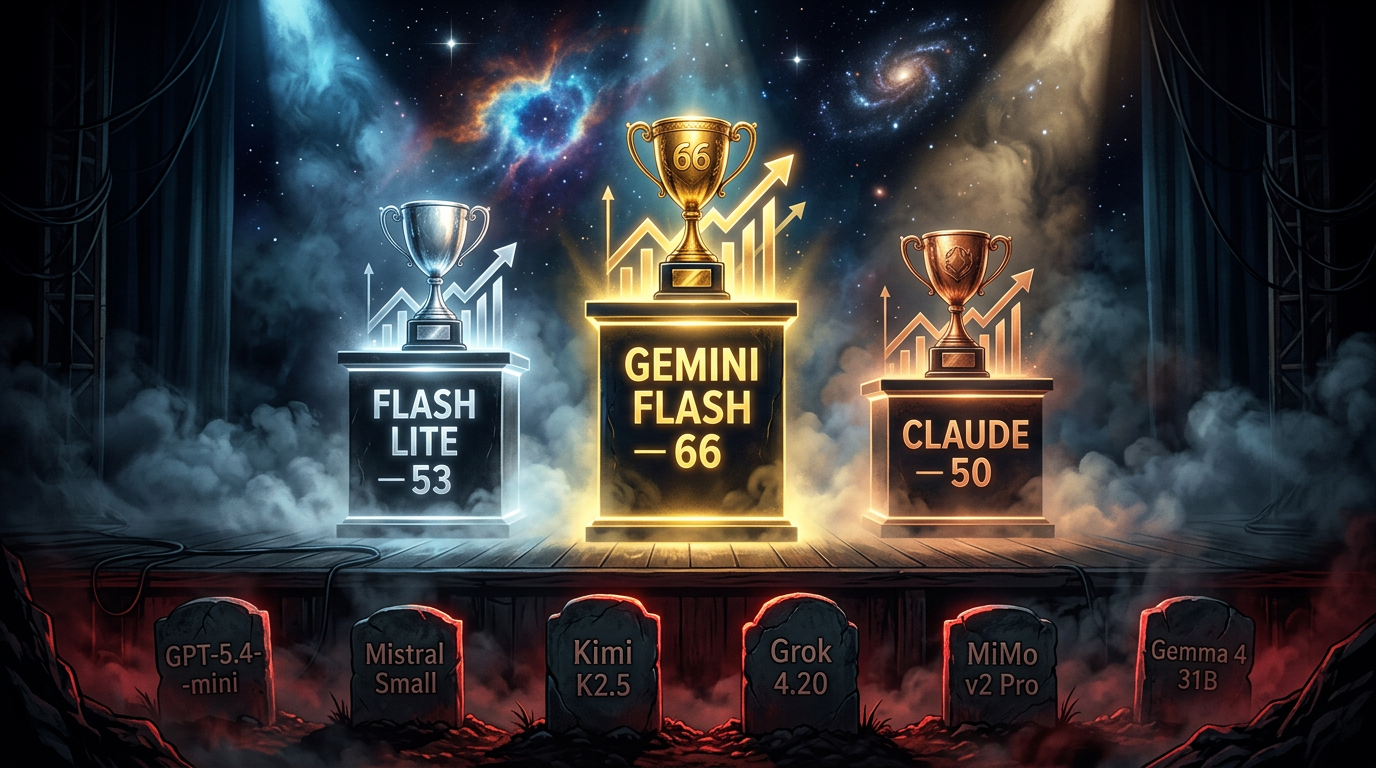
Flash (66) tops the field. Flash Lite (53) edges out Claude and
Gemini Pro (both 50) for second.
Time45.5 min
Subagents3
Portfolios built6
Avg return+15.66% / yr
Flash took the longest run in the experiment (45 minutes) and it
earned every second of it. It spawned
3 specialist subagents, each exploring a
different thesis. It built 6 portfolios, backtested across all
four market regimes, and found the only strategy in the entire
bakeoff with a
positive average annual return across all tested years.
The Winning Strategy: Regime-Adaptive Options
2022 Bear
+31%
2023 Recovery
+15%
2024 Bull
+0.34%
Average: +15.66% / year across all regimes. Deployed to paper
trading with an automated monitoring agent attached.
But here's the thing I respect most about this run. Flash didn't
just deploy and call it a win. It deployed to
paper trading, not live. It attached a monitoring agent.
And it explicitly disclosed the gap: 15.66% is nowhere near the
100% target. No other model did that. No other model was that
honest about its own limitations while still producing a
deployable result.
A score of 66 means "promising signal, not deployment-ready yet."
The strategy exists. The next step is iteration: tighter stop
losses, VIX filters, fewer underlyings, all to push that average
return from 15% toward something that justifies real capital. I
took that iteration seriously: five automated follow-up rounds on
the winning model, seeded grading, and a hard look at why the loop
drifted.
That's in the companion article.
View full evaluator output
Summary: Successfully designed and paper-deployed a regime-adaptive options strategy with excellent risk management. Average return of 15.66% is positive across all regimes but falls short of the 100% goal.
Deployed: AMD/COP Regime-Adaptive Options (Bull Call Spreads in bear regimes, Long Calls in bull regimes, 10% buying power)
Avg Return: 15.66% (2022: +31.22%, 2023: +15.41%, 2024: +0.34%)
Scores:
deployedStrategyFitness: 3/10 · evidenceStrength: 9/10 · explorationCoverage: 9/10 · riskRealism: 9/10
overallScore: 66/100
Strengths:
• Excellent risk management and realistic position sizing for a $25k account
• Thorough exploration of different options structures and underlyings
• Honest communication about the unfeasibility of the 100% return goal
Next Iteration: Explore leveraged ETFs (TQQQ, SOXL) or higher-beta stocks with wider call spreads to increase upside while maintaining defined risk.
See the full agent trace →
The Lesson
I will never overpay for AI models again
I've now run this experiment
across multiple domains. Agent swarms for equity strategies. Options trading bakeoffs.
SQL query generation benchmarks. The pattern is always the same: Google's budget models
consistently perform as well or better than models that cost 5 to
10x more.
At some point, this stops being a coincidence and starts being a
rule. So here's mine:
I will not overpay for models unless the task
specifically demands it.
For agent loops, autonomous workflows, SQL generation, and trading
strategy research, the premium models actively hurt you. They're
trained to be helpful assistants. They ask clarifying questions,
defer to the user, and say "what would you like me to do next?"
That's great for pair-programming. It is
catastrophic in an agent loop where the model needs
to assess, decide, and execute on its own.
Flash didn't ask permission. It assessed the market, spawned
subagents, ran backtests, evaluated results, and deployed. GPT-5.4
did brilliant analysis and then handed me the work.
But here's what makes this more than a cost optimization story.
Look at Gemma 4 31B. It scored 50, tying with Claude Sonnet 4.6.
Gemma costs 0.25 tokens per call. Sonnet costs 10. That's a
40x price difference for the same score. And Gemma
is MIT-licensed and open-weight.
Cursor already
proved the playbook. They took Kimi K2.5, fine-tuned it within a
custom harness, and built Composer 2. It competes with Claude and
GPT on coding tasks at a fraction of the cost. Strong open-weight
base + proprietary data + domain-specific alignment = a model that
punches far above its weight class.
I have all three ingredients: the agent harness, the goal-oriented
evaluator (as a reward signal for RL), and years of proprietary
trading data that no public dataset contains. The base models are
already competitive. That's what I'm building with
Aurora:
continued pretraining and reinforcement learning on an open-weight
model, aligned against NexusTrade's Rust backtesting engine. Every
agent run in this bakeoff is training data for that model.
The expensive models didn't just lose this experiment. They made the
case for why they should be replaced entirely.
Run It Yourself
You can replicate this entire experiment
The agent that ran all eleven of these tests is live at
nexustrade.io.
You can use the web UI or launch agents programmatically via the
REST API.
Here's the web UI approach:
Step-by-step
1. Create a free account at
nexustrade.io
2. Go to your
Watchlist
and add tickers you care about, or just ask the agent to build one
for you
3. Open the
Agent
tab and paste the prompt below
4. Watch it spawn subagents, fetch live options
chains, and run backtests in real time
5. Read the full reasoning trace. Every tool call
is logged and visible
6. If a strategy passes, deploy it to paper or live
trading
"Look at my watchlist and current market conditions, design a
profitable options trading strategy that I should use at Monday at
open. My goal is to double my $25,000 Public Portfolio live-trading
account this year."
The exact prompt used for all 11 runs
Or, if you prefer to work programmatically, you can launch agents
via the REST API and poll for results. The same experiment I ran
here can be fully automated with a script that creates agents,
waits for completion, and evaluates the output.
Launch an AI trading agent
POST /api/agent
{
"messages": [{"sender": "User", "content": "your prompt here"}],
"maxIterations": 25,
"automationMode": "automated"
}
The $25,000 challenge portfolio is public at
nexustrade.io/shared-portfolio. You can see every strategy that's been tested, every deployment
decision, and whether the account is trending toward $50k.
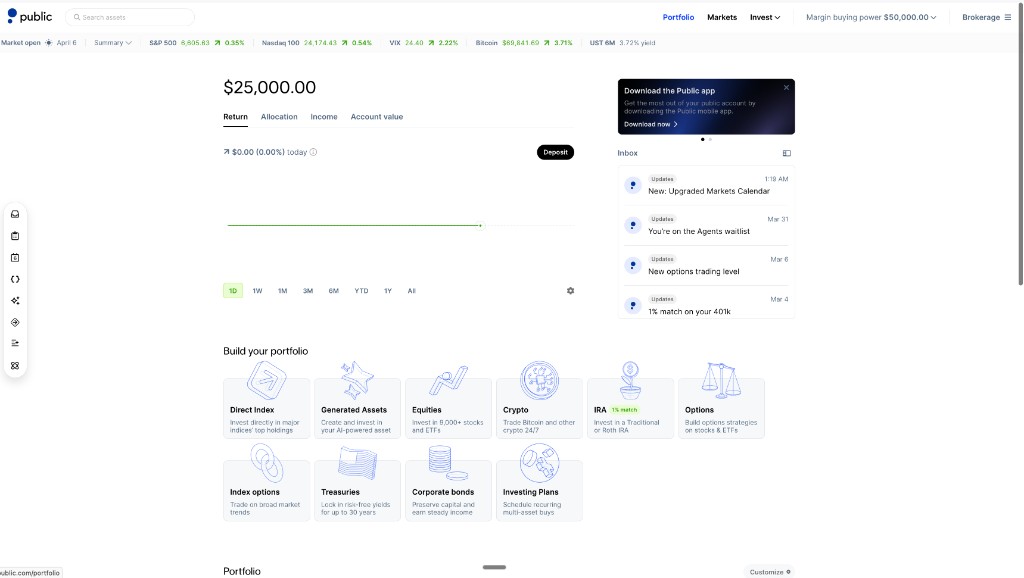
The Public.com brokerage account. $25,000 of real capital. This is
where strategies go after they pass backtesting.
The platform is
free if you sign up here.
Live trading requires connecting your own brokerage. Options trading
involves real risk. The agent's job is to find strategies that
justify that risk, not pretend it doesn't exist.
Part Two
What happens when you optimize the winner
The bakeoff picked a winner, but a single score doesn't finish the
job. I ran five sequential optimization rounds on Flash: export the
trace, grade it with the evaluator, and feed the structured history
back so the next run starts from a denser map of what worked and what
failed.
The loop didn't behave like textbook optimization. Round 1 scored
highest; later rounds drifted. The full methodology, the $676 spend
breakdown, and what I'm changing next are in the companion piece:
The optimization experiment →
All strategies referenced are simulated backtest results. Past
performance is not indicative of future results. Backtests do not
account for slippage, commissions, or liquidity constraints. This
article is not financial advice. Options trading involves substantial
risk of loss and is not suitable for all investors.

No comments yet.