
← All Articles
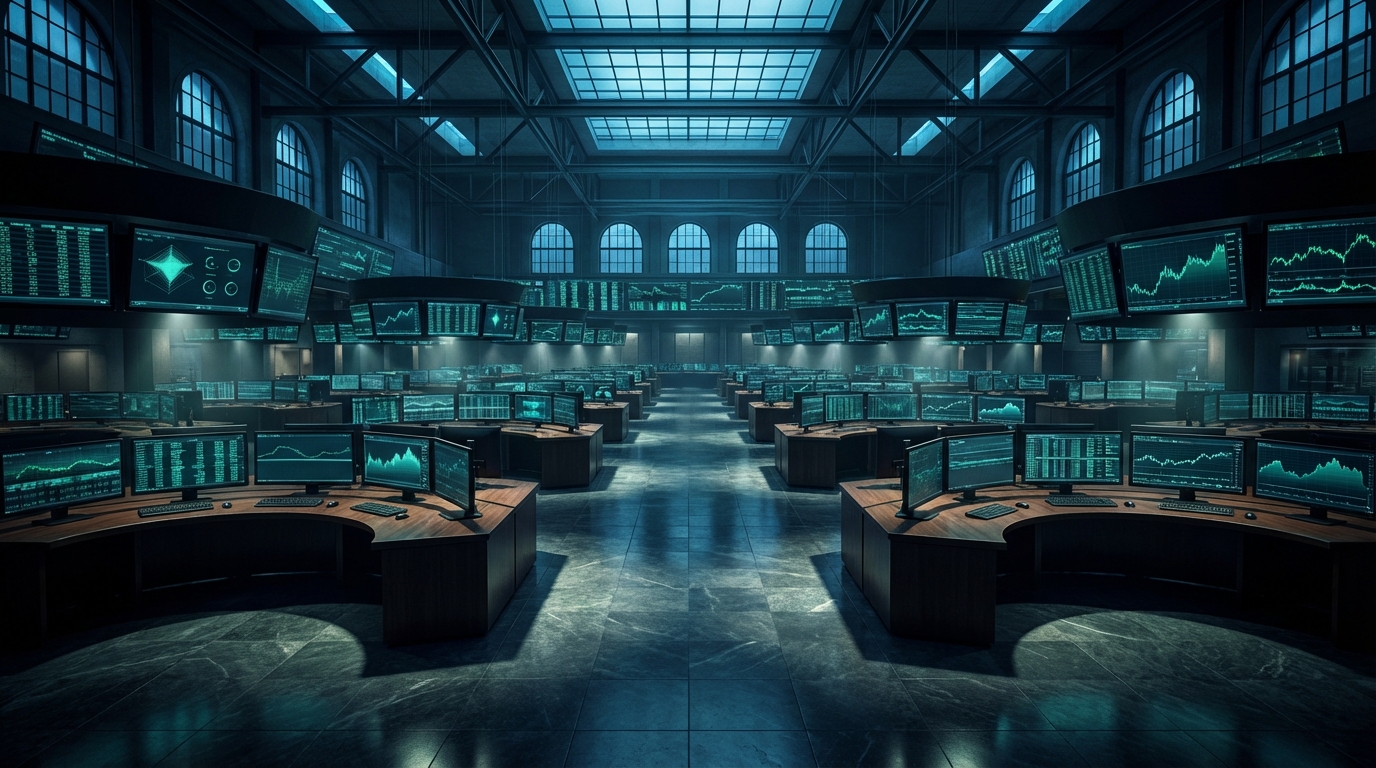
Empty Wall Street trading floor at night — monitors glowing with green data streams

Algorithmic Trading Fundamentals · Module 1 of 6

I watched my portfolio crash from a Cornell lecture hall.

The market doesn't pause for you. Wall Street already knew that. So they automated. This is the series that shows you how to do the same thing, without a single line of code.

Austin Starks Austin Starks ✦ Founder, NexusTrade ✦ April 2026 ✦ 10 min read

I was sitting in an intro programming lecture at Cornell when I realized I was completely powerless.

The professor's name was Walker White. Yes, like Walter White. Except this one taught Python instead of cooking meth, and his lessons were considerably less dangerous. He was at the board walking through loops and conditionals, and I was supposed to be following along.

I wasn't following along.

My phone was flat on my thigh under the desk. I was watching my portfolio bleed in real time, refreshing every 90 seconds, each number worse than the last. Walker White was telling 500 students that to understand recursion, you first have to understand recursion. I had 17 minutes left in class. The market did not care. It never does.

That was the moment I understood something it took me years to fully say out loud: the market doesn't pause for you. It moves constantly, reacts instantly, and punishes hesitation. Manual trading is a losing game not because your instincts are wrong. It's because the game is rigged against human reaction time.

Wall Street figured this out decades ago. The firms that consistently win aren't better at reading charts than you are. They have code. Algorithms that read market conditions and execute trades automatically, without emotion, without hesitation, and without needing to be in the room. They don't watch the market. They set rules, and the rules do the watching for them.

I built NexusTrade because I was tired of being the guy in the lecture hall with his phone under the desk. This series is what I wish someone had handed me then.

"This is not a get-rich-quick course. I'm going to give you the exact framework professional traders use, and show you how to build it yourself, without writing a single line of code."

Watch the full intro · Algorithmic Trading Explained — What Every Retail Investor Should Know

Over six modules, we go from zero. What even is a trading indicator? All the way to deployment, where your strategy is live and executing real trades. We'll cover testing, optimization, and the traps that catch most beginners. By the end, you'll understand not just how to use tools like NexusTrade, but why the tools work the way they do.

Algorithmic Trading Fundamentals · Full Series

From indicator to deployed strategy. Five modules. No code required.

nexustrade.io


Algorithmic trading isn't magic. It's a set of rules that execute automatically.

An algorithmic trading strategy is, at its simplest, a set of rules. Rules for when to buy. Rules for when to sell. Rules for how much to invest. Rules for when to do nothing. The difference between an algorithmic trader and a manual trader is that the algorithmic trader has written those rules down in a way that a computer can understand and execute. Without the trader needing to be present.

The advantage isn't that a strategy never adapts. It's that when it does, it's because the data says to. Not because your stomach dropped when you saw the red. Not because someone on CNBC said something alarming. The strategy executes exactly as written, every time, without hesitation. And when you want it to change, you change the rules. Not the mood.

This is the most fundamental shift in how modern professional trading works. Understanding it is the prerequisite for everything else in this course.

MANUAL TRADER
ALGORITHMIC STRATEGY
Example Strategy
"Oversold Quality"
INDICATORS
SPY
Price
SPY
50-SMA
— — —
Revenue
YoY
CONDITIONS
Price <
50-SMA
AND
Rev >
10% YoY
ACTION
BUY
5% cash
↻ 24/7 · no emotion · fully automatic
The same loop. One runs on discipline and sleep schedules. The other runs on code — around the clock.

Key insight

A trading strategy is just a set of rules. The power of algorithmic trading is that those rules are codified and executed consistently. Not based on how you feel when you wake up and check your portfolio.


Every algorithmic trading strategy is built from three things. This series teaches all of them.

No matter how complex a professional trading strategy looks from the outside, it always comes back to the same three components. You're going to learn each one from the ground up:

MODULE 2 Indicators MODULE 3 Conditions & Actions MODULE 4 Strategies MODULE 5 Backtesting MODULE 6 Deployment Go Live
The full pipeline from raw data to live deployed strategy.

In Module 2, we cover all four types of indicators: technical, fundamental, economic, and alternative data. In Module 3, those signals become conditions and actions. In Module 4, you combine them into a complete strategy. In Module 5, you backtest and optimize it. In Module 6, you deploy it live.


Before strategies, conditions, or actions: there are indicators.

An indicator is the most fundamental building block of a trading strategy. Everything starts here. An indicator is a signal, a piece of information, that can help us make a decision about a stock. Indicators don't tell you what to do. They give you a number. You decide what to do with it.

There are four major categories of indicators, and understanding each one gives you a dramatically different lens on the market:

Back in that Cornell lecture hall, the only data I was watching was a stock's price going down. A technical indicator. A red line. I had no idea why it was falling, and I had no system to tell me. If I had been tracking fundamental indicators — revenue growth, margins, the company's actual financial health — the move would have made far more sense. The price was noise. The fundamentals were the signal.

THE FOUR INDICATOR TYPES 01 · TECHNICAL Price & Price History Moving averages, RSI, MACD, Bollinger Bands, volume Pattern: what has happened → what might happen 02 · FUNDAMENTAL Company Financials Revenue, net income, free cash flow, PE ratio, earnings growth Pattern: business health → long-term price 03 · ECONOMIC Macro Conditions Interest rates, GDP, unemployment, CPI, Fed policy, yield curve Pattern: economy health → market direction 04 · ALTERNATIVE DATA Everything Else Satellite imagery, Reddit sentiment, social media, job postings, web traffic Pattern: real-world signals → earnings surprise
You can use any combination of these four types in a single trading strategy.

Watch · What is a Trading Indicator? — The Building Blocks of Algorithmic Trading

Here's the rule that ties them all together: an indicator is any data source that produces a number you can use to make a trading decision. That's it. Whether it's a 50-day moving average or the number of cars in a Walmart parking lot counted by satellite: if it evaluates to a number, it can be an indicator.

Why this matters

Most beginners only use technical indicators. Professional strategies combine all four types. The gap between a 10% return and a 30% return is often in which data you decided to pay attention to.


Two questions before you go to Module 2.

Question 1

What is the core difference between a manual trader and an algorithmic trader?

Answer: A manual trader makes decisions based on judgment in the moment. An algorithmic trader defines rules in advance and lets a computer execute them automatically. The algorithm removes emotion and runs consistently 24/7.

Question 2

Which of the following is NOT a valid trading indicator: (a) a stock's 50-day moving average, (b) a company's free cash flow, (c) the number of Reddit posts mentioning NVDA, (d) your gut feeling about the market?

Answer: (d) Your gut feeling. An indicator must evaluate to a number that can be measured, compared, and acted on consistently. Gut feelings can't be codified. Options (a), (b), and (c) all produce quantifiable values and are real strategies used by professionals.

Five modules. One complete framework.

This is Module 1. The next article goes deep on the two most common indicator types, technical and fundamental, and explains why you need both to build a strategy that actually works.

Ready to build your first strategy?

NexusTrade lets you create, backtest, and deploy algorithmic trading strategies. No coding required. Aurora, our AI agent, can help you every step of the way.

Get 3 Months Premium Free — via Public.com

Open a Public.com brokerage account, connect it to NexusTrade, and get 3 months of Premium free.  ·  Or take the full course →

Discussion

Sign in or create a free account to join the discussion.

No comments yet.