

Algorithmic Trading Fundamentals · Module 6 of 6
Deployment: from paper trading to going live.
You've built the strategy and tested it. Now comes the part most people rush and get wrong. Paper trading first. Live trading second. Here's exactly how to do both.
The $25,000 Question
At some point, you stop backtesting and wire in real money.
In early 2026, I deposited $25,000 into a live Public.com brokerage account and attached my AI strategies to it. Then I shared the portfolio publicly so anyone could watch the P&L in real time. Every trade. Every position. Every loss.
I called it the $25,000 Public Portfolio Challenge. It is still going.
Right now, the portfolio is essentially flat. Still at $25,000.
I built the platform. I have years of profitable trades behind me. I know how to backtest. And deployment is still hard.
"I'm terrified that the platform I've spent 5 years building is not actually useful. That I will fail publicly in front of millions of people with proof of the uselessness of my tool."
Most people who fail at deployment do not fail at building strategies. They skip paper trading, treat the backtest as a guarantee, and pull the plug the first time a normal loss hits. Here is the framework for doing it right.
Watch · Recap: From Building Blocks to Deployment — Review Everything You've Learned
Five modules to get here. Indicators, conditions, actions, strategies, backtesting. Now the part that makes all of it real: deployment.
Step 1
Paper trading: run your strategy live without risking real money.
You don't just click deploy and wire in real capital. That's a beginner's mistake. The professional path is two steps: paper trading first, then live trading.
Paper trading is exactly what it sounds like: your strategy executes trades in real time, with real market data, but using simulated money. No real capital at risk. You watch the strategy run in live conditions without the consequences. If you connect a Public.com brokerage account to NexusTrade, you get 3 months of Premium free. That is enough time to paper trade, backtest, and find out if your strategy is worth going live with.
Why paper trading matters even if your backtest was great
A backtest tells you how your strategy performed on historical data. Paper trading tells you whether it behaves the way you expect when the market is moving in real time. Does it fire on the right conditions? Are fills coming back at the prices you assumed? Is the execution schedule working? Paper trading answers those questions before real money is on the line.
Run your strategy on paper for at least 30 to 90 days. Watch how it behaves in live conditions. Does it trade when you expect it to? Are the fills reasonable? Does the behavior match what the backtest suggested?
What a failing paper trading period actually looks like
A lot of people believe that a great backtest is proof the strategy works. Run it, see the number, deploy it.
They are wrong. Take for example this strategy. I used GPT o1 to generate a TQQQ SMA crossover and was so impressed by the 277% backtest returns that I wrote an article calling it market-destroying. I deployed it.
For a while, it worked. Up 22% by December. Then Trump announced tariffs. The S&P dropped 18% in two months. The strategy was fully allocated throughout the entire decline, down 44% at the trough. Then the tariff pause hit. TQQQ rallied nearly 40% in days. The strategy's take-profit condition triggered right at the bottom, locking in the loss permanently while the rest of the market recovered.
It finished down 40%. Sharpe ratio negative. Full post-mortem here. The live portfolio is still public.
Three problems paper trading should have caught: no drawdown protection, leveraged instrument with no risk plan, and no real theory for why the rules would hold in market conditions the backtest never saw. Any one of those is a reason to pause. All three is a reason to not go live at all.
Signs your strategy is not ready to go live
Stop if you see any of these during paper trading:
✗ The strategy trades at times or in ways you do not expect
✗ The max drawdown in paper trading is already near or past your personal limit
✗ You cannot explain why each rule in the strategy should work going forward
✗ You find yourself wanting to override the strategy manually ("I would've sold here")
✗ The strategy makes a big loss and you feel surprised — not because markets were extreme, but because you didn't know it could do that
If yes to all of the above, you are ready for Step 2.
Step 2
Going live: how to deploy your strategy with confidence.
Watch · Deploy Your First Trading Strategy — From Paper Trading to Real Money
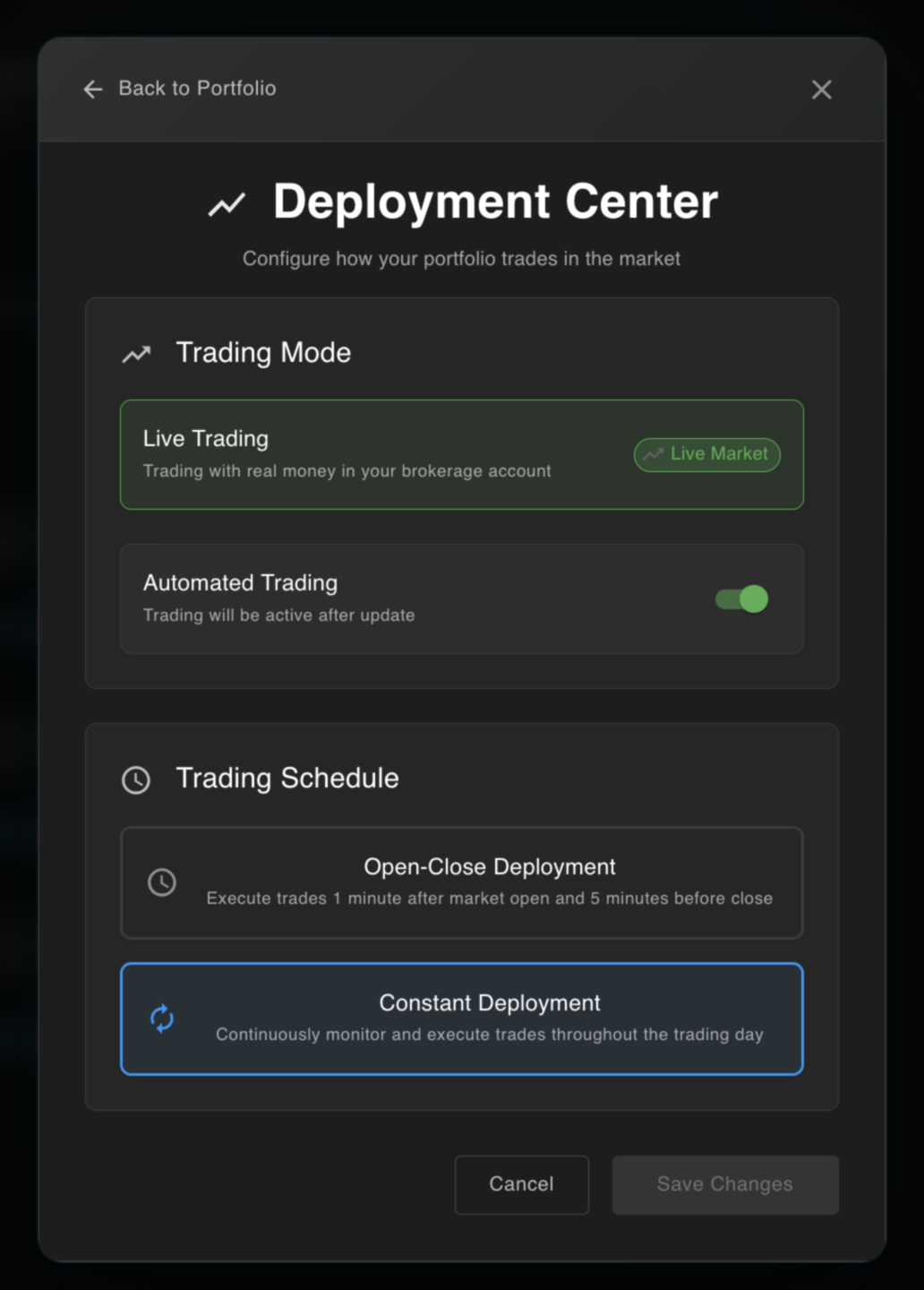
After your strategy has run on paper consistently for at least a month or two, you can move to live trading with actual capital. NexusTrade's Deployment Center lets you configure trading mode, schedule, and risk limits. Switching between paper and live is a single toggle.
Choosing your trading schedule
Once you enable live trading, you pick how often your strategy runs. There are two modes:
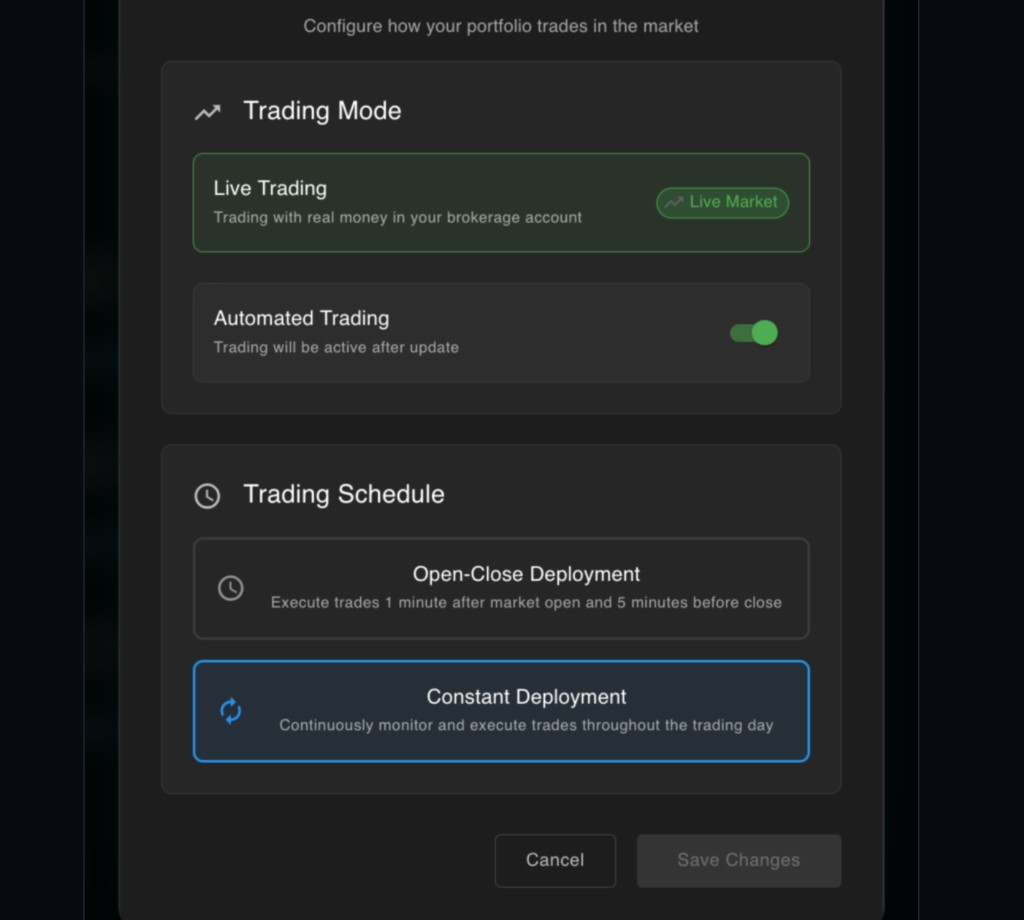
Open-Close Deployment executes trades 1 minute after market open and 5 minutes before close. This is the right choice for most strategies — it avoids the chaos of the opening bell and the illiquidity of the final minutes, while still reacting to daily conditions. Lower frequency, lower cost, lower noise.
Constant Deployment monitors the market continuously and executes whenever your conditions are met throughout the trading day. Use this if your strategy is designed to react to intraday signals. It requires more precise condition logic — a strategy that fires too loosely will overtrade.
When in doubt, start with Open-Close. You can always switch.
Supported brokerages
NexusTrade integrates with Alpaca, Tradier, and TradeStation. You can connect an existing account or open a new one. Once connected, your strategy trades directly through your brokerage account. NexusTrade never holds your funds.
If you open a new TradeStation account through NexusTrade, you get 1 month of Premium free and up to $5,000 cash back depending on deposit size. Use promo code NXTRAGMC at signup. Full details at nexustrade.io/tradestation.
The professional deployment checklist
Before going live, confirm:
✓ Strategy passed out-of-sample backtest validation
✓ Strategy ran on paper for at least 30 days without surprises
✓ Position sizes are sized to your actual account, not your backtest
✓ You have a clear plan for when to turn the strategy off (drawdown limit, time limit)
✓ You understand every condition and action (no black boxes)
Final Check
One last question to close out the series.
Question 1
Your strategy performed well in backtesting and paper trading. On day 3 of live trading, it takes a 6% loss in a single day. What should you do, and what should you NOT do?
Series Complete
You now know what it takes to be an algorithmic trader.
Six modules. One complete framework. You've gone from "what is algorithmic trading" to building, testing, and deploying your own strategy. That's not nothing.
When you complete the full course on NexusTrade, you earn a verified certificate of completion. Something to show for the work.
The next step is building your first real strategy. Go to nexustrade.io/agent and tell Aurora what you want. She will build it, backtest it, and walk you through deploying it. You do not need to write a single line of code.
Go to Aurora and describe your strategy in plain English. She will build it, backtest it, and walk you through going live. No code required.
Open Aurora and Start Building →Connect a Public.com account and get 3 months of Premium free. · nexustrade.io/public → · Re-watch the course →
No comments yet.