TL;DR
A cash secured put is a put you sell while keeping enough cash to buy 100 shares at the strike, in case the stock ends below it.
For my SNDK $60 put, my broker, Public, set aside $6,000 of cash, while NexusTrade's own rule reserves $5,620, the strike minus my $3.80 premium, times 100. A cash secured put backtest that sold one NVDA put a month made money in 24 of 28 months, +$7,176.82 in total after fees.
Put assignment: the NVDA $116 put that turned into 100 shares
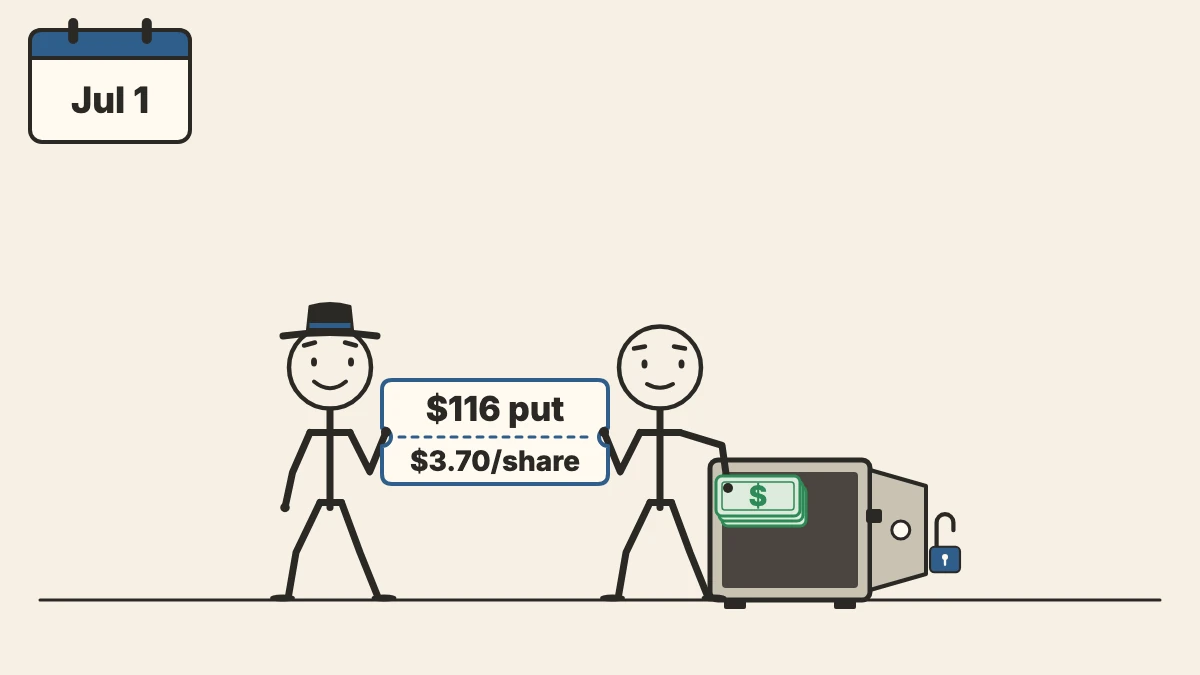
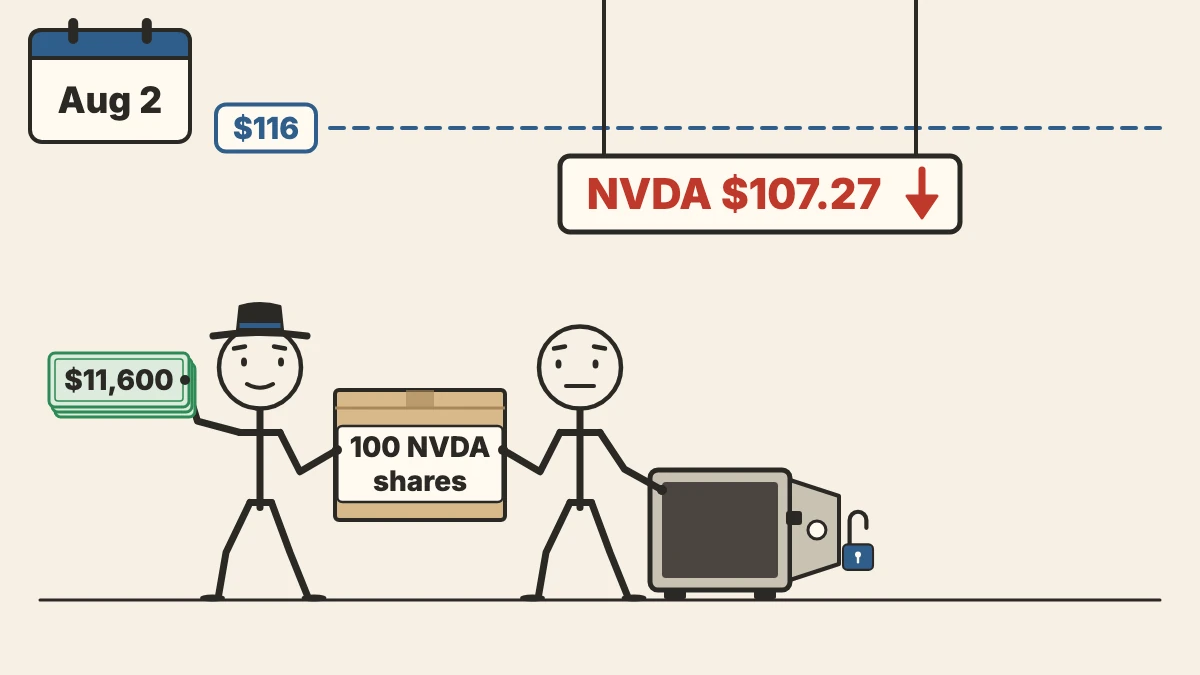
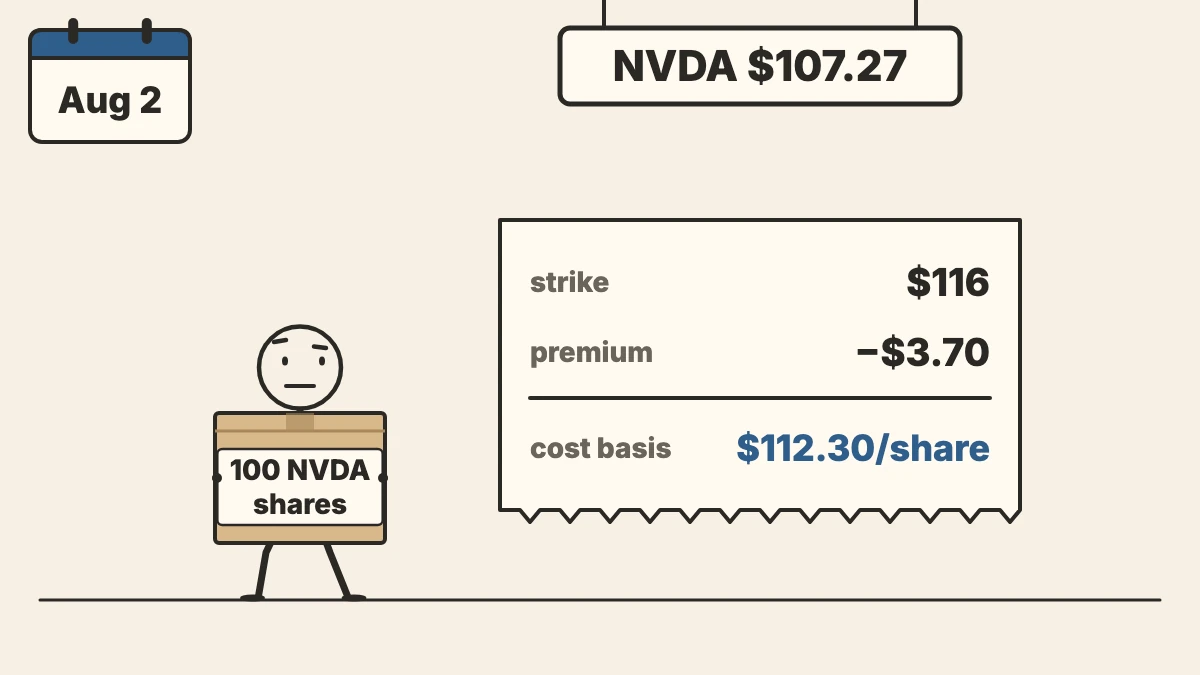
The premium you collected lowers your real cost. Your cost basis, the price you count as paid per share, is $116 minus $3.6965, or $112.30. At that day's close the 100 shares were worth $503.35 less in total than that basis. Selling calls on them next would be the wheel strategy. This run kept the shares, and the account finished +9.29% on $100,000 by October 30, 2026.
The $6,000 my broker locked for one SNDK put
Public's figure was read from my account on November 25, 2026, after the sale. NexusTrade's figure applies its cash-secured put rule to the same trade.
Collateral is cash your broker sets aside so you can pay for the shares if the put's buyer makes you buy them. After my sale the account showed $12,927.16 of cash and $6,927.16 of buying power. The $6,000 gap is the $60 strike times 100.
NexusTrade's own rule subtracts the $380 premium I already collected, so it reserves $5,620. That is also the most I can lose on this put, and only if SNDK falls to $0.
Cash secured put backtest: 28 months of selling NVDA puts
Account value on $100,000, monthly NVDA put sales vs 100 shares held
- Cash secured put account: one 0.30-delta NVDA put a month 2026-10-30
- $107,176.81
- 100 NVDA shares bought July 1, 2024 and held, no options (price only) 2026-10-30
- $108,118.64
This account sold one put a month and never took shares: it bought all 28 back before expiration. It made +$7,176.82 after fees, a +7.18% return on $100,000. Holding 100 shares over the same dates made +$8,118.64 in price, with a largest drop of 5.37% against 1.33% for the put account.
How the two NVDA put backtests were run
Both started with $100,000 and used daily NVDA prices and option quotes between July 1, 2024 and October 30, 2026. The monthly run sold one 0.30-delta put in the first 7 days of each month with no put open and bought it back 1 day before expiration. That delta means the put's price moved about $0.30 for each $1 NVDA moved. The assignment run held its put to expiration, so an in-the-money put turned into 100 shares, and the backtests do not model early assignment. Each option fill came from a recorded quote, at least halfway from the midpoint toward the worse side of the quote. Fees were $0.65 per contract on every fill.
Run it yourself: backtest a cash secured put on any stock
Backtest a cash secured put
Cash-secured put, monthly
Create this options portfolio on NVDA and backtest it with daily data from 2025-10-31 to 2026-10-30, $100,000 starting cash: in the first 7 days of each month when no option is open, sell one cash-secured put at 0.30 delta expiring 28 to 42 days out, and buy it back 1 day before expiration. Show me every trade and the account curve.
Exact request settings
{
  "name": "Options for beginners I3-roll: NVDA cash-secured put (delta 0.30), closed 1 day before expiration, 28 to 42 days to expiration",
  "strategies": [
    {
      "name": "Sell one NVDA 0.30-delta cash-secured put each month",
      "action": {
        "type": "OpenOption",
        "builder": {
          "legs": [
            {
              "direction": "short",
              "optionType": "put",
              "strikeSelector": {
                "distance": 0.3,
                "distanceType": "delta"
              },
              "expirationSelector": {
                "preference": "nearest",
                "maxDaysToExpiration": 42,
                "minDaysToExpiration": 28
              },
              "fallbackStrikeSelector": {
                "distance": 5,
                "distanceType": "percent"
              }
            }
          ],
          "underlyingSymbol": "NVDA"
        },
        "allocation": {
          "type": "contracts",
          "amount": 1
        }
      },
      "condition": {
        "type": "And",
        "conditions": [
          {
            "lhs": {
              "type": "OptionPositionCount",
              "underlying": "NVDA"
            },
            "rhs": {
              "type": "Value",
              "value": 0
            },
            "type": "Base",
            "comparison": "equal"
          },
          {
            "lhs": {
              "type": "Date"
            },
            "rhs": {
              "type": "Value",
              "value": 7
            },
            "type": "Base",
            "comparison": "lessThanOrEqual"
          },
          {
            "lhs": {
              "type": "DaysSinceStrategyFired"
            },
            "rhs": {
              "type": "Value",
              "value": 20
            },
            "type": "Base",
            "comparison": "greaterThanOrEqual"
          }
        ]
      }
    },
    {
      "name": "Sell NVDA options 1 day before expiration",
      "action": {
        "type": "CloseOption",
        "quantity": {
          "type": "all"
        },
        "triggers": [
          {
            "type": "dte",
            "maxDte": 1
          }
        ],
        "underlyings": [
          "NVDA"
        ]
      },
      "condition": {
        "lhs": {
          "type": "OptionPositionCount",
          "underlying": "NVDA"
        },
        "rhs": {
          "type": "Value",
          "value": 1
        },
        "type": "Base",
        "comparison": "greaterThanOrEqual"
      }
    }
  ],
  "initialValue": 100000
}Free accounts can run one daily options backtest a month, up to a year long, so the default dates are the last 12 months of this run.
Pick a stock, the dates, a strike and an expiration. The defaults are the monthly put sale from the 28-month backtest above with your stock in place of NVDA. Run it here, or open it in Aurora to edit it first.
No comments yet.