TL;DR
Published 2025-10-03. MongoDB time-series collections used 7.73 GB against 136.93 GB and answered backtest queries in 274 ms against 549 ms. TimescaleDB answered portfolio queries faster, 716 ms against 938 ms.
- Published
- 2025-10-03
- Published model rows
- 2
- Evidence
- Historical task evaluation
Follow this evaluation
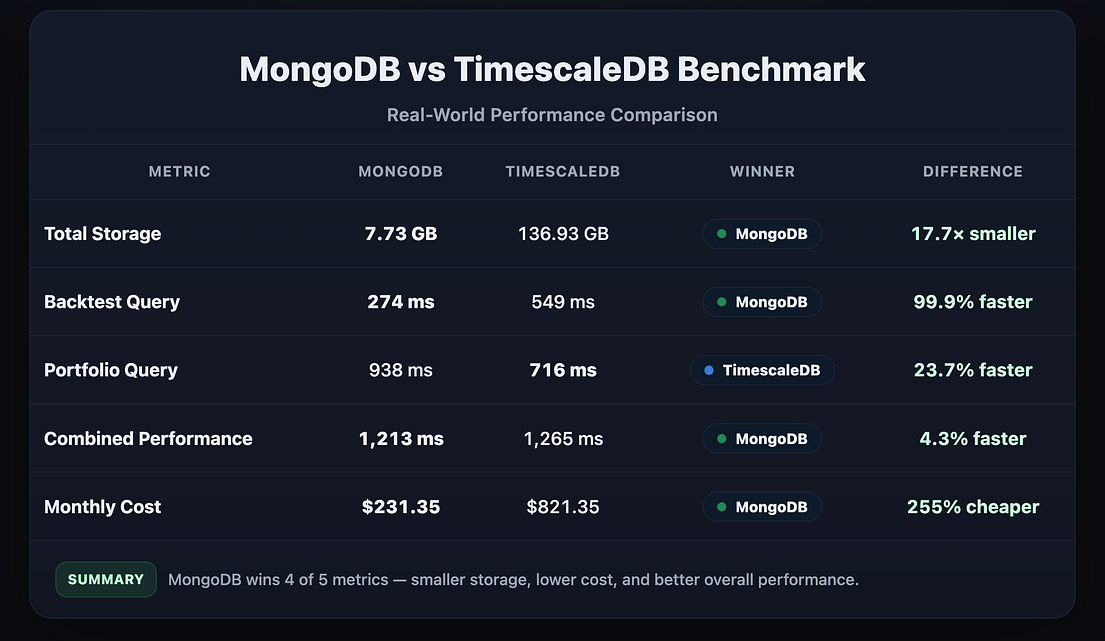
Published results
MongoDB time-series collections vs TimescaleDB for backtest data: source evidence dated 2025-10-03.
- Exact model version
- MongoDB (time-series collections)
- Total storage
- 7.73 GB
- Backtest query
- 274 ms
- Portfolio query
- 938 ms
- Combined performance
- 1,213 ms
- Monthly cost
- $231.35
The displayed values belong to the identified model versions and this published task, with their original metric units.
What did this task require the model to return?
Read the tested version, task and rubric together. Check failures alongside successful answers; compare costs only within the reported unit.
2025-10-03: MongoDB time-series collections vs TimescaleDB for backtest dataKeep the study date and exact model ID beside the result. Do not average different tasks into one winner.
Test a strategy with Aurora
Keep the study date and exact model ID beside the result. Do not average different tasks into one winner.
Test a strategy with AuroraKeep reporting dates and units beside the answer, and inspect its original citations.
Published results
2 databases, backtest and portfolio-history queries, 20 requests in batches of four per the article. Published 2025-10-03. Values retain their original units and grading scale.
See the complete published results
Scroll sideways to compare all columns. Select a heading to sort.
| MongoDB (time-series collections) | 7.73 GB | 274 ms | 938 ms | 1,213 ms | $231.35 |
| TimescaleDB | 136.93 GB | 549 ms | 716 ms | 1,265 ms | $821.35 |
No matching rows. Clear the filter to see all records.
2 databases, backtest and portfolio-history queries, 20 requests in batches of four per the article. Published 2025-10-03. Values retain their original units and grading scale.
Task and tested input
Store and query time-series backtest history and portfolio history for a trading platform.
Instruction in brief (task summary)
Run the same benchmark script for concurrent query performance, data size and cost against MongoDB time-series collections and TimescaleDB.
How the runs worked
2 databases, backtest and portfolio-history queries, 20 requests in batches of four per the article
Open-source MongoDB-vs-Timescale-DB benchmark script (github.com/austin-starks/MongoDB-vs-Timescale-DB) over NexusTrade backtest and portfolio history data
Step 1
Load NexusTrade backtest and portfolio history into both databases.
Step 2
Run the benchmark script's backtest and portfolio history queries, 20 requests in batches of four.
Step 3
Record average latency per query type, total storage and monthly cost.
How to read the measurements
Grading and valid output
Measured averages from the benchmark script. There is no quality score. Lower storage, latency and cost are better.
Cost
Monthly cost: $231.35 for MongoDB alone and $821.35 for MongoDB plus a separate $590 Timescale instance (4 CPU, 16 GB).
Time
Average query time in milliseconds per query type, as published in the table.
Why this model was selected
The article returned to MongoDB with time-series collections, citing smaller storage, faster backtest queries and the avoided $590 monthly Timescale instance, and judged TimescaleDB's faster portfolio queries unnoticeable to users.
See the published results
This image was published with the 2025-10-03 article. Read the source for the full test procedure and every result it reports.
Sample and scope
This compares databases, not AI models, using one October 2025 production workload and configuration.
The backtest queries return different row and embedded-position counts on each side, which the article says makes the latency figures implementation results rather than a controlled ranking.
The TimescaleDB monthly cost ($821.35) is the combined MongoDB plus a planned $590 Timescale instance, and the published image's Difference column ('99.9% faster', '255% cheaper') is omitted because it does not match the article's own text.
No comments yet.