NexusTrade / Product launch
Meet NexusTrade Videos.
AI trading, explained.
Find the explanation inside a video, then follow the links to the lesson, data, or portfolio behind it.
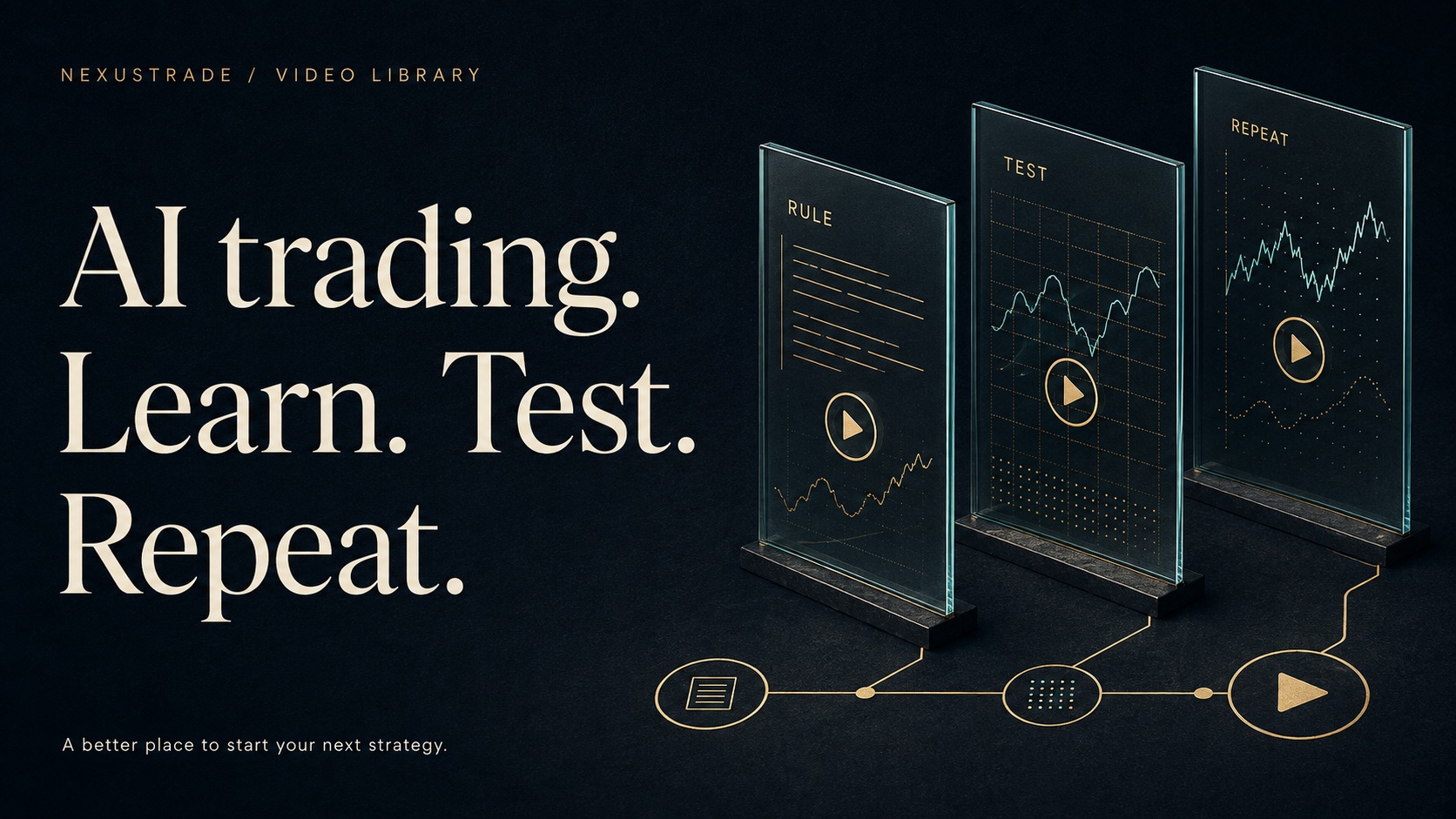
I'm launching NexusTrade Videos, a searchable video library for NexusTrade, the AI backtesting platform I run. It brings together the trading experiments, tutorials, and AI systems I've been building, with search that reaches inside every transcript. Remember a phrase about paper trading or agent memory? You can find the explanation without remembering the video title.
If you watch a video about a trading strategy, the obvious next questions are pretty specific. What were the rules? Which dates did you test? What happened during the drawdown? Where can I see the portfolio?
The links beside each video lead to its next step: a lesson, the public portfolio, or the data behind an experiment.
Free to watch; no account required.

01 / Open the library
Algorithmic trading and AI: what to watch first.
You can browse AI trading videos, algorithmic trading tutorials, and backtesting experiments separately. You can also switch to the longer lessons without digging through the shorts.
These are four places I'd start. They cover AI evaluation, a trading experiment, preparation for deployment, and a public portfolio.
Your first watch.
Browse everything ↗ ▶ 9:01
A deeper lesson / AI evaluation
How do you know if your AI agent works?
Go beyond a convincing demo. Learn how to evaluate an agent's results and find what needs to improve.
Watch the AI agent evaluation ↗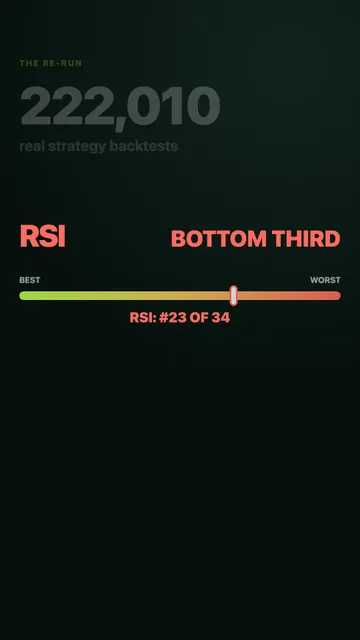 ▶ 0:51
Does this indicator help?
Does RSI Work? I Analyzed 222,010 Trading Backtests
Where RSI ranked, with the limits of the comparison included.
Ask about the archive ↗ ▶ 0:36
Is my bot ready?
20 things to do before you deploy an AI trading bot
A review of data bias, overfitting, validation, and paper trading.
Watch the checklist ↗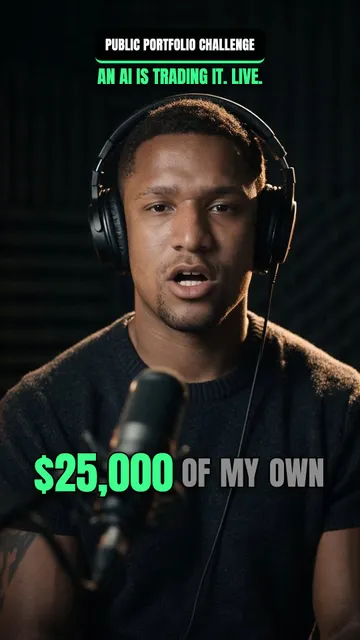 ▶ 0:47
What does this look like live?
I Put $25,000 Into an AI Trading Strategy
The Public Portfolio Challenge and the work behind the trading decisions.
Inspect the public portfolio ↗02 / Inspect the results
Backtesting RSI: what the results actually show.
Take the RSI experiment. I analyzed 222,010 backtests. Of the 34 indicator types that appeared in at least 500 results, RSI ranked 23rd by median Sharpe ratio, a measure of return relative to volatility.
For the comparison below, I narrowed the archive to daily equity strategies starting in 2020 or later. Within that subset, the median Sharpe was 0.87 for strategies without RSI and 0.51 for strategies using it.
Inside the backtest archive
Strategies using RSI had a lower median Sharpe.
Median Sharpe ratio · Daily equity strategies starting in 2020 or later
From the transcript
0:31"That is correlation, not proof that RSI caused worse results, because users chose different tickers and rules."Does RSI Work? I Analyzed 222,010 Trading Backtests
03 / Work through a lesson
Short experiments. Focused lessons.
Some walkthroughs take only a few minutes. The deeper lessons spend more time on one problem, such as evaluating an AI agent or deciding when it needs permission to act. You can also follow a whole series in order.
After the backtest
Read the results beyond the return.
Compare a strategy with its benchmark, then look at Sharpe ratio, Sortino ratio, and maximum drawdown. The evaluation lesson explains what each measure helps you see.
Watch the strategy evaluation ↗The AI agent architecture
See how an AI agent fits together.
Tools, the ReAct loop, memory, permissions, and evaluation all have a job. This overview connects them, with individual videos in the library when you want to explore one part further.
Watch the overview ↗Want exercises and a structured sequence too? Preview Algorithmic Trading Fundamentals or AI Agents from Scratch through the opening lesson. Each video series also has an optional interactive course.
Already testing a strategy? Watch the lesson on optimization and overfitting before you keep adjusting the rules. QuantConnect's research guide is a useful companion on overfitting and look-ahead bias.
04 / The production process
How the videos get made.
I explain the production approach in why I engineer videos instead of recording every take. A reusable voice clone, an avatar, and graphics built in code let me turn a script into a video without starting the filming and editing process from scratch each time. The avatar walkthrough shows the tools.
I still develop the ideas, do the research, and decide what is ready to publish. Some videos use my AI avatar and cloned voice; others are tutorials. A polished presentation still needs a result you can inspect, especially when money is involved.
A few useful answers
Before you pick a video.
What is NexusTrade Videos?
It's a place to follow what I'm building and testing, from trading rules to the software behind the platform. Browse a short experiment or work through a longer lesson.
Where should a beginner start learning algorithmic trading?
Start with the first Algorithmic Trading Fundamentals lesson. Continue with the videos on indicators, trading rules, backtesting, and deployment as those questions come up. The strategy-building short gives you a quick overview if you want to see the process first.
Are AI trading and algorithmic trading the same thing?
They overlap, but describe different things. Algorithmic trading follows a defined computational process. AI trading uses AI somewhere in the research or trading workflow. An AI assistant can help develop a strategy whose trading rules run without AI, and a trading algorithm can operate without machine learning.
Can I search for something said inside a video?
Yes. Try a term such as "paper trading" or "overfitting" in the library search. You don't need to remember which video it came from.
Do the AI trading videos prove a strategy will make money?
No. A historical backtest and a public portfolio record answer different questions, and neither guarantees future returns. AI-generated information can also be wrong. The SEC, NASAA, and FINRA's investor alert on AI explains why claims of guaranteed returns and reliance on unchecked AI output deserve scrutiny.
NexusTrade Videos is live
Your next backtest starts here.
Start with the backtesting walkthrough, then choose the lesson that answers your next question.
Keep watching. The email signup near the bottom of the library sends you a video you haven't seen, at a frequency you choose. You can also subscribe on YouTube for future uploads.
Find the video email signup ↗
No comments yet.