I lost $16,649 on NVIDIA. Here's why I bought more.
 8 min read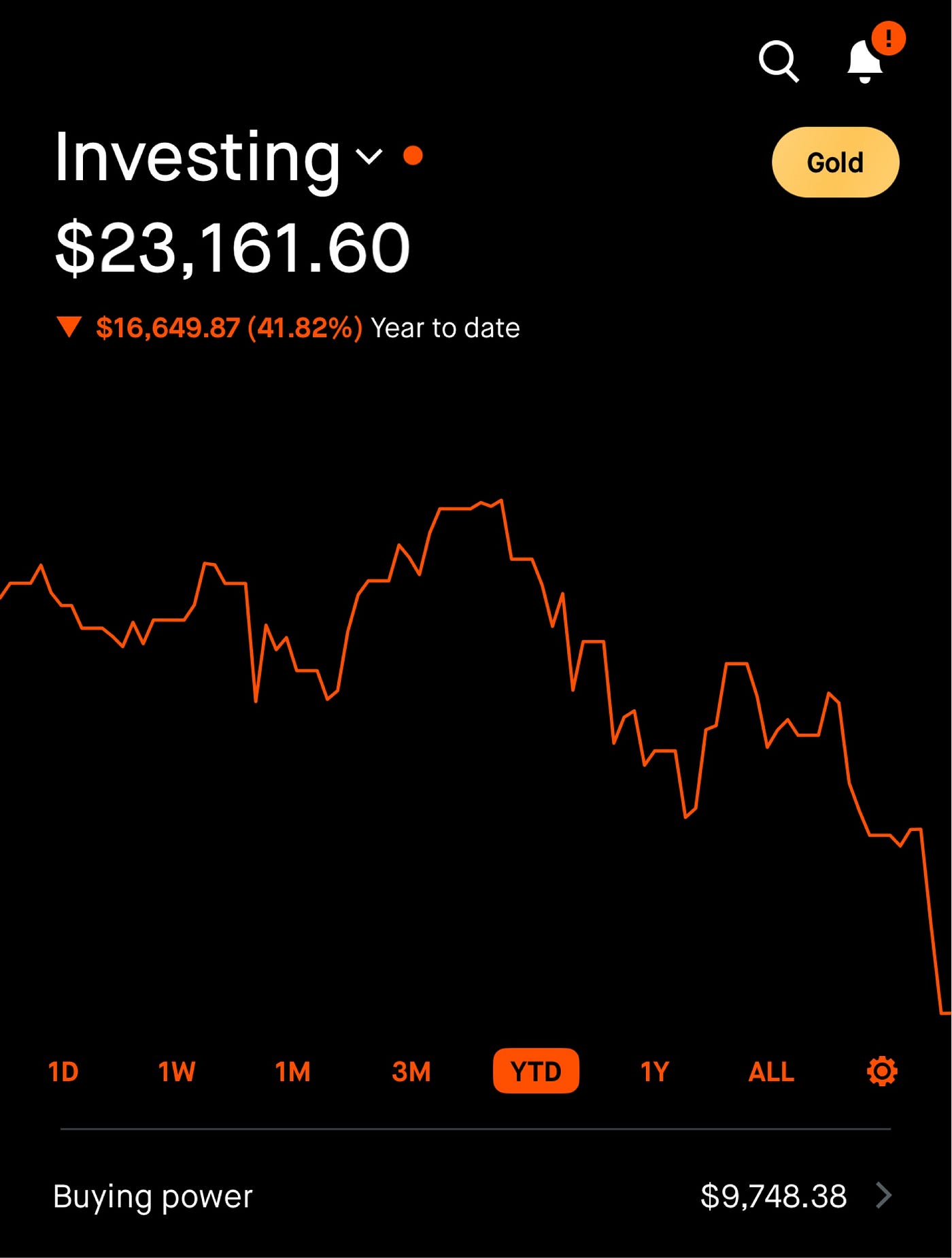
Before I describe why I bought more NVIDIA, I want to start this article with a strong disclaimer.
This is NOT financial advice.
The reason why I’m able to make such a risky decision is that I have saved enough money from my day job where if I lost this money, it would not significantly affect my quality of life. This investment strategy is extremely risky, and is not suitable for the vast majority of investors.
With that being said, I wanted to answer the question that I’m asked most often: what is my actual trading strategy?
Here’s why I decided to trade long-term call options on NVIDIA.
Describing how I built my trading strategy
My trading strategy is based on many of the leveraged strategies that I’ve backtested with my algorithmic trading platform.
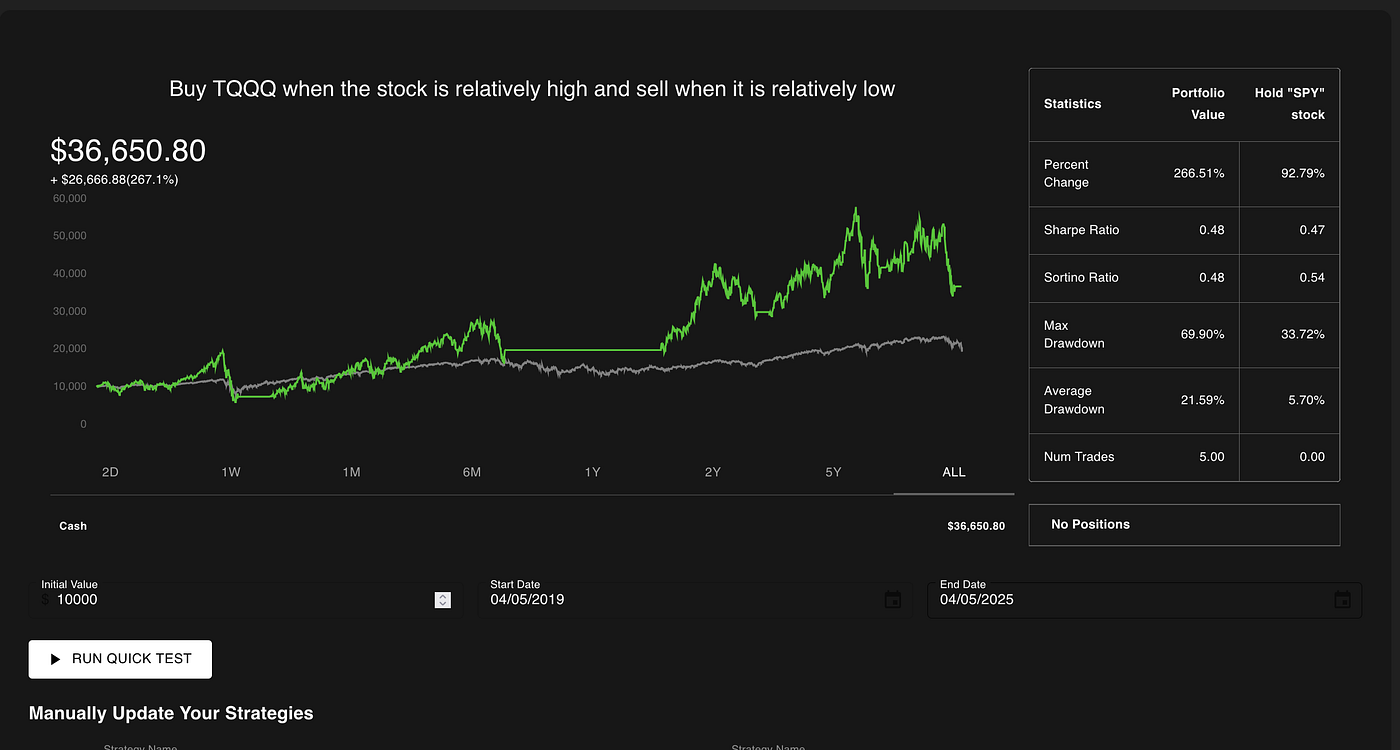
As someone who has seen the performance results of over 5,000 backtests, I’ve come to the conclusion that trading leveraged ETFs is one of the fastest ways to make outsized returns over the long run… at a cost.
An insane amount of volatility.
For example, take a look at the picture above. This TQQQ trading strategy earned more than twice as much as buying and holding SPY over the past 5 years (even after the massive drawdown this past week).
But at an extreme cost. The drawdown for the leveraged strategy is more than twice the drawdown of holding the S&P 500.
Simply put, from these backtests, I’ve learned that leveraged strategies are one of the fastest ways to “get rich quick”, if you’ve accepted the risk that you might quite literally lose it all.
With this in mind, here’s how I applied this knowledge to develop a NVIDIA options trading strategy.
Developing a NVIDIA options trading strategy
To deploy this strategy, I manually execute trades using Robinhood. However, I developed this strategy using the NexusTrade platform. Let me show you how.
NexusTrade does not natively support options trading (yet), so to develop the strategy, I used an alternative: NVDL.
NVDL seeks twice NVIDIA’s daily percentage return before fees and expenses. That is a daily target, not a promise of twice NVIDIA’s return over a year: resetting and compounding make the longer-period path matter. Read the historical issuer report.
NVDL is the ETF proxy used in the next backtest. It is not my actual NVIDIA option position: it does not supply the calls’ strike, expiration, premium or payoff. Those contract details are absent here, so this test cannot show whether my calls recover before they expire.
Let’s start with the base-case. Let’s assume NVIDIA goes up 20% in the next year. This is far more than the average of SPY’s 10% per year.
Let’s create a strategy that beats the market assuming this happens.
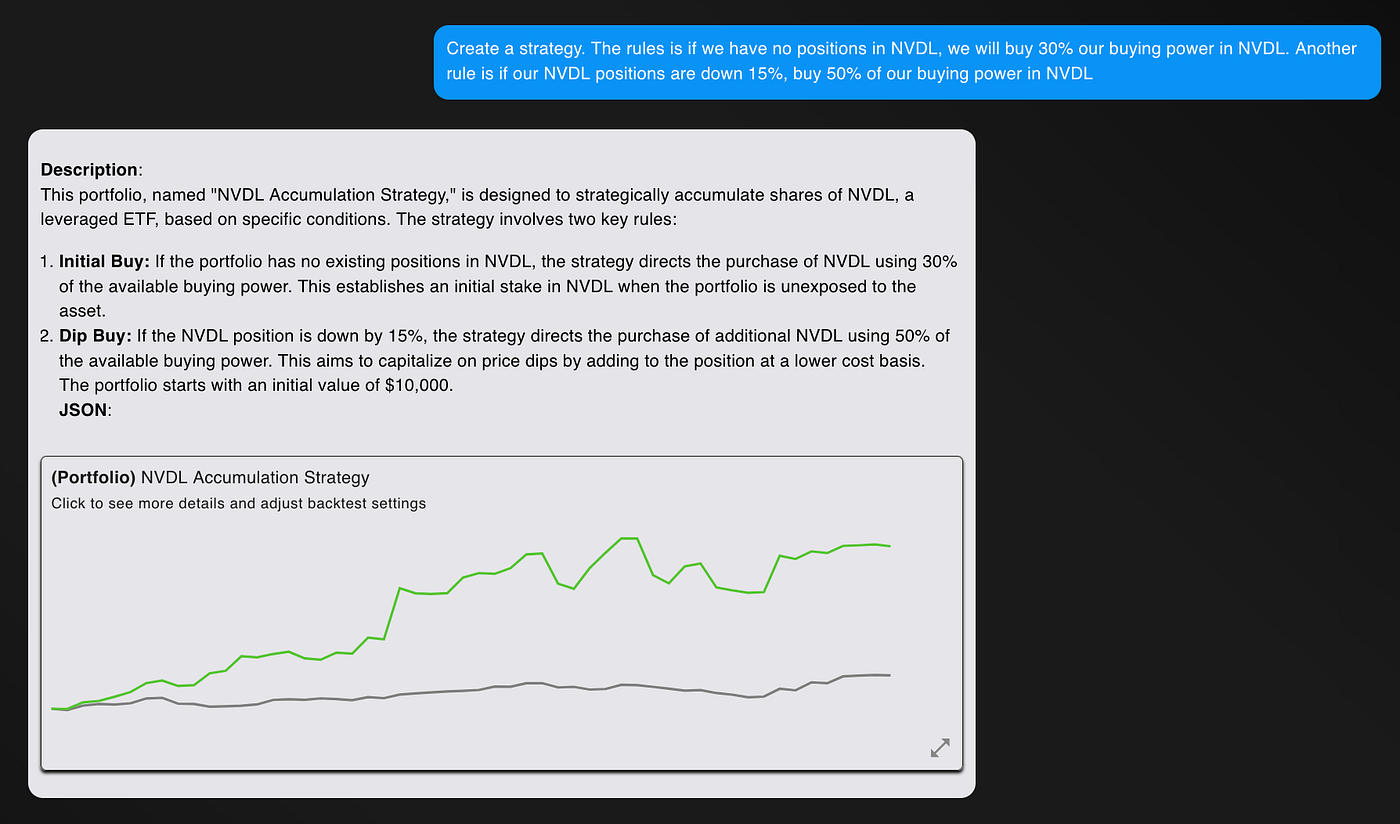
Create a strategy. The rules is if we have no positions in NVDL, we will buy 30% our buying power in NVDL
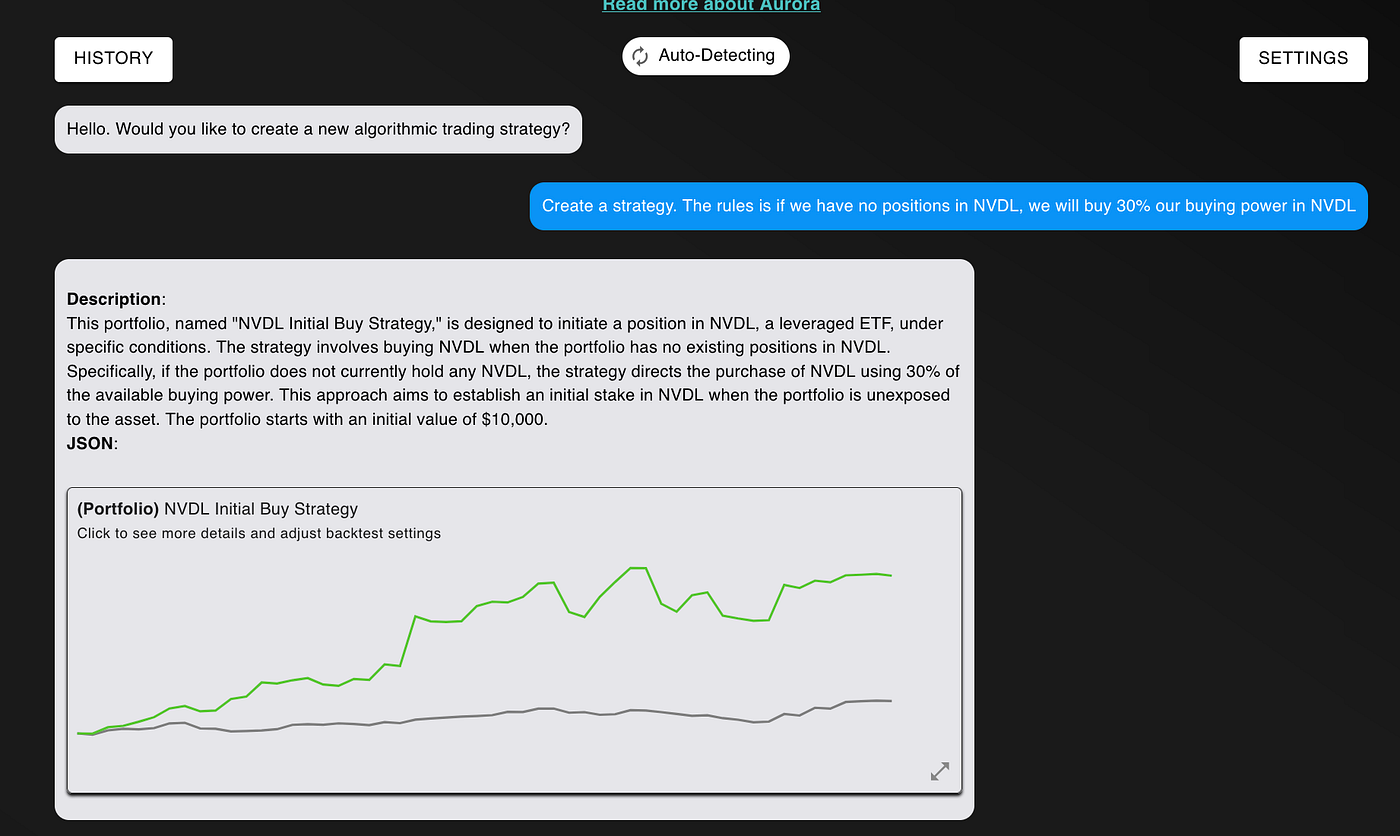
Specifically, if we look at the performance, this strategy gained 125%, while SPY gained 25%. It also had a higher sharpe ratio and sortino ratio than holding SPY during this period.
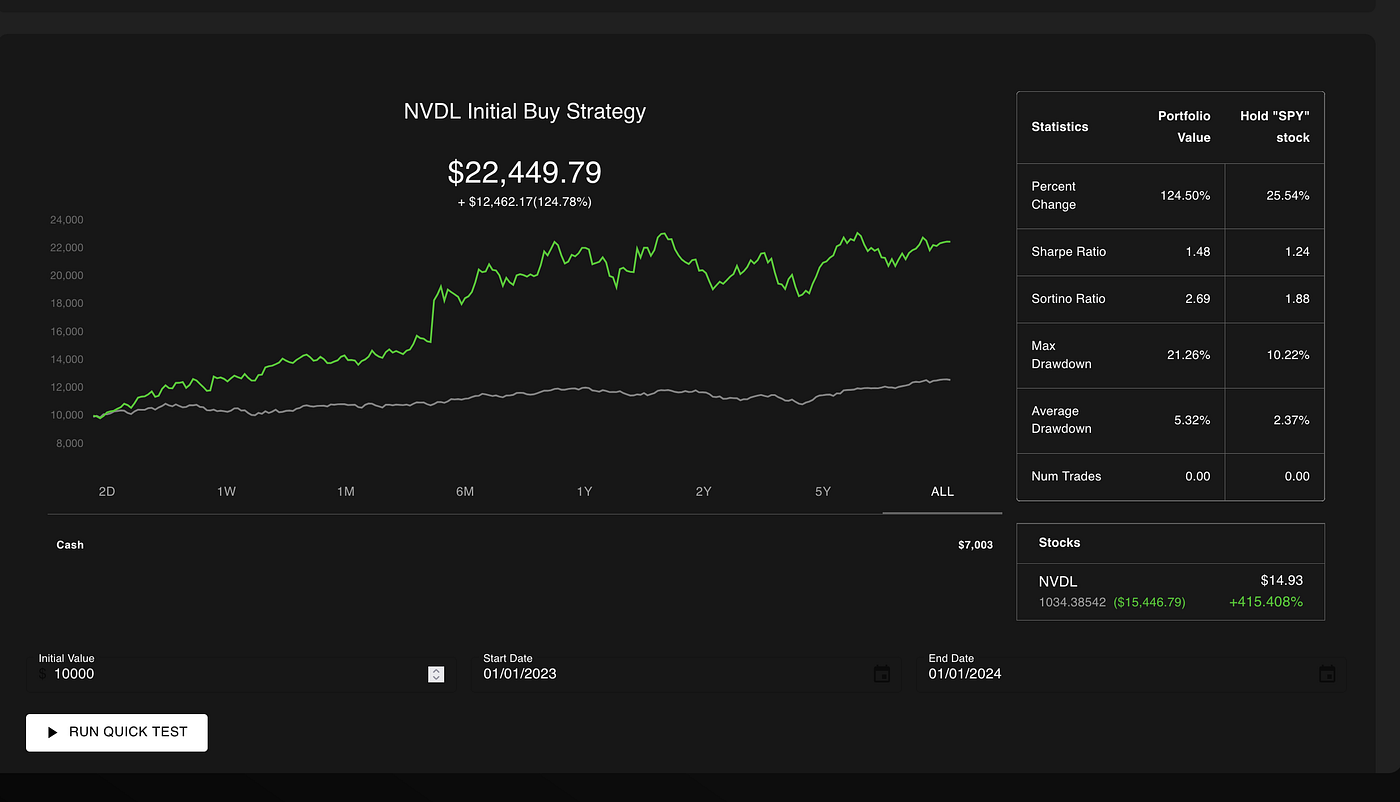
This was the assumption that I made. I assumed that NVIDIA would go up 20% because of advancements in artificial intelligence led by NVIDIA’s monopoly on GPUs.
I was wrong. So I had to deploy my contingency plans.
Context: Why did I choose NVIDIA?
Before I discuss my contingency plan, I want to talk about why did I choose NVIDIA in the first place.
It’s the best stock on the planet.
Fundamental Analysis
The reason why I chose NVIDIA over any other stock or cryptocurrency can be summed up in one picture.
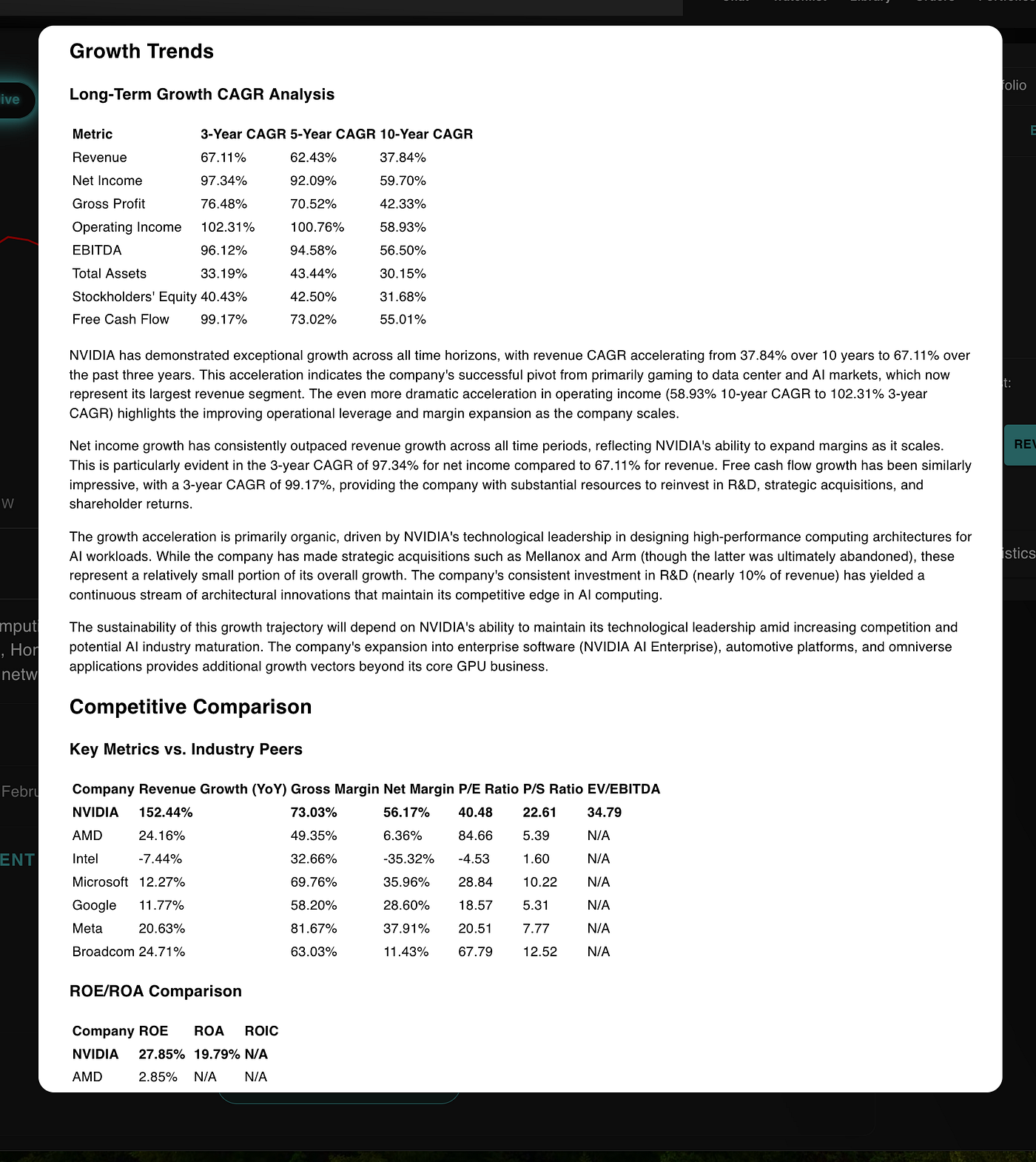
This is the growth trend analysis for NVIDIA. As someone who has seen similar analyses for over 1,000 stocks, including Apple, Amazon, Google, AMD, and Meta, I have quite literally never seen a stock growing so fast.
In this screenshot, it shows a 40% 10-year CAGR for NVIDIA’s revenue. 40% annual growth is genuinely mind-blowingly insane. I mean, for most companies, 10% is considered amazing. And I’m not making this up.
For instance, let’s look at the most valuable company on Earth: Apple.
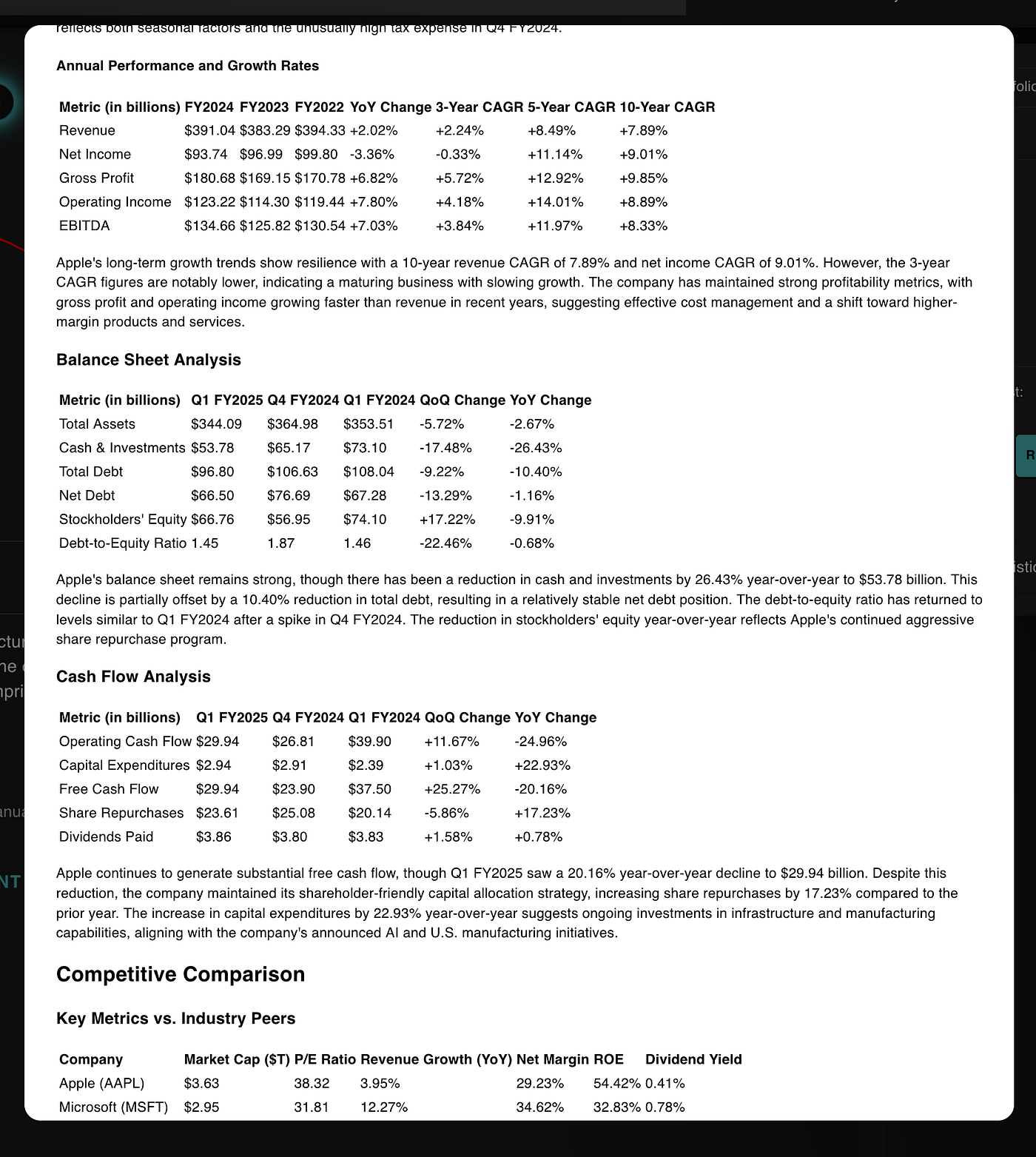
In comparison to NVIDIA, which has a 40% 10-year CAGR, Apple has an 8%. Their 3-year CAGR is even worse, at 2.24%.
NVIDIA’s 3-year CAGR is 70.
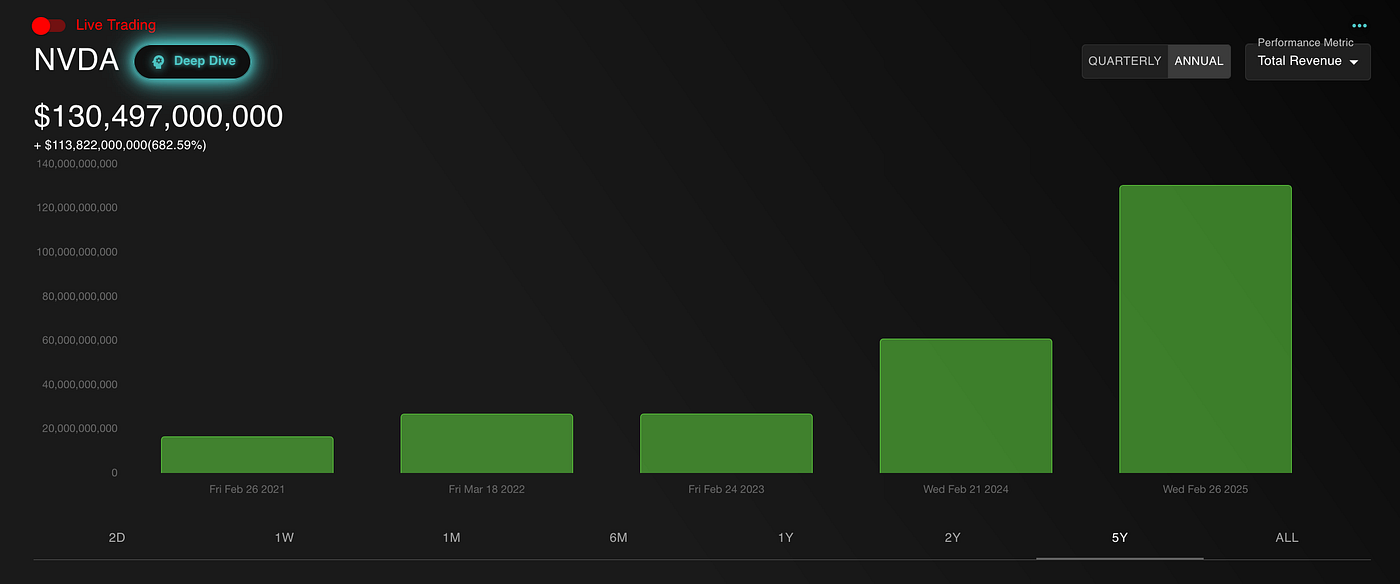
So, while tech giants like Apple are barely growing at all, NVIDIA is printing cash unlike anything we’ve ever seen. Even if NVIDIA’s revenue is completely flat on the year (which it very likely would not be with innovations like Blackwell), they still have a compound annual growth rate that destroys even the best stock in the world.
Domain Expertise
With this fundamental analysis, I combined it with my domain expertise in artificial intelligence.
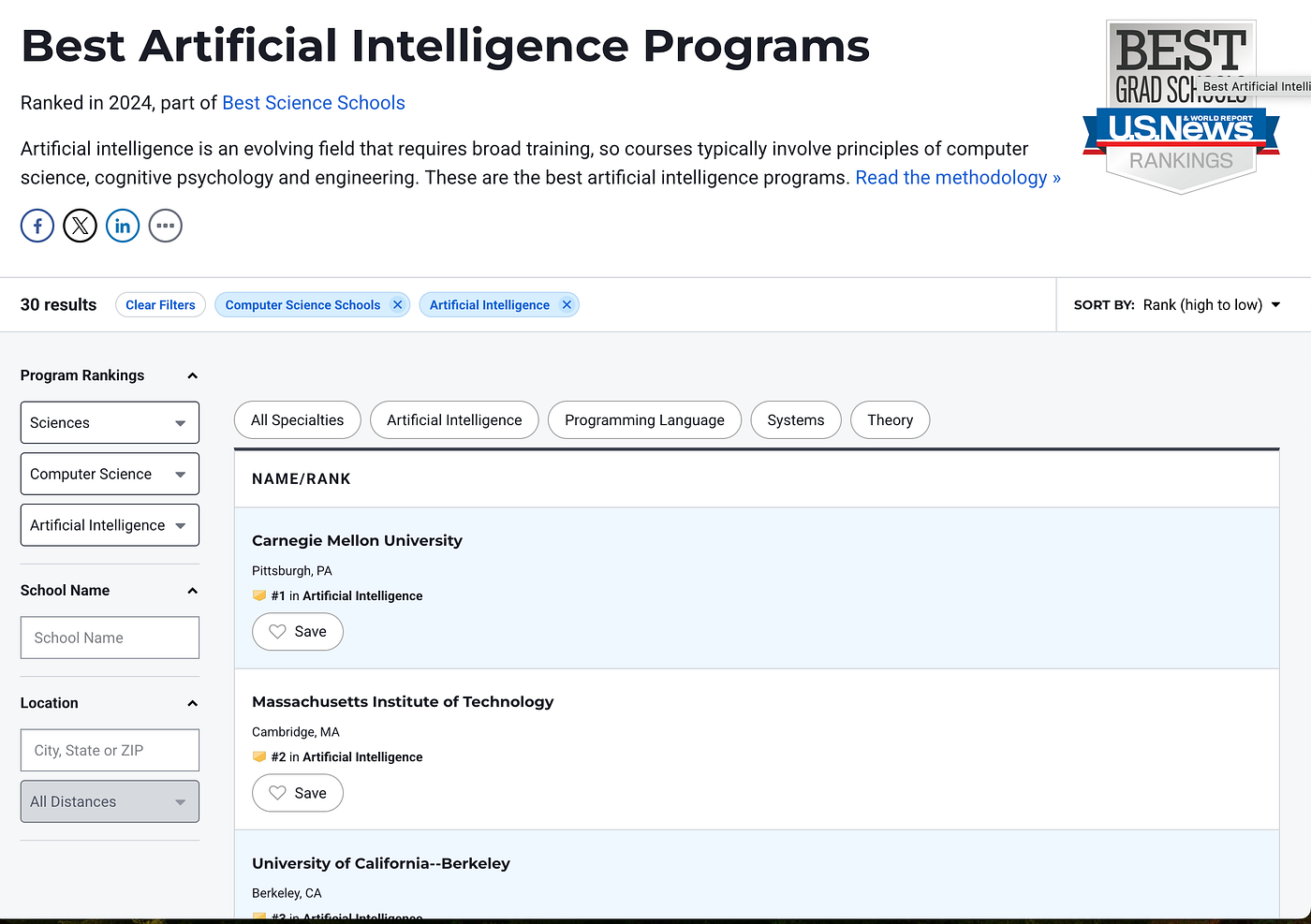
I’ve loved AI even before it was cool. I took a course called Introduction to Artificial Intelligence when I was completing my Bachelors in Computational Biology at Cornell University. Then, still enthralled, I took the hardest course in my entire life, Intro to Deep Learning, when I was getting my Masters in Science in Software Engineering from Carnegie Mellon (the best school in the entire world for artificial intelligence).
After graduating, I kept working in AI, and built the first platform that uses AI to help retail investors make smarter investing decisions.
NexusTrade - No-Code Automated Trading and Research
Perform financial research and deploy algorithmic trading strategies
nexustrade.io
I say all of this to say: I know artificial intelligence VERY well. I know that we are not slowing down in AI progress. In fact, I would dare say we’re going even faster. GPT’s image generator, Perplexity’s Deep Research tool, and Anthropic’s Claude 3.7 Sonnet are innovations made in the past two months that would’ve been jaw-droppingly useful 2-years ago.
Now? It just feels like an everyday occurrence.
And the applications for this are insane.
- Video games: one of my dreams is to build a competitor to the Elder Scrolls V: Skyrim. Being able to generate ALL of the assets using AI? All I would need to do is apply my creativity. I’m very good at that.
- Movies: imagine any Benjamin Jones who graduated from Dartmouth with a degree in writing. He can, quite literally, put his degree to use, and create feature-length films with just $25,000 and OpenAI’s Sora.
- Software development: this should be self-evident to any software engineer. Tools like Cursor are not going away.
- Marketing: with GPT’s newest image generator, creating marketing images has never been easier.
- Sales: with tools like LeadGenGPT, it has never been easier to do cold outreach campaigns.
I’m willing to bet my entire Robinhood account that NVIDIA’s revenue does not slow down DESPITE the tariffs. If I’m right and NVIDIA’s stock continues to fall, I will deposit $25,000 and buy even more.
Activating my contingency plan
As I mentioned in the beginning, I made an assumption about NVIDIA’s future returns. This assumption was violated in the worse way possible.
Specifically, instead of gaining 20% from starting the position like I thought, NVIDIA has fallen drastically.
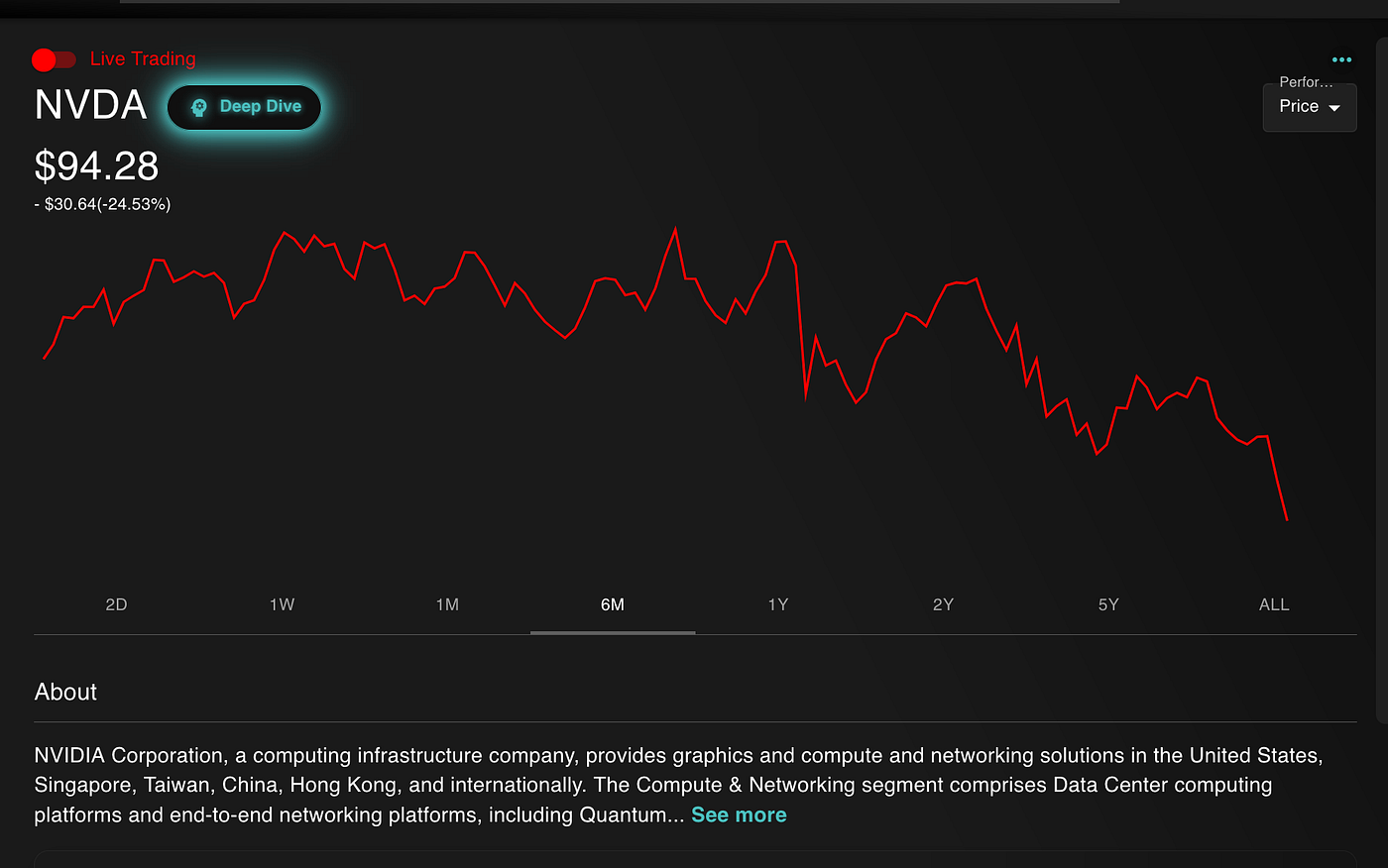
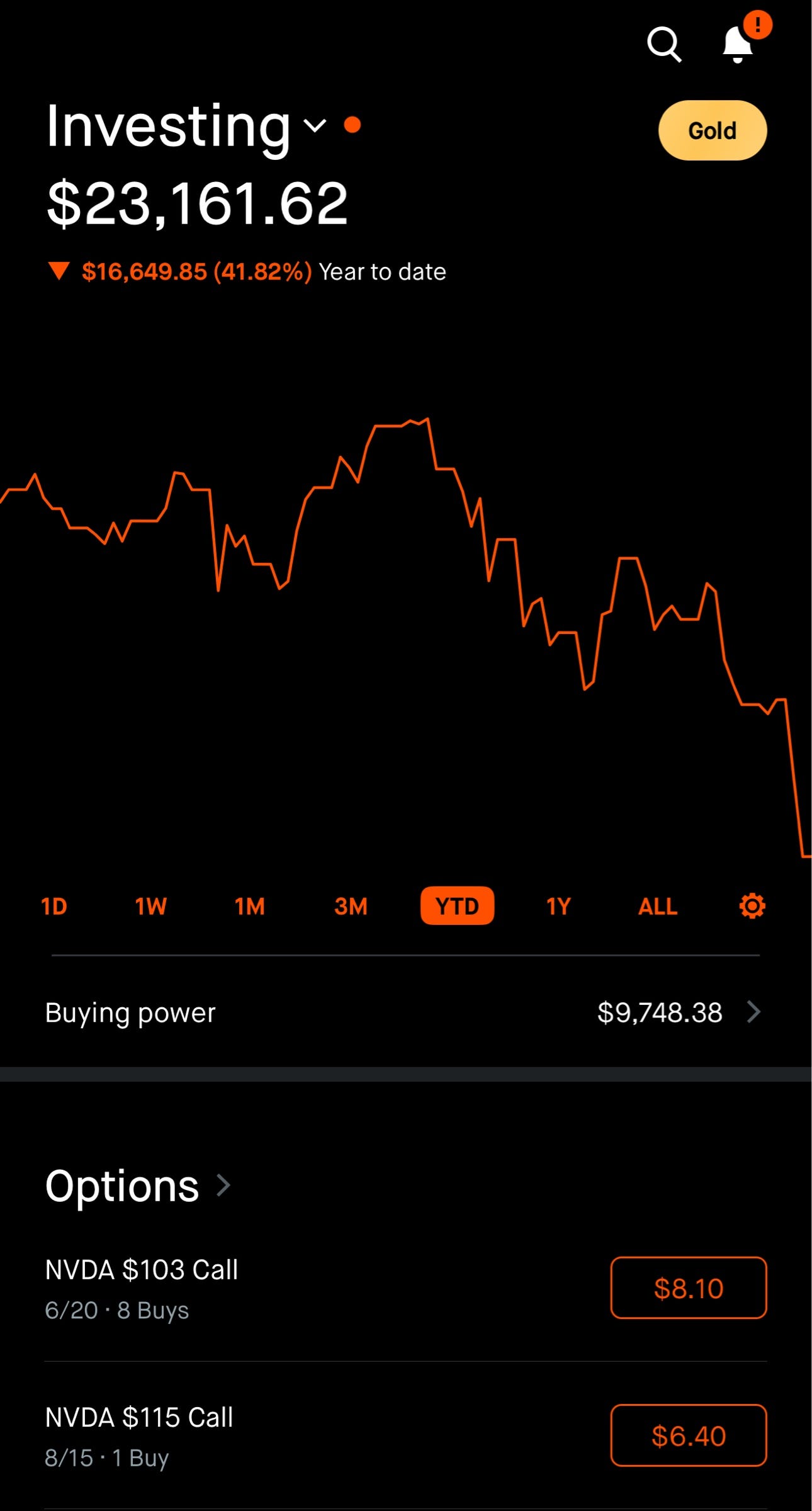
In the past 6 months, NVIDIA has fallen 25%. Holding options, I experienced a significant setback, losing over 41% year-to-date.
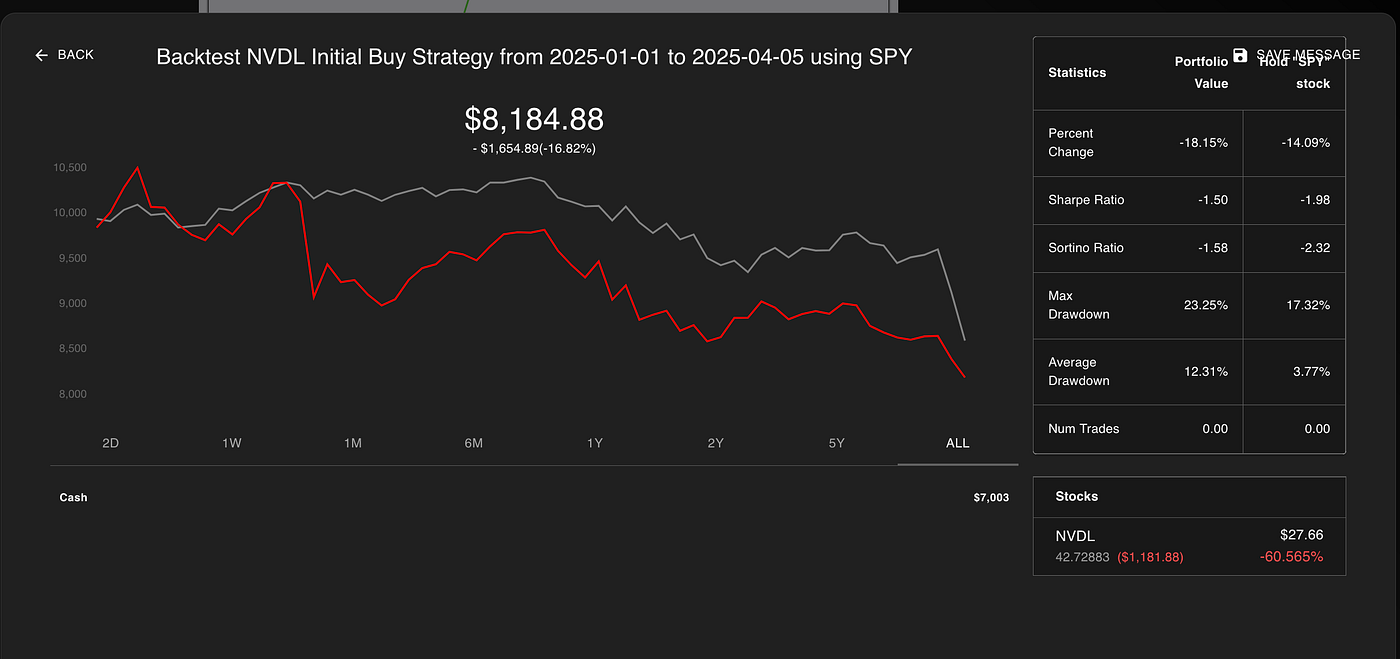
Believe it or not, this actually closely aligns with what you’d see in the backtests with NVDL.. of course less dramatically.
According to the backtests, the way I’ve seen to survive this is simple.
Hold and buy more.
NVDL rules: Buy 30% of buying power when no NVDL position is held. If the NVDL position is down 15%, buy another 50% of remaining buying power.
TQQQ rules: Apply the same two conditions separately to TQQQ.
Illustrative cash arithmetic: Starting with $1,000, the first purchase uses $300 and leaves $700. If a later qualifying purchase occurs, 50% uses $350 and leaves $350; another would use $175. These figures exclude costs. The article does not supply the evaluation schedule or repeat-entry controls, so this arithmetic does not establish when repeated purchases actually occur.
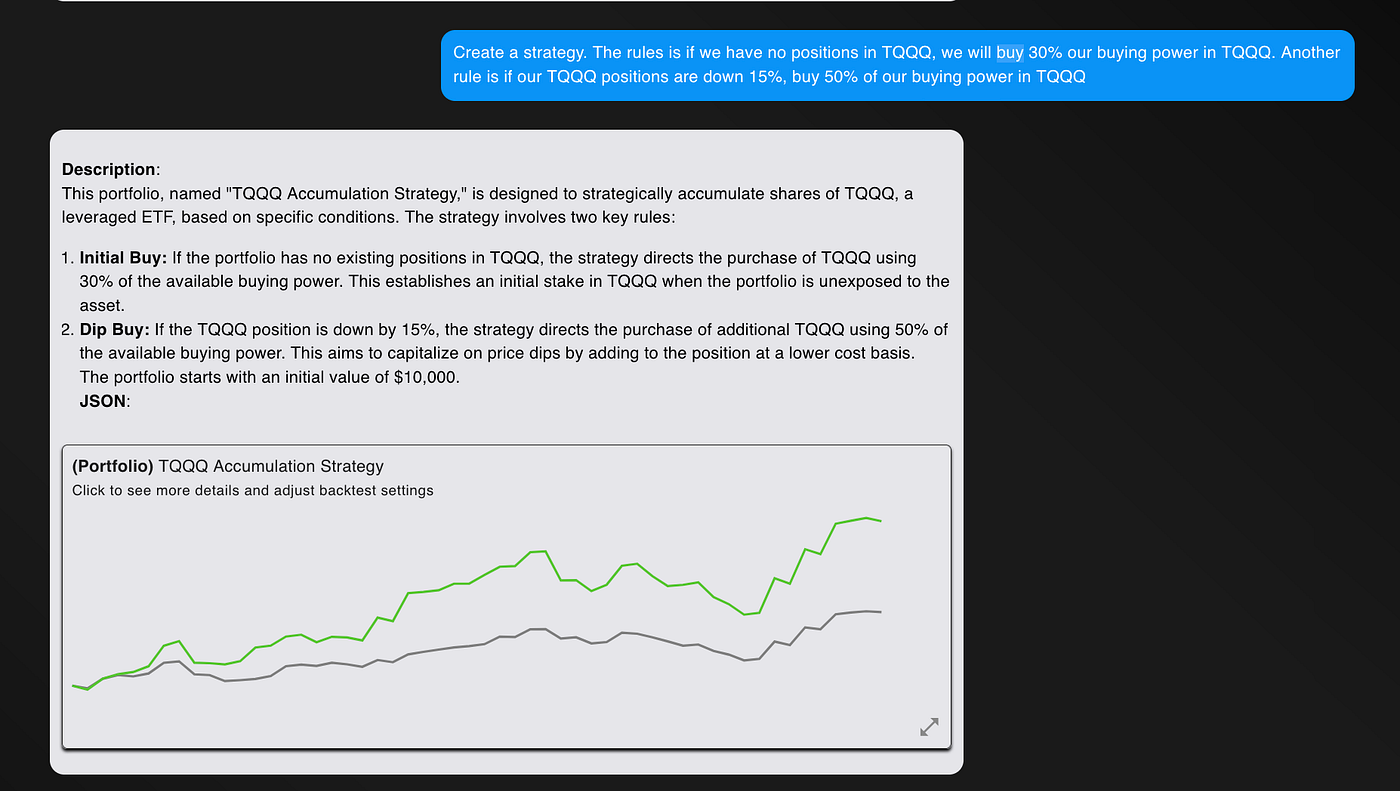
By adding a new trading rule, we can attempt to recover losses by buying more when the stock is low. For instance, let’s look at the following backtest.
backtest both across Covid
I created a new strategy for TQQQ to demonstrate what happened during Covid. NVDL is a new stock, and didn’t exist in 2020.
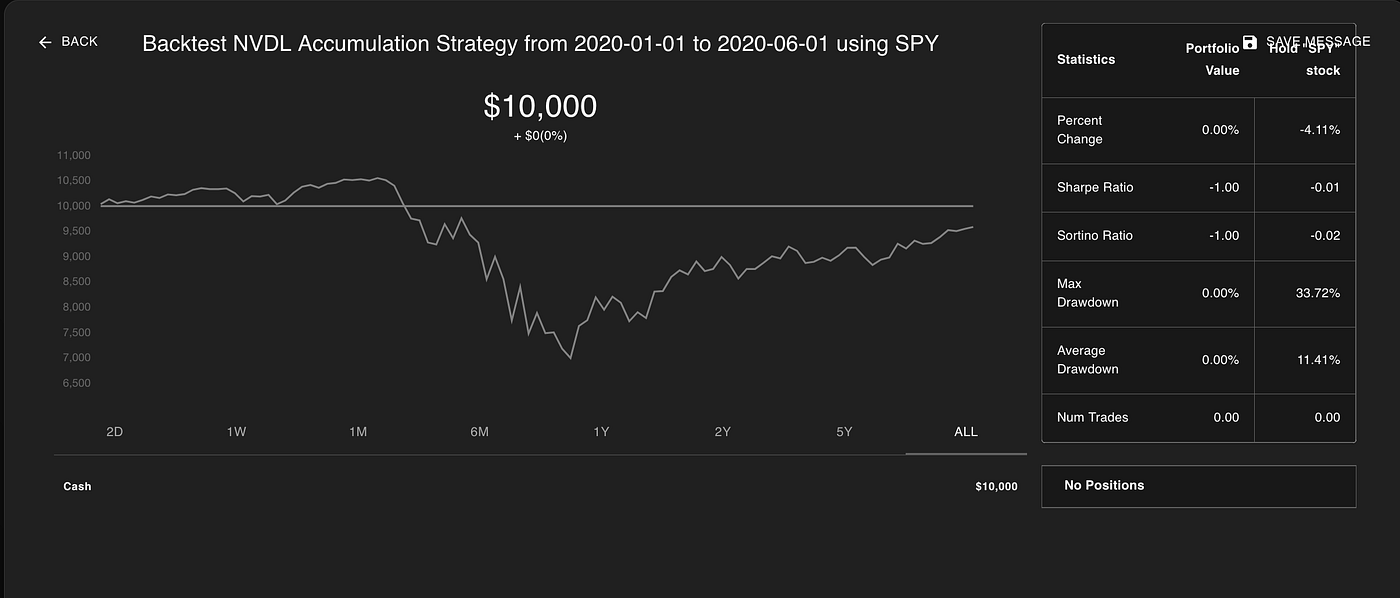
The next test is a separate TQQQ ETF illustration during COVID. NVDL had no history for that period. TQQQ is not NVIDIA, and this test has no NVIDIA call strike or expiry, so it cannot establish recovery of my option position.
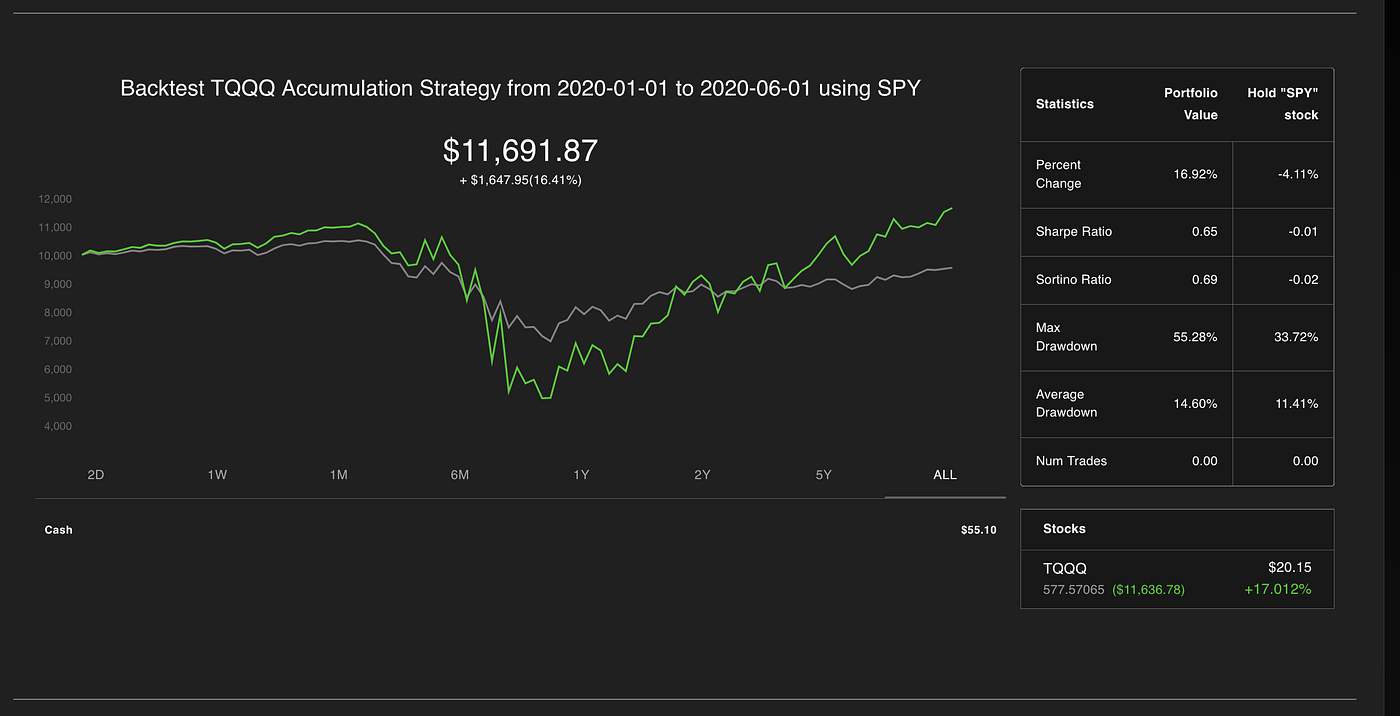
In this selected TQQQ backtest, the strategy returned 17% while SPY lost 4%. Repeated purchases use remaining buying power and can exhaust available cash. This one ETF result does not establish survival through other bear markets or recovery of the NVIDIA calls before expiration.
And if it doesn’t then 🤷🏾♂️. I accepted the risk when I purchased my first option. I’m ready to accept the consequences.
Concluding Thoughts
As I’ve said from the beginning, this is not a strategy that I’d recommend to the vast majority of people. I’m in an extraordinary place in my life to deploy such a risky strategy.
Nevertheless, I wanted to be transparent.
I’ve shown you my trading strategy, my significant losses, and why I’m doubling down on NVIDIA despite the recent downturn. Because here’s what I believe.
NVIDIA’s fundamental growth metrics are unmatched in the market. AI adoption WILL continue to accelerate, and leveraged strategies, while volatile, can deliver exceptional returns when deployed with proper risk management and conviction.
The selected ETF backtests show why I considered adding to a losing position. My April 2025 decision remains a personal thesis; without the actual calls’ strikes, expiry, premiums and purchase records, these proxy tests cannot demonstrate the outcome of my options.
If you’re interested in researching and backtesting your own trading strategies, I invite you to try NexusTrade, the platform I’ve built and used throughout this analysis. You can create your own algorithmic trading strategies without writing code, test them against historical data, and make more informed investment decisions.
NexusTrade - No-Code Automated Trading and Research
Perform financial research and deploy algorithmic trading strategies
nexustrade.io
Whether you’re a seasoned investor or just starting out, having data-driven insights can transform how you approach the market. Just remember — always invest responsibly and only risk what you can afford to lose.
No comments yet.