AI stocks did something weird last year and nobody is talking about it
Austin Starks · Originally published
 5 min read
Imagine investing $500 per month for 30 years. If you do the math, you would’ve invested $180,000 in that timeframe. How much money do you think you’d have?
If you were a smart investor, and threw it at the S&P500, you would have a whopping $1.1 million! That’s insane right? That’s assuming a booming 10% per year — the historical average for the S&P500 for the past 100 years.
But the last two years were weird.
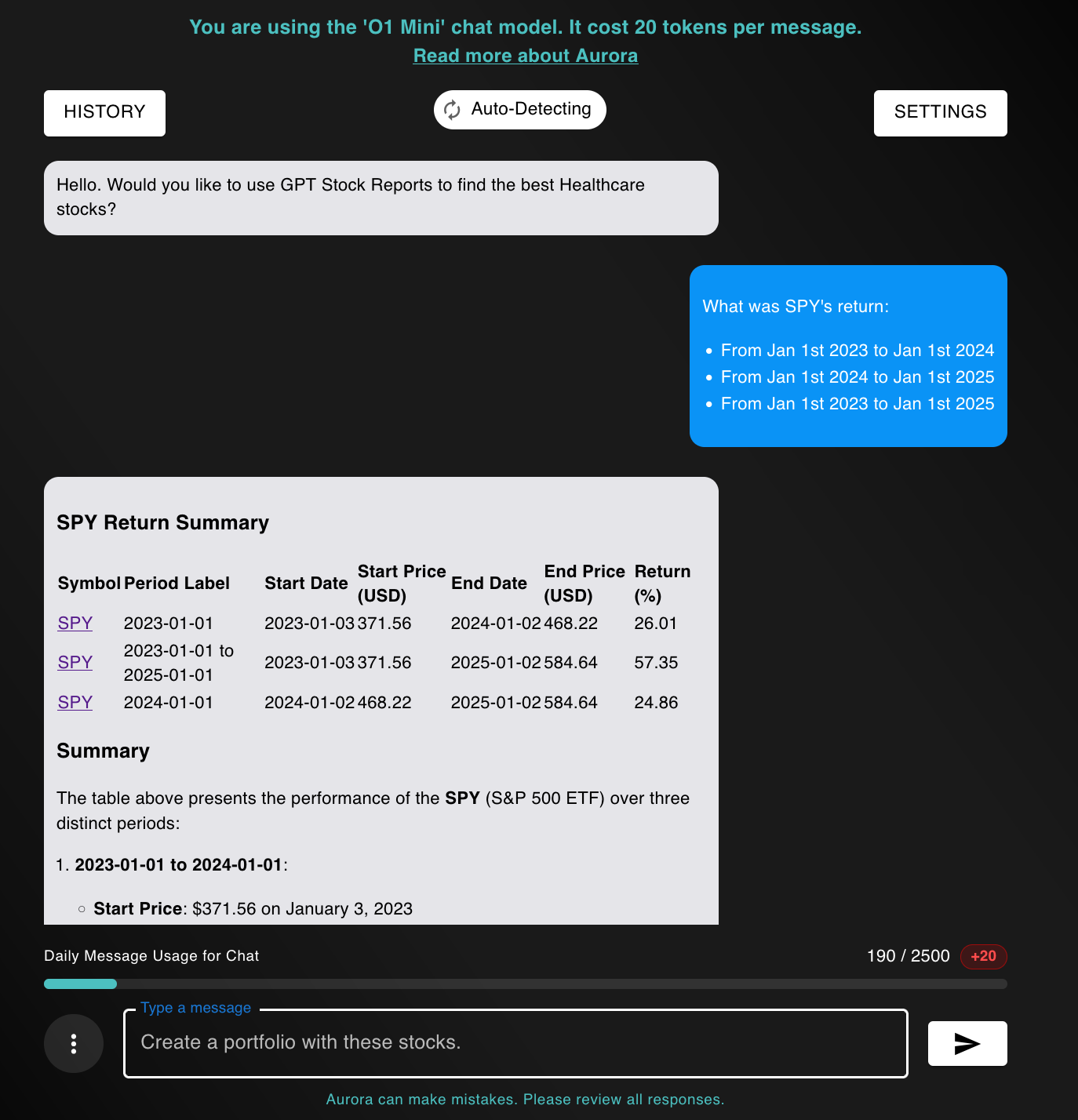
The two-year window discussed here runs from January 1, 2023 to January 1, 2025. The archived answer reports about 57% for SPY across that span. For comparison, compounding a hypothetical 10% annual return for two years gives 21%.
Those are the rounded historical figures printed in the January 2025 answer. The excerpt does not identify whether its SPY calculation uses price return or dividend-reinvested total return; that convention needs to match before comparing it with another series.
What is going on?
It might be a side effect of AI.
A Market Melt-Up (Fueled By Artificial Intelligence)
When I saw these returns, I was extremely curious.
What could be driving this rally?
I knew stocks like Tesla, NVIDIA, and other technology stocks saw massive gains these past few years. And then it hit me…
Could this rally be fueled by AI hype?
Here’s how I found out.
I used NexusTrade, a natural language stock analysis tool, to analyze stock returns since 2023.
NexusTrade AI Chat - Talk with Aurora
Talk to an AI assistant to perform financial analysis and create algorithmic trading strategies.
nexustrade.io
NexusTrade allows you to uncover patterns in the market using natural language. I asked Aurora the following:
What was SPY’s return:
- From Jan 1st 2023 to Jan 1st 2024
- From Jan 1st 2024 to Jan 1st 2025
- From Jan 1st 2023 to Jan 1st 2025
With the following groups:
- SPY
- All stocks
- All technology stocks
- All AI stocks
- All non-technology stocks
- All non AI stocks
This was our result.

Now before discussing these crazy results, let me talk to you about the rationale for these groups.
Did I pull these groups from thin air?
These groups were chosen deliberately. I was curious if tech stocks were driving the stock market rally, if AI stocks were, or if there wasn’t a correlation.
Ideally, I’d be checking for the stocks within the S&P500. Unfortunately, NexusTrade doesn’t have access to that data. So I went with all stocks instead. A more robust analysis would include historical S&P500 stock participants.
Nevertheless, we can still find some interesting patterns in our data.
Breaking down our results
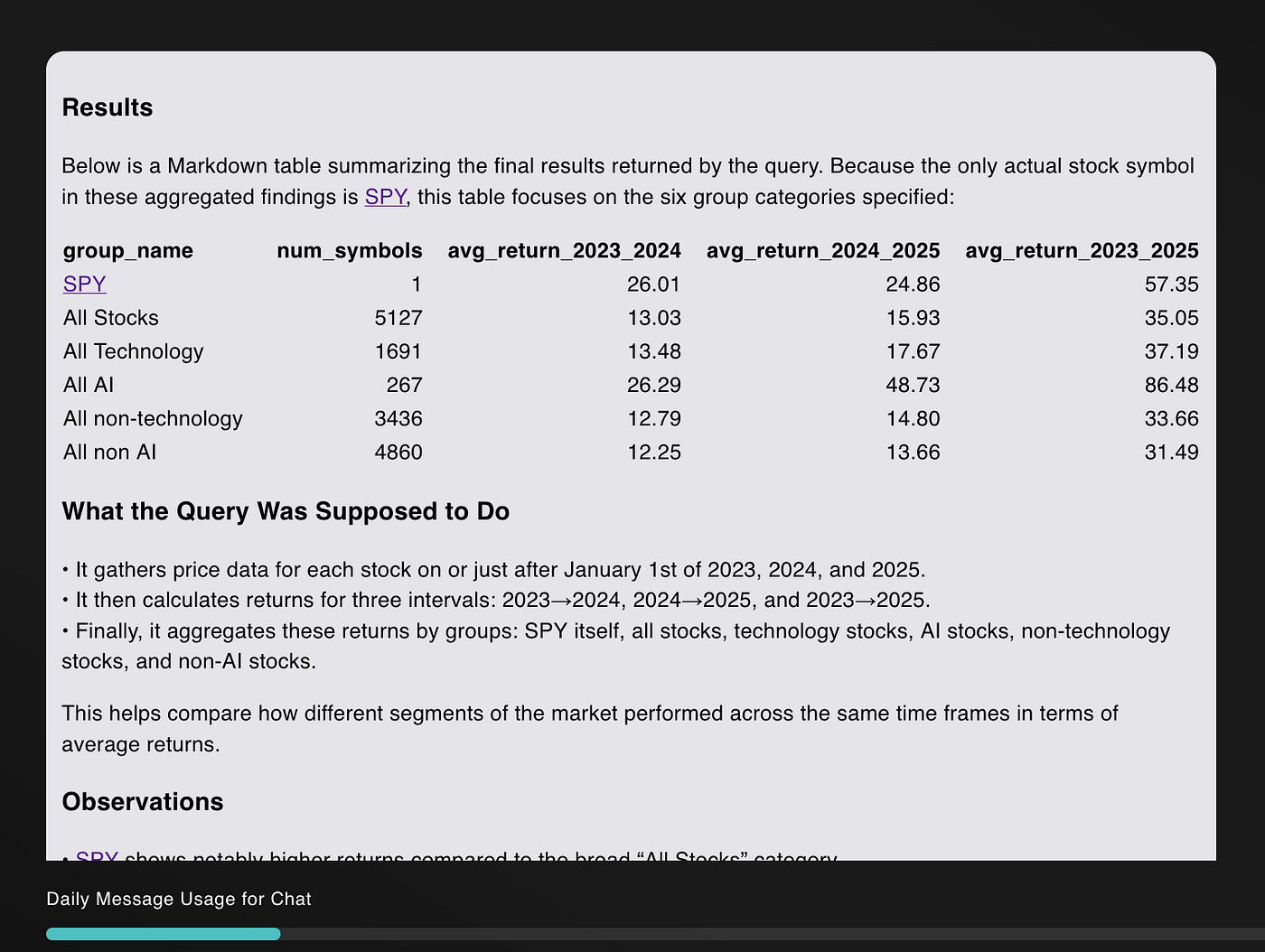
From the screenshot, we can see that all US stocks in our dataset had an average return of 35% in the past two years. This is more in line (but still a tad bit higher) with what we’d expect from the S&P500.
“All stocks” means the stocks covered by that dataset, not the historical S&P 500 membership. This excerpt does not print the group counts, excluded names, classification dates or averaging weights. The reported stock-group average and SPY’s own return therefore need separate definitions. The share link below preserves the original conversation for inspecting those inputs.
If we looked at non-technology and non-AI stocks, the percent decreases slightly to 34 and 31% respectively. Technology stocks are similar – at 37% in the past two years.
The only massive outlier is artificial intelligence stocks.
The reported AI-stock group gained 86% across the two years. Using the printed rounded returns, 86% / 35% is about 2.46 times the covered-stock average return, and 86% / 57% is about 1.51 times the reported SPY return. Those are return ratios, not percentage-point differences.
That is BEYOND insane.
SPY and Stock Market Returns Analysis (2023-2025)
An analysis of SPY's returns compared to various stock categories, including all stocks, technology stocks, AI stocks…
nexustrade.io
What could this mean?
The stark outperformance of AI stocks may stem from several factors. First, the explosion of generative AI technologies in 2023 and 2024 created unprecedented demand for AI hardware and services, driving revenue growth for leaders like NVIDIA.
Additionally, institutional investors may have disproportionately allocated funds to AI-related companies, fueling further price increases. However, the hype cycle in technology often leads to overvaluations, which could pose risks if growth fails to meet lofty expectations.
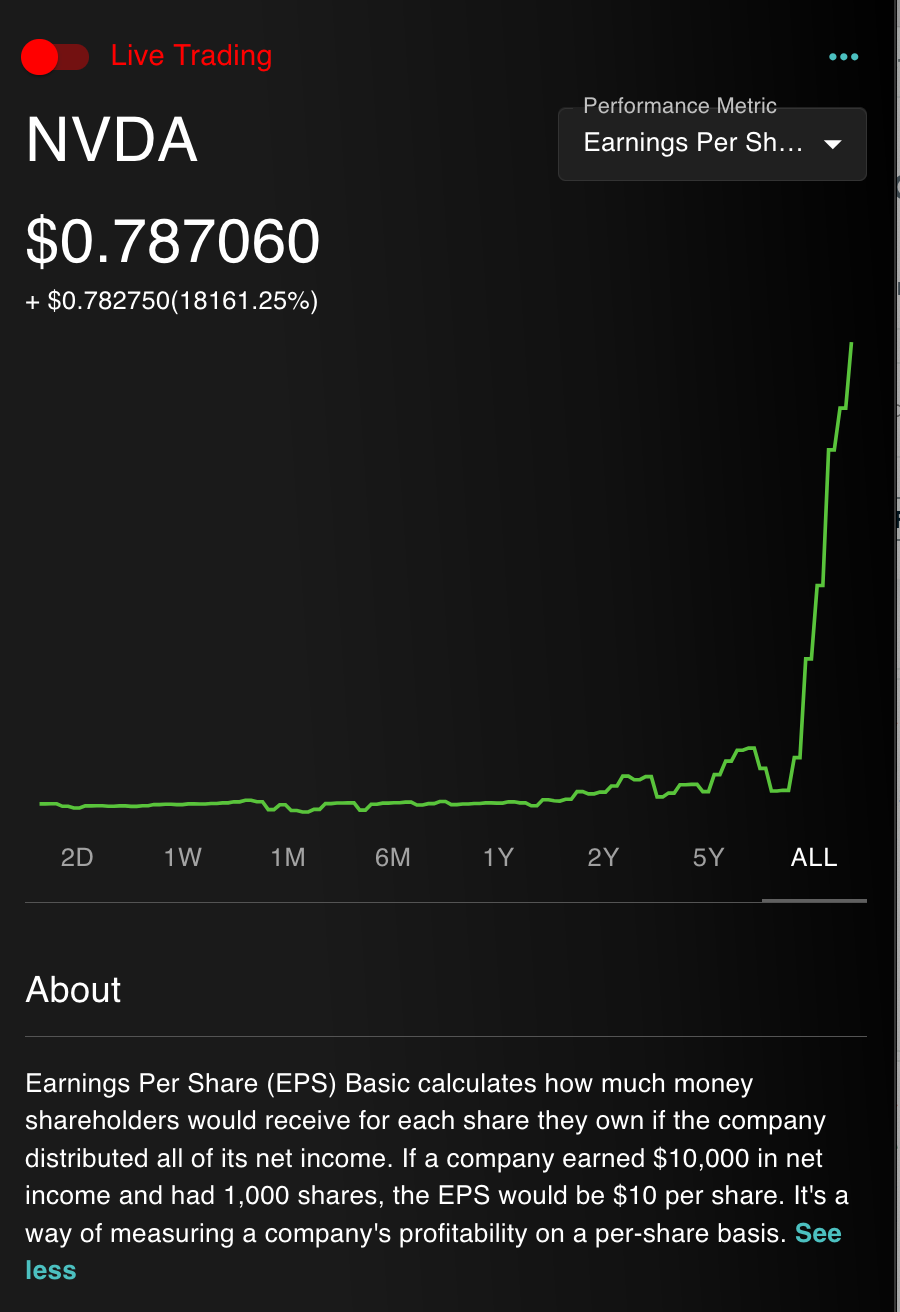
For example, when we look at some AI stocks like NVIDIA, they are printing cash and earning more money, faster than any company in the history of the world.
However, when we look at stocks like AMD, we can see that it underperformed, with peaks and troughs in metrics like its earnings per share and net income.
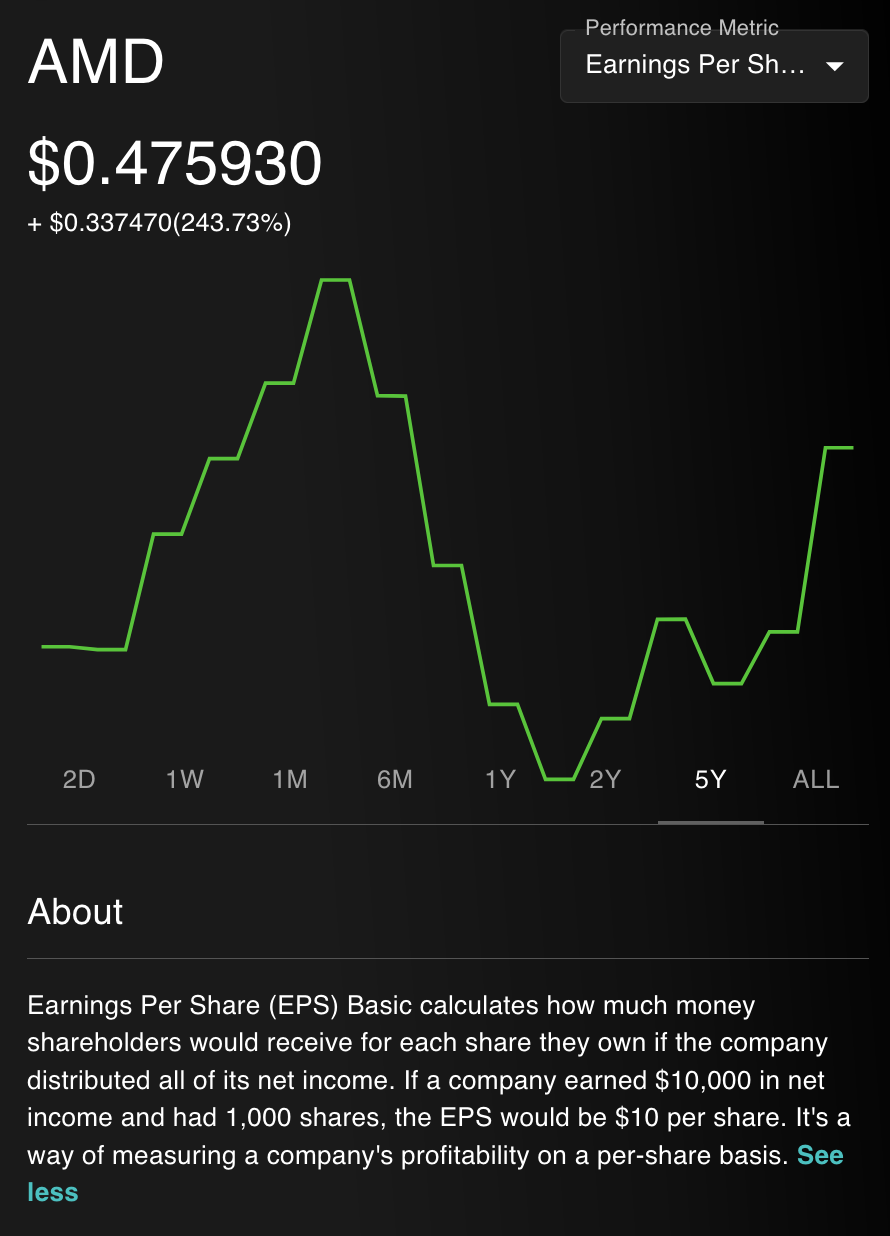
These examples suggest questions about earnings growth, demand and valuation. The group-return comparison itself does not isolate the cause of the rally: membership, weights and exposures can also affect the result. Treat the explanations above as hypotheses to test against company and portfolio data. The 2025 outlook below is the original January 2025 forecast.
Unfortunately, my crystal ball broke last week, so I’m unable to say for sure whether this trend towards AI stocks will continue, or if this group of stocks is in for a rude awakening in 2025. While the market seems confident that AI is the future, this enthusiasm comes with risks.
History has shown that rapid sector-specific rallies, like the dot-com bubble of the late 1990s, often lead to corrections. Additionally, broader economic factors — such as interest rate hikes, tariffs, or shifts in global supply chains — could impact AI stocks disproportionately, especially those with weaker fundamentals.
As a concrete example, the increase in interest rates in 2022 demolished the tech industry as a whole. With President Elect Trump threatening tariffs on all of our allies, we may see a similarly disproportional negative effect on stocks like NVIDIA and Apple, which rely on other countries to manufacture their products.
Only time will reveal what happens next, but being cautious and staying informed is a safe bet.
Concluding Thoughts
For January 2023 to January 2025, the reported average return of the selected AI-stock group was 86%, compared with 35% for the covered-stock average and 57% for SPY. That is about 2.46 times the covered-stock average return and 1.51 times SPY’s return. The article’s missing cohort-selection details still matter when interpreting this historical comparison.
NexusTrade makes this type of analysis easy. It has a natural language analysis interface that allows anybody to find REAL insights from historical stock data.
Will this AI-fueled market melt-up continue in 2025? Or will the bubble burst, burning many investors who hopped in late? The market’s enthusiasm for AI suggests optimism, but only time will reveal whether these expectations are justified — or overblown.
What do you think? Share your thoughts in the comments below. Let’s discuss where the market might be heading next!
NexusTrade - AI-Powered Algorithmic Trading Platform
Learn to conquer the market by deploying no-code algorithmic trading strategies.
nexustrade.io
No comments yet.