

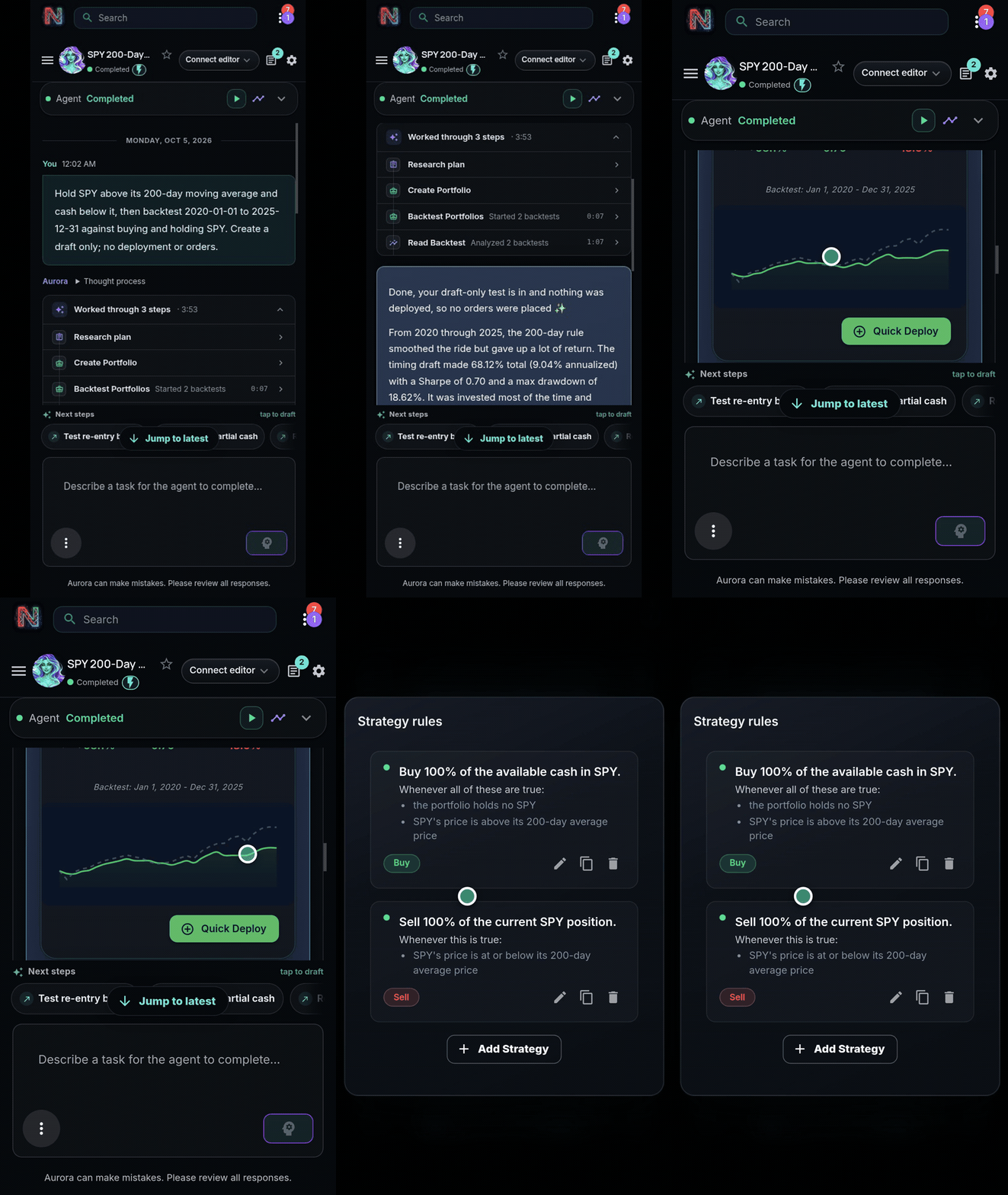
The strategies that work now won't stay special
In September 2026, I published an analysis of 222,010 backtests. That research gives me a better starting point for deciding which ideas to test. Agents can use those findings to build and compare strategies much faster than I could by hand.
But other people's agents can investigate the same ideas using the same market data. I expect the advantage to shrink as more of them discover and trade the same opportunities.
Here's an actual example. In February, I asked Aurora: “Create the best momentum-based strategy for fundamentally strong stocks.” After testing competing ideas, I published three of the resulting strategies.
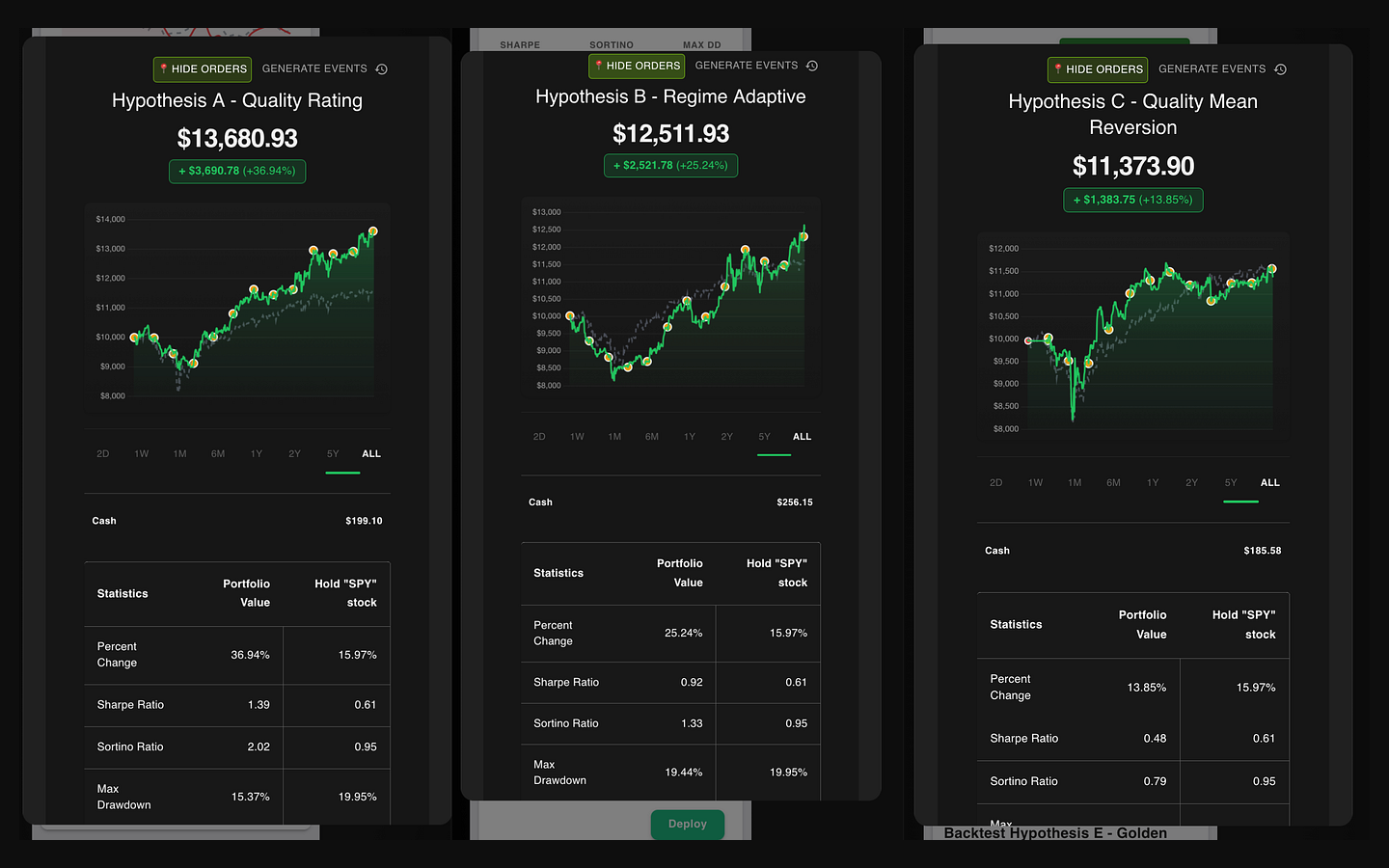
That strategy became The “All-Weather” Winner. It selects 15 S&P 500 stocks with strong quality ratings and the highest 30-day momentum, then rebalances monthly.
Those inputs are public fundamentals and price history. Another agent can test the same idea. Once millions of agents are doing that, I expect the trades to get crowded.
Published strategies have already shown this kind of decay. McLean and Pontiff studied 97 stock-return predictors and estimated a 32% reduction in predictor-portfolio returns attributable to trading informed by their publication. Read the Journal of Finance study.
I expect agents to speed that process up. By 2031, I think many obvious fundamental and technical strategies that show an edge today will be noise. Earnings and cash flow will still matter to companies. Making money after costs from familiar rules around that public information will get much harder.
While Robinhood plays catch up getting their agents to execute backtests, the next revolution in finance is alternative data.
The next edge is the data
Once everybody can ask an agent to build, backtest, and deploy a strategy, the competition moves to what those agents know. If they're all working from the same prices, earnings reports, and indicators, I expect them to keep discovering the same trades.
The advantage shifts to information other people's agents don't have, or haven't thought to use. That could be satellite observations, weather, specialized industry records, or your own dataset that reveals customer demand before an earnings report. Even connecting public datasets in a way nobody else is testing could reveal an opportunity.
I also expect that competition for information to take uglier forms. Some participants will seek insider information. Others will try to manufacture the data that trading agents consume.
Imagine 100,000 AI agents on Reddit gradually manufacturing a narrative about a stock. Other trading agents gather those posts as social-media data, interpret the narrative as genuine investor sentiment, and trade on it. The operators have created the signal themselves, then used other agents' reactions to it. That's the market manipulation I expect to see more of as agents compete for an information advantage.
My bet is on collecting overlooked data and turning it into indicators agents can actually test.
I'm putting that data to work
I've been building custom indicators into NexusTrade so people can use their own datasets in a strategy.
You bring the data, turn it into a numeric indicator, and combine it with trading conditions. An agent can help find or transform the source, and you can test the resulting rules alongside price, fundamentals, and other inputs. Here's how the custom-data workflow works.
I've also published historical datasets for three kinds of disclosures:
- Congressional trades: House and Senate trading disclosures going back to 2012. Download the congressional dataset.
- Corporate insider trades: SEC Form 4 disclosures from executives, directors, and other reporting insiders, going back to 2006.
- Institutional holdings: SEC Form 13F disclosures going back to 2013. Download the insider and institutional datasets.
The dates matter. Someone can make a trade before you learn about it. A quarterly holdings report tells you about a past position. Your backtest has to use the information you could actually have known on that day.
My next big bet takes this further: a custom-built trading model on custom-built data.
Through NexusTrade, I've spent years collecting trading strategies and their backtest results. The corpus behind my September research contains 222,010 backtests. That research history is itself an alternative dataset.
Price history tells a model what the market did. My backtesting data records which strategies were tested against that market and how they performed: the rules, the parameters, and the variations people tried.
I intend to train my own large language model on the data I've collected building NexusTrade. It will learn from agent conversations, my backtesting data corpus, and, of course, reinforcement learning.
I want it to learn which research decisions led to useful strategies, which experiments failed, and what to test next. The goal is a trading agent trained on years of actual strategy-development work, with a research process that keeps learning from its next experiment.
That's the alternative-data approach I'm pursuing. Other agents can download the same stock prices. They won't have the years of conversations and experiments I've collected while building NexusTrade.
Try NexusTrade
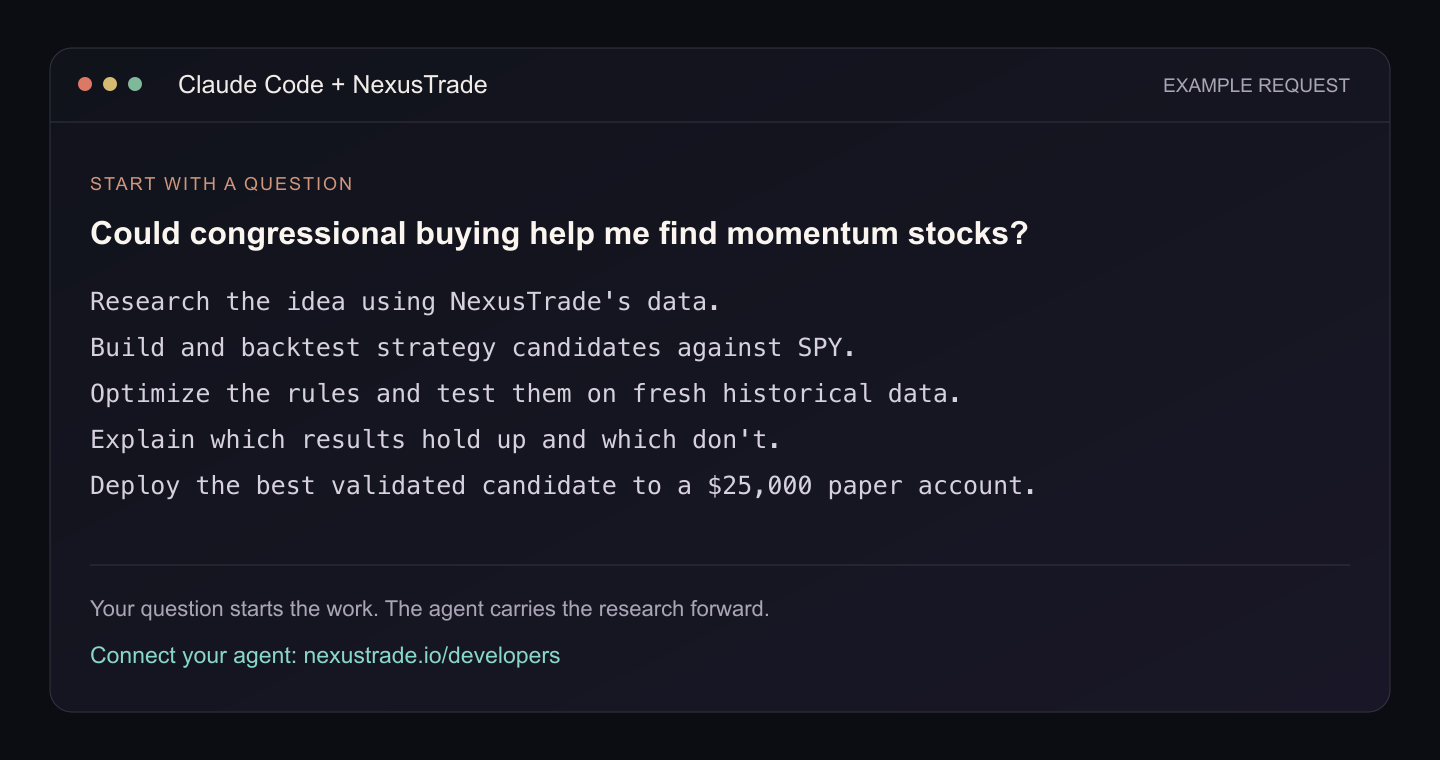
Give Aurora a trading idea, have her build and backtest it, and try it in a paper portfolio. If you prefer working through Claude Code or Codex, connect your coding agent to NexusTrade.
For October, your first three calendar months are free with weekly or monthly billing. Annual plans are 25% off the first year. After the offer, your plan renews at its regular price unless you cancel. Claim it by October 31 at 11:59 p.m. Central.
Start with a trading idea, compare its backtest with a benchmark, and try it in a paper portfolio. The October offer includes three free calendar months on weekly or monthly plans, or 25% off the first annual year.
Claim the October offer
No comments yet.