What Oil Stocks to Buy After Trump Captured Maduro?
I Asked an AI Agent, Then Backtested the Results.

My mom texted me today asking what oil stocks to buy.

She’s not wrong. If you haven’t seen the news: the United States just captured Venezuelan President Nicolás Maduro.
In the early hours of January 3rd, 2026, U.S. forces carried out a large-scale military strike. Maduro and his wife were flown out of the country. He’s now in New York awaiting arraignment on narco-terrorism charges.
President Trump announced the U.S. will “run” Venezuela until there’s a proper transition of power. This is the most significant U.S. intervention in Latin America since Panama in 1989.
My mom saw what millions of investors are seeing: Venezuela has the largest oil reserves in the world at 303 billion barrels, and American oil companies are about to get access.
Instead of guessing, I did what I always do. I did research. This time, I decided to ask an AI agent to research it for me. Then, I backtested the results.
What I found is worth sharing.
First, Some Proof: Why I Trust This Framework
A year ago, TikTok was banned in the United States. I wrote an article asking: which companies would benefit?
Instead of guessing, I used AI to analyze the fundamentals of potential beneficiaries. The thesis was simple: fundamentals act as a filter. They separate the companies that can actually capitalize on an opportunity from the ones that just sound like they might benefit.
I created two portfolios. The first included META, GOOGL, and TSLA, all with stronger fundamentals. The second included SNAP and PINS, which had weaker fundamentals but seemed like more “obvious” plays on the TikTok ban.
Results after one year? The fundamentally strong portfolio returned +21.54% with a Sharpe ratio of 1.01. The weaker-fundamentals portfolio? It lost 19.7% and its sharpe ratio is -0.60. That’s a dramatic difference.
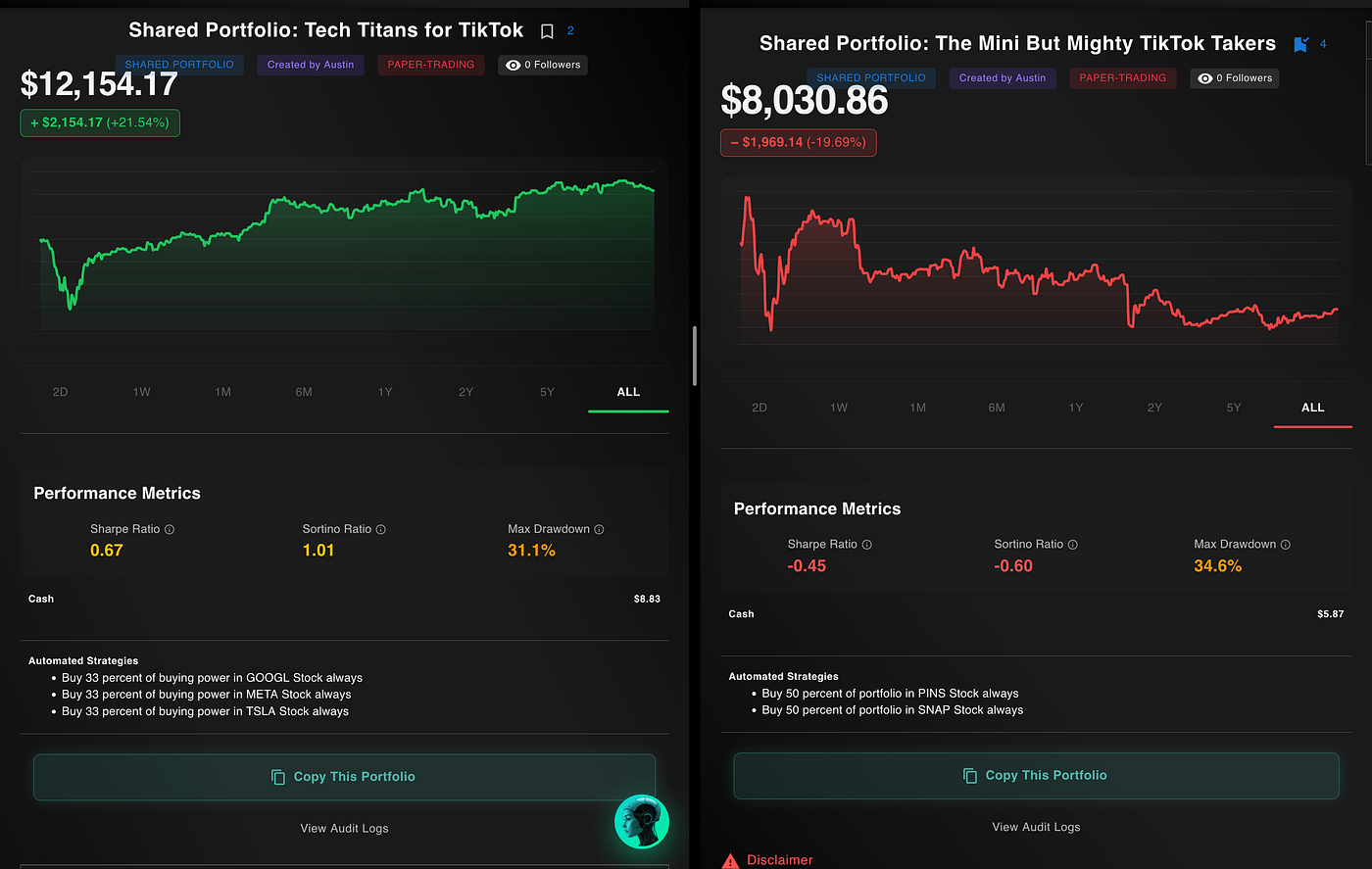
You can verify the live-trading results yourself.
The fundamentally strong stocks crushed the speculative plays by over 40 percentage points.
This is the framework: When breaking news creates an opportunity, use AI to identify beneficiaries, then filter by fundamentals.
It worked for TikTok. Would it work for Venezuela?
What the AI Found: Best Oil Stocks to Buy for Venezuela
I asked Aurora, the AI agent that powers NexusTrade:
“Trump just captured Maduro. What oil companies will benefit? Do deep research.”
She ran autonomously for 15 minutes. She created a research plan, identified four categories of beneficiaries, pulled financial data, searched recent news, and synthesized everything.
You can view her full research session here: NexusTrade Agent Research
Here’s what she found:
- Operational Presence: Chevron (CVX) is the only major U.S. producer with active Venezuelan joint ventures. They have personnel on the ground and infrastructure in place.
- Debt Recovery: ConocoPhillips (COP) holds an $8.7 billion arbitration award for assets expropriated in 2007. ExxonMobil (XOM) has roughly $2.6 billion in claims. Regime change finally gives them a path to collect.
- Infrastructure Rebuilding: Venezuela’s oil infrastructure needs an estimated $7–9 billion in rehabilitation. SLB and Baker Hughes (BKR) are the service companies that will do the actual work.
- Refining: Gulf Coast refineries were specifically built for heavy Venezuelan crude. Valero (VLO) was historically the largest importer.
The pattern that emerged? SLB and BKR have the highest fundamental ratings at 4.0, stronger than the integrated majors like Exxon (3.5) and Chevron (3.0). If the TikTok thesis holds and fundamentals filter for execution ability, these service companies should outperform.
Smart research. Logical framework.
Then I did something most articles don’t do: I backtested it.
I used high-quality fundamental data from EODHD to backtest these strategies. Get instant access here!
The Honest Truth: What the Historical Data Says
I took all 10 oil stocks Aurora identified (CVX, COP, XOM, VLO, PBF, PSX, SLB, HAL, BKR, and WFRD) and backtested them from January 2023 to January 2026.
The results are sobering.
An equal-weight basket of these stocks returned +33.2% over three years. Sounds decent until you realize the S&P 500 returned +92.6% over the same period. That’s nearly a 60-point opportunity cost.
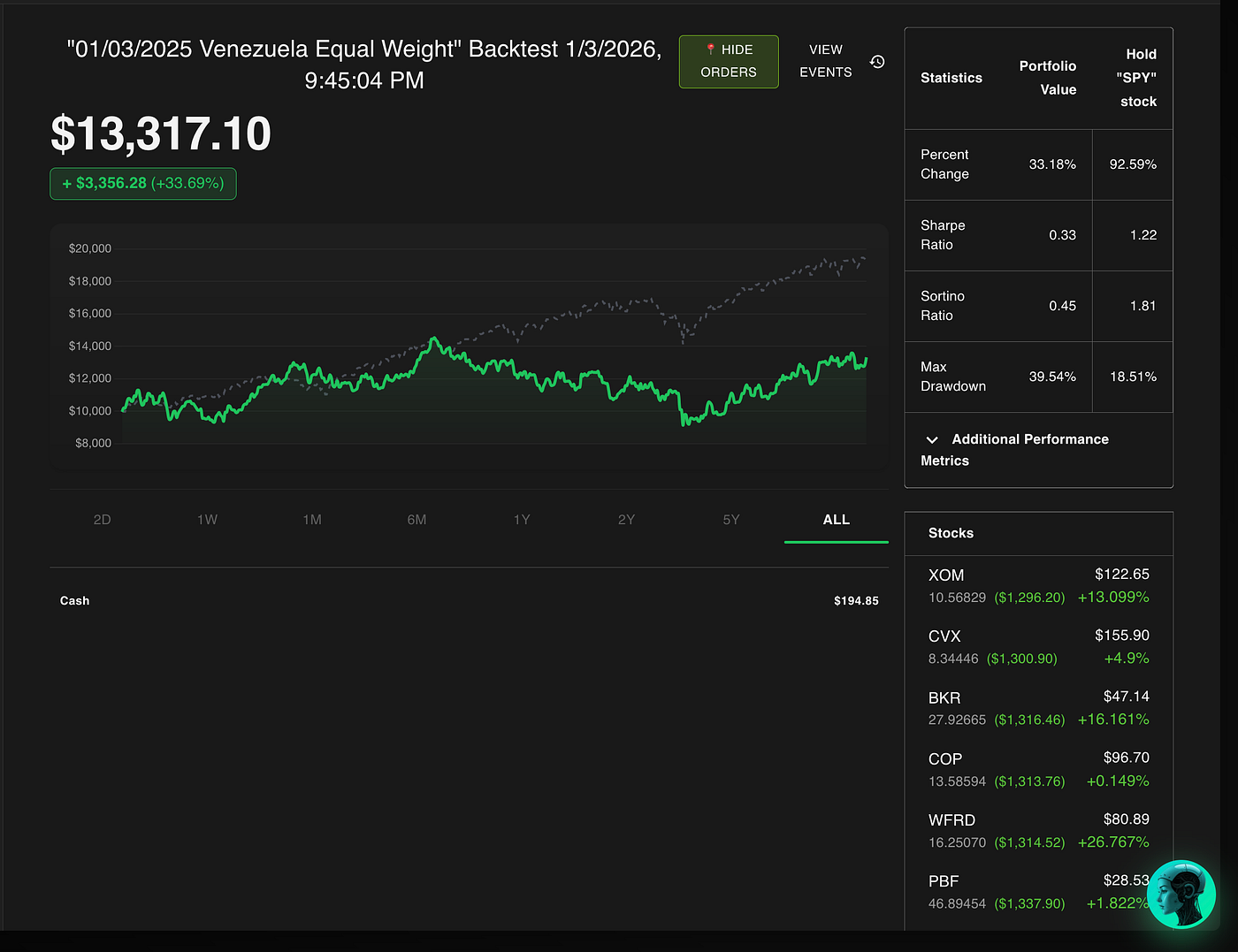
The risk-adjusted numbers tell the same story. The oil basket had a Sharpe ratio of just 0.33 compared to 1.22 for SPY. And the maximum drawdown hit -39.5%, more than double SPY’s drawdown.
For three years, this was dead money. Investors weren’t compensated for the additional risk.
Could a Smarter Strategy Do Better?
The simple equal-weight approach failed. So I tested whether a smarter rebalancing strategy could improve the results.
I ran 8 different strategies through the backtester:
- Value: Rebalance monthly into the 5 cheapest stocks by P/E ratio
- Growth: Rebalance quarterly into the 5 stocks with highest revenue growth
- Momentum: Rebalance weekly into the 5 stocks with strongest price momentum
- Regime Filter: Only hold when SPY is above its 200-day moving average
- Risk Parity: Weight by inverse volatility to reduce drawdowns
- And a few others
Most of them failed just like the simple basket. Value, growth, and regime filtering all underperformed SPY significantly.
Here’s where the AI made mistakes.
First, Aurora built a “momentum” strategy that was supposed to sort stocks by RSI and pick the top 5. But she built it wrong. The strategy sorted by RSI without actually limiting to the top performers. The sort did nothing. It was functionally identical to the equal-weight basket.
Second, Aurora created a narrative about “event alpha” during the January 1–3 Maduro capture window, claiming the oil basket spiked 2.8% while SPY fell. But the capture happened on a Sunday. Markets were closed. The stocks haven’t actually moved yet in response to this news.
This is one of the pitfalls of working with AI agents. Aurora did excellent research identifying the right companies. But when it came to building trading logic and interpreting market data, she made errors that would have gone unnoticed if I hadn’t verified the results myself.
But here’s what’s interesting: I still ran genetic optimization on the broken strategy.
The genetic optimizer doesn’t care what the strategy was ‘supposed’ to do. It treats the whole thing as a black box with tunable parameters and searches for combinations that maximize historical returns.
In this case, those parameters are the stock weightings. Aurora’s broken momentum logic became irrelevant. The sorting was essentially a no-op. The optimizer just asked: ‘What allocation across these 10 stocks works best?
And it found something.
The optimized portfolio returned +47.7% from 2023–2026, compared to +33.2% for the simple equal-weight basket. That’s a 44% improvement.
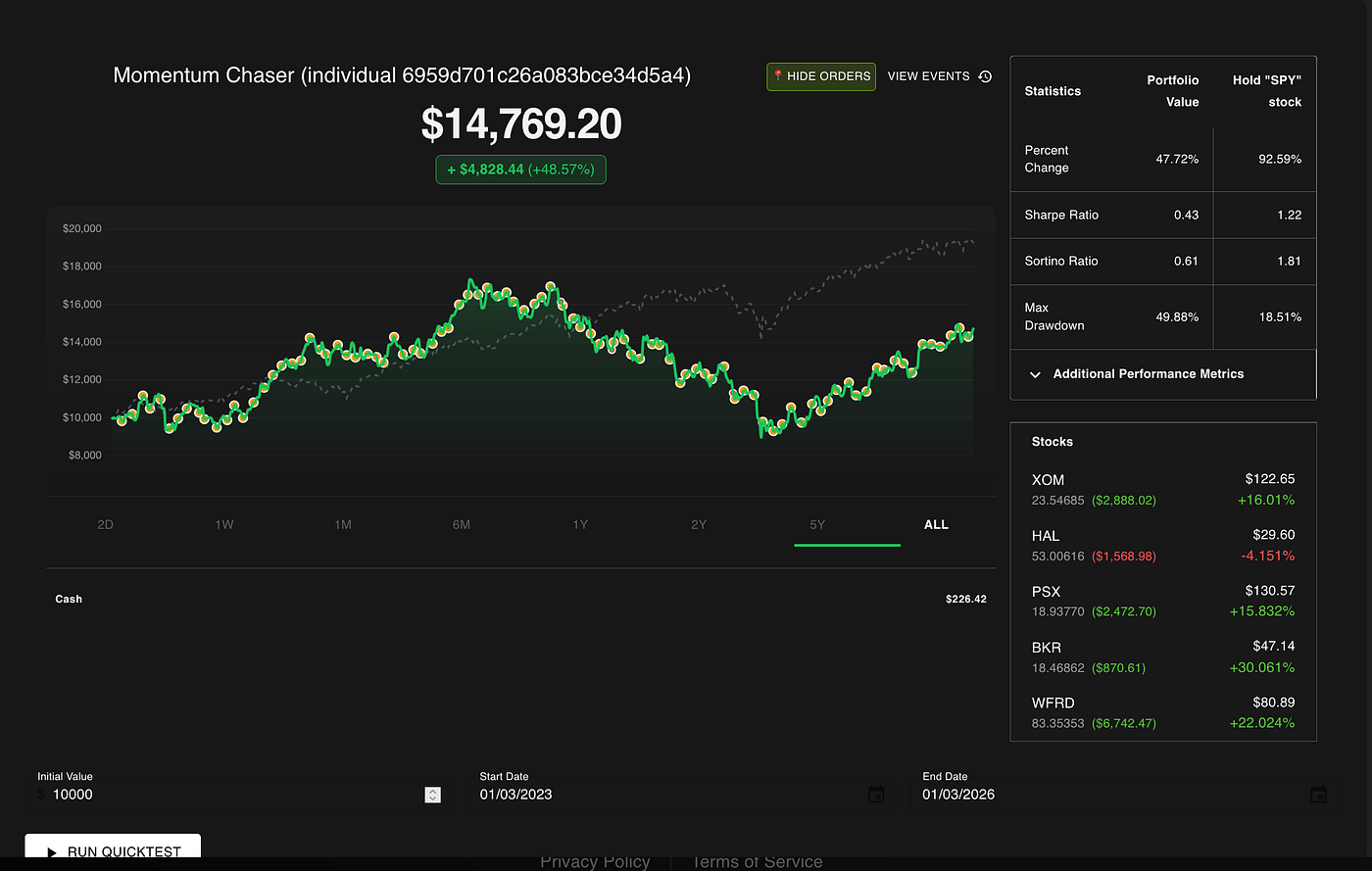
So what did the optimizer actually find?
It concentrated the portfolio into five stocks: WFRD (47%), XOM (19%), PSX (17%), HAL (10%), and BKR (6%). The other five were completely excluded, including Chevron.
The thesis is interpretable. Bet on oilfield services equipment companies, not refiners or integrated majors. Weatherford (WFRD), the smallest and most volatile name, gets nearly half the allocation. The refiners (Valero, PBF) are cut entirely because they benefit from cheap crude, not necessarily more crude. And Chevron, despite being the only U.S. major with boots on the ground in Venezuela, didn’t make the cut.
The optimizer is betting on infrastructure rebuilders, not the incumbent operator.
Is this real signal or overfitting? That’s exactly what the live experiment will test.
The Real Test: Will Optimization Actually Work Going Forward?
Here’s the thing about backtesting: you can always find something that looks good historically. The real question is whether it works going forward.
So I’m running an experiment.
I’m deploying two live portfolios on NexusTrade:
- Venezuela Recovery (Buy & Hold) is an equal-weight basket of all 10 stocks. Simple. Passive. No rebalancing logic. Just bet on the sector and hold.
- Venezuela Recovery (Optimized) uses the strategy the optimizer found. Whatever it actually is.
In one year, I’ll publish the results.
This is the test that actually matters. If the optimized portfolio beats the simple basket, it suggests that momentum signals add real value during sector recoveries. If the simple basket wins, it means the optimization was just overfitting to historical data and you’re better off keeping it simple.
My bet? The optimized portfolio wins. The out-of-sample performance was strong, and I’ve been surprised by the power of AI-driven optimization again and again. But I’ve been wrong before, and the only way to know for sure is to run it live and publish the results.
What I Told My Mom
I sent her Aurora’s research with specific advice:
If you believe the Venezuela thesis, the data points to infrastructure rebuilders over incumbent operators. BKR and WFRD had the strongest fundamentals, and the optimizer concentrated heavily in WFRD. CVX has boots on the ground, but historically trailed both. If you don’t want to make the Venezuela bet at all, SPY remains the safer long-term play.
That’s the honest answer. If you have conviction on Venezuela, WFRD dominated the optimizer’s allocation — it captured nearly half the optimized portfolio’s weight. For broader exposure, XOM and PSX were the next largest positions. SPY remains the safer choice if you’d rather skip the sector bet entirely.
See For Yourself
🔗 View Aurora’s Full Venezuela Research
🔗 View the Buy & Hold Portfolio
🔗 View the Optimized Portfolio
Ask Aurora any investment question. Run your own backtests. See if her logic makes sense to you.
War broke out on a Sunday. Markets open Monday. Let’s see who was paying attention.
I’ll revisit this experiment in one year with full results. Want to learn how to build your own algorithmic trading strategies. Sign-up today for the Algorithmic Trading Fundamentals Comprehensive Course!
No comments yet.