Growing up, I was obsessed with Shark Tank. Even though I would say "I want to be a doctor", I remember my dad always telling me that I should think about being an entrepreneur. "Y'all (referring to me and my twin brother Justin) loooove that show. Y'all should be entrepreneurs." At the time, I just shrugged him off...
|
For those who don't know, Shark Tank is a popular American TV show where hopeful entrepreneurs walk into a room (called a "tank") of wealthy, successful entrepreneurs (the "sharks"). The entrepreneurs pitch their idea to the sharks in the hopes of getting an investment in exchange for some percentage of their company. Kevin O'Leary, aka "Mr. Wonderful" is a prominent shark on the show.
|
Mr. Wonderful is known for his blunt and direct criticism of the entrepreneurs on the show. One of the things he emphasizes over and over again is the importance of cash flow. Cash flow is the amount of cash coming into (and leaving) the business. Companies with high free cash flows are capable of covering their operational costs efficiently and reinvest their money or pay dividends.
|
Thus, we're going to see how good our "Cash Flow King" strategy is compared to the good ol' fashion "Buy and Hold SPY" strategy.
|
Finding our Cash Flow Kings
|
Our first step is to find companies with high cash flows. Traditionally, this step would be extremely difficult, and involve using spreedsheets, SQL queries, and other methods to find our companies. However for this article, we'll be using a simplified approach: artificial intelligence.
|
We're going to use NexusTrade's AI-Powered Stock Screener to find our cash flow kings. This screener is capable of searching for companies that belong in certain industries and filter by companies with certain fundamental metrics. We'll use the screener to find companies with high cash flows. Here's how you can do it.
|
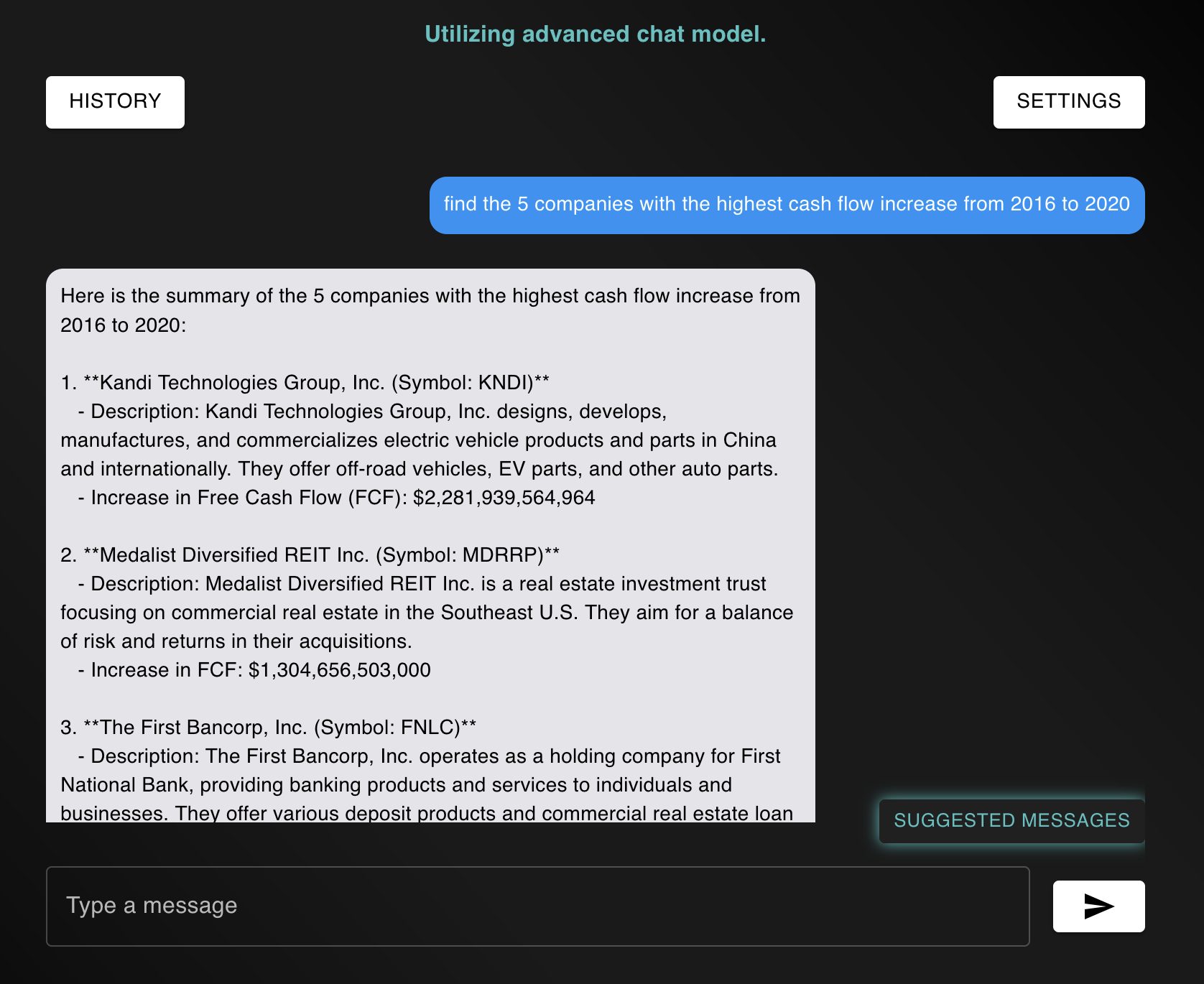
find the 5 companies with the highest cash flow increase from 2016 to 2020
|
These results look a little odd. Never in my life have I heard of KNDI, MDRRP, and FNLC. Not only that, but the AI is saying they made over $1 trillion in 5 years? What's going on here?
|
The Importance of Data Integrity
|
Believe it or not, the AI model didn't make a mistake. The model just translates plain English into a query against the database. The database has incorrect data.
|
This is one of the biggest weaknesses of AI models – the reliance on accurate, high-quality data. The model isn't designed to make guesses on if the data is right or wrong; it's just generating a query.
|
The old saying "garbage in, garbage out" absolutely applies here.
|
Ignoring companies with data integrity issues
|
I've emailed the company that provides NexusTrade's fundamental data about this issue. In the meantime, to continue our analysis, we can ask our AI to exclude these companies.
|
find the 5 companies with the highest cash flow increase from 2016 to 2020. Exclude KNDI, MDRRP, and FNLC
|
Here is the summary of the 5 companies with the highest cash flow increase from 2016 to 2020:
1. **The Goldman Sachs Group, Inc. (Symbol: GS)**
- Description: The Goldman Sachs Group, Inc. provides financial services globally for corporations, financial institutions, governments, and individuals. They operate through various segments offering financial advisory, asset management, and platform solutions.
- Initial Date: March 31, 2016
- Final Date: December 31, 2020
- Increase in Free Cash Flow (FCF): $35,431,000,000
2. **Apple Inc. (Symbol: AAPL)**
- Description: Apple Inc. designs, manufactures, and markets smartphones, personal computers, tablets, wearables, and accessories worldwide. They offer a range of products and services including iPhone, Mac, iPad, wearables, and various digital services.
- Initial Date: March 31, 2016
- Final Date: December 31, 2020
- Increase in FCF: $29,328,000,000
3. **Amazon.com, Inc. (Symbol: AMZN)** - Description: Amazon.com, Inc. engages in the retail sale of consumer products, advertising, and subscriptions service through online and physical stores in North America and internationally. They also manufacture and sell electronic devices and develop media content.
- Initial Date: March 31, 2016
- Final Date: December 31, 2020
- Increase in FCF: $18,878,000,000
4. **Microsoft Corporation (Symbol: MSFT)**
- Description: Microsoft Corporation develops and supports software, services, devices, and solutions worldwide. They offer a range of products and services including office, cloud services, and devices.
- Initial Date: March 31, 2016
- Final Date: December 31, 2020
- Increase in FCF: $15,750,000,000
5. **Alphabet Inc. (Symbol: GOOG)**
- Description: Alphabet Inc. offers various products and platforms in different regions. They operate through Google Services, Google Cloud, and Other Bets segments.
- Initial Date: March 31, 2016
- Final Date: December 31, 2020
- Increase in FCF: $14,056,000,000
|
Now that we've found our cash flow kings, let's see how well they perform in a backtest.
|
Testing our Cash Flow Kings' Performance
|
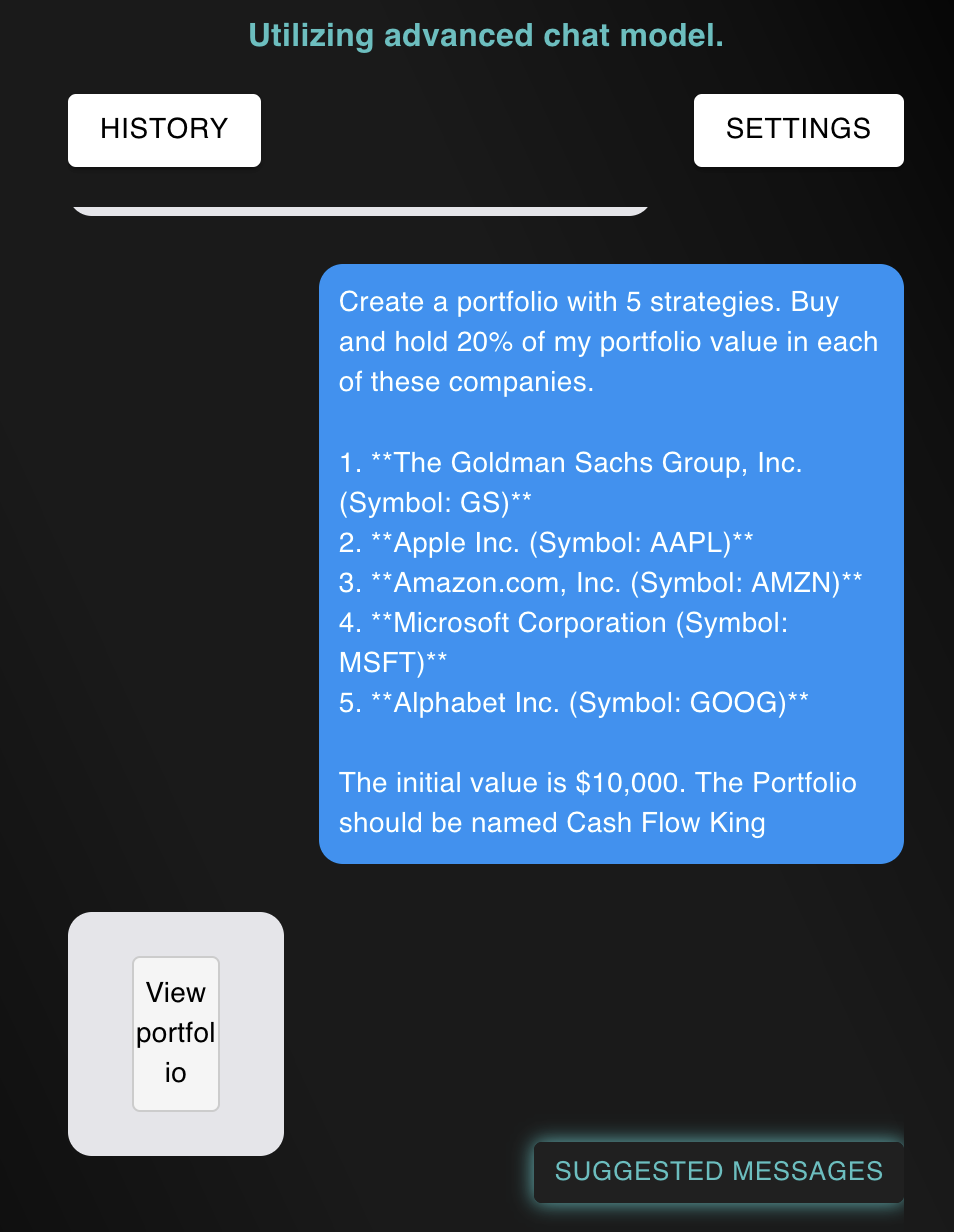
To see if Mr. Wonderful's "Cash Flow King" hypothesis holds any weight, we'll test the performance of these stocks from 2021 until today. First, let's generate our portfolio.
|
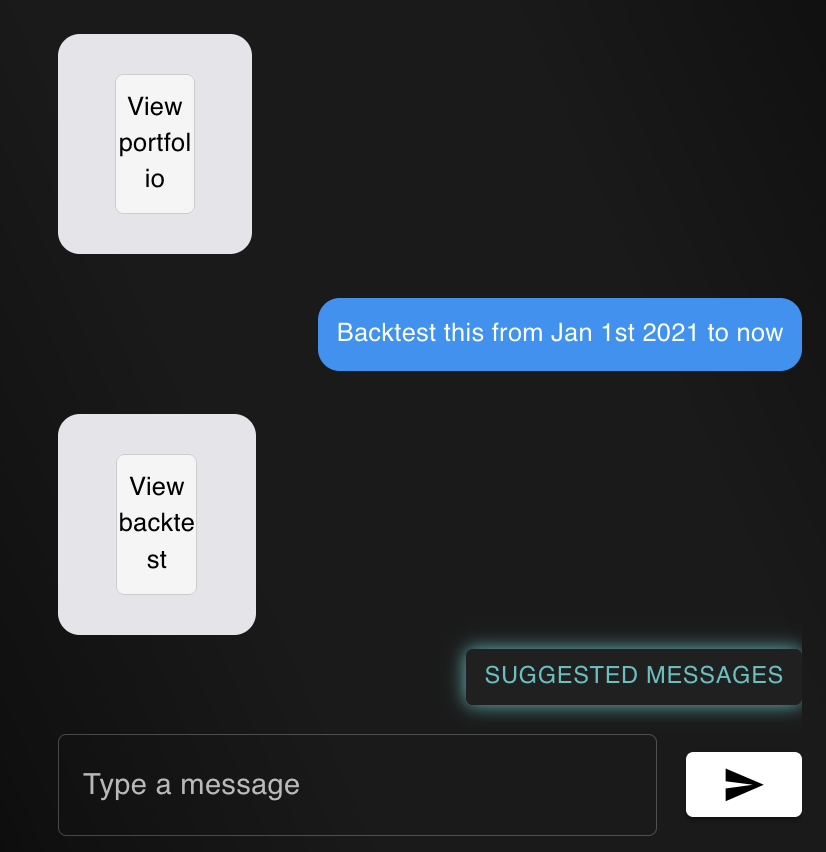
Then we'll backtest this portfolio. A backtest is a historical simulation on how a particular set of strategies would've performed had we used it in the past. It gives us an idea of how profitable a particular portfolio might've been.
|
Backtesting in NexusTrade is as easy as asking Aurora to execute one.
|
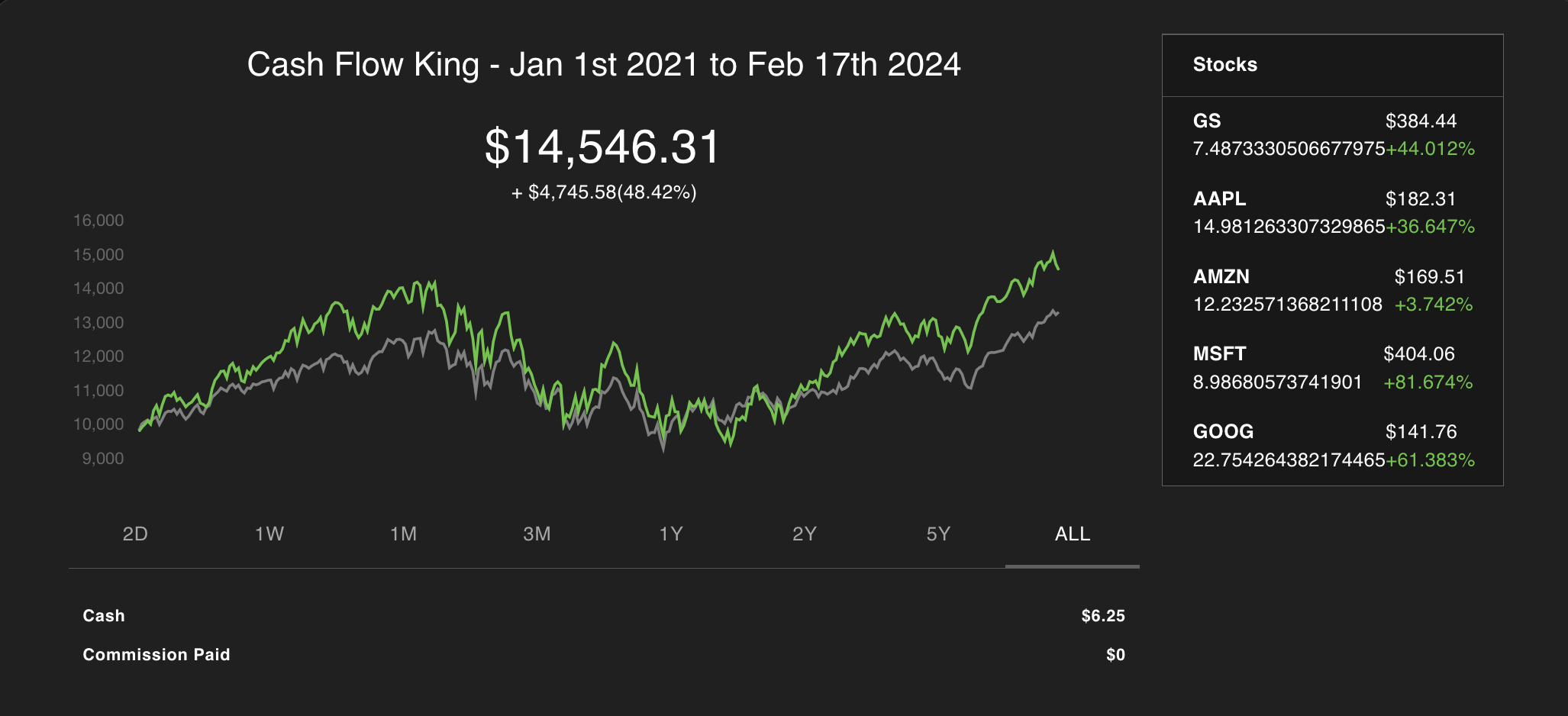
And now, for our results.
|
From this backtest, we can see that our portfolio performed pretty good! It outperformed the baseline strategy of "Buy and Hold SPY". And the impressive thing is that this is just based on one fundamental metric at a fixed period of time.
|
The thing I LOVE about this approach the most is that we're basing our strategies based on objective fundamental metrics. We're not going on YouTube or TikTok to find opinion pieces on what stocks to buy. In this scenario, we're solely using one objective metric, cash flow, and seeing how well it leads to a company's future success.
|
Even though the stocks that were selected objectively have high cash flows, there is a glaring problem that any seasoned financial advisor would realize. Of all the portfolios, four out of five of them are technology stocks. Microsoft, Apple, Amazon, and Google are considered the "Big Tech" companies, and their stock prices tend to be correlated with one another.
|
One thing we could've done was explicitly include companies in a wide variety of industries. For example:
|
find the 2 technology, 2 non-technolgy companies, 1 biotech company, and 1 healthcare company with the highest cash flow increase from 2016 to 2020. Exclude KNDI, MDRRP, and FNLC
|
This would've introduced diversity into our portfolio. That way, if congress were to pass a bill that specifically targeted these big tech companies, our portfolio wouldn't be absolutely demolished.
|
Future Improvements to this Process
|
This analysis is already far beyond what traditional brokerage platforms can do. But it can also be significantly improved in a variety of ways. All of these suggestions are currently on the NexusTrade roadmap.
|
Rebalancing Actions for Strategies
|
Right now, users have the ability to execute two types of actions for their strategies: buying and selling. However, in many cases, especially with portfolio optimization, a user wants to be able to define a weighted criteria for the stocks in their portfolio.
|
For example, a user might not want to buy $1,000 of a particular stock, but to change the weightings of their portfolio. This weighting might be customizable, so one person might want to rebalance based on market cap and the other might want to rebalance based on free cash flow.
|
This new action would give users the ability to express even more types of strategies in the platform. Having a way to rebalance mid-backtest would be extremely valuable for investors trying to test different strategies.
|
Fetching dynamic data during backtests
|
In the same vein, in the example I demonstrated above, we're only using the change in free cash flow based on a fixed period of time. A more robust approach would have a strategy that automatically rebalances the portfolio every few months based on the free cash flow of companies in the market. This approach would be more rigorous and allow us to create a fully automated strategy that changes over time.
|
Optimizing fundamental metrics
|
Finally, another thing we would like to test is if cash flow is really king. Maybe net income is a better fundamental metric. Perhaps revenue is all you need. The exact fundamental metric (or metrics) that leads to the most gains can be determined algorithmically. Having a way to automatically optimize for the best metrics would lead to creating far more profitable portfolios based on objective fundamental data.
|
We can really go very far with this. For example, we could create a basket of stocks with certain criteria, and include stocks whose stock prices are lowly correlated to each other. We can include technical indicators into the mix, and see if the combination is successful in improving stock returns. The reality is that the number of possible strategies is infinite, and developing unique ways to explore this search space is the best way to create profitable trading strategies.
|
Mr. Wonderful isn't a multimillionaire for no reason. He understands the power of compound interest, and investing in companies with health cash flow.
|
Now, thanks to NexusTrade, it's easy to invest based on objective, fundamental metrics. We don't have to search for stocks based on what other people say is a good investment. We don't have to dig through financial statements or wrangle with SQL queries and Excel spreedsheets. We can get the exact companies we want based on objective data.
|
However, as I cautioned, AI is only as good as the input data into the system. Data Integrity becomes even more critical because incorrect data can cause a novice investor to make critical mistakes. This is why it's important to not solely rely on AI, but also build an intuition for when the results of the system make sense.
|
Nevertheless, the value AI brings here couldn't be more clear. In this article, we searched for companies that had the highest cash flow increase for a certain period of time. We then backtested these portfolios and saw that this conglomeration outperformed the traditional Buy and Hold SPY trading strategy. Finally, we speculated how this process could be improved and automated for a more robust trading system.
|
The proof is clear. AI expedites the creation, testing, and deploying of fully automated trading strategy. And while it makes mistakes, it's only getting better. I cannot wait to see how this process improves throughout 2024.
|
Disclaimer: The content provided in this post is for informational purposes only and is not intended as financial advice or a recommendation to buy or sell any securities. I am not a financial advisor. The insights and analysis shared are meant to demonstrate the capabilities of NexusTrade in automating financial research. It's important to conduct your own due diligence and consult with a professional advisor before making any investment decisions.
|
|


No comments yet.