A January 2024 guide to NexusTrade’s strategy optimizer controls
Austin Starks ∙ 8 min read ∙ View on MediumAn In-Depth Guide On Mathematically Improving Your Trading Strategy
The Most Important Guide for All Traders in 2024
 The Category 3 Trader,
generated by DALL-E
The Category 3 Trader,
generated by DALL-E
Start with one saved rule and decide what historical objective you want to improve. Record its size, entry/exit conditions and baseline metrics; choose training dates and a separate validation period before searching. A higher training score is a candidate, not an automatic improvement. The control definitions below explain how this January 2024 interface searches.
A later worked example makes that distinction concrete: the January 2025 META crossover search selected return and average drawdown as objectives. From generation 1 to 50, its reported validation maximum drawdown worsened from 21.84% to 24.88%, and the article reports no trades in 2024. Reject the claim of universal improvement; inspect the chosen rule and no-trade signals before accepting it. That later example is not a run completed in this January 2024 guide.
I used to be a Category 1 trader. In my own progression, I started as an uninformed investor, then moved toward systematic research and algorithmic testing.
Eventually, realizing that I’d have better luck going to Vegas, I evolved into a better trader. Let’s call it Category 2: the independent systematic trader. Oftentimes, these types of folks used to be WallStreetBets Yoloers, but have learned the hard way that following the crowd doesn’t work. These traders often maintain trade journals, reflecting on their decisions to improve future strategies. Embracing technology, they often use APIs for efficient trading. However, when faced with unpredictable market movements, emotions can still cloud their judgment, leading to panic-driven decisions and regret when the market eventually stabilizes.
A systematic process makes decisions and failures inspectable. It does not guarantee a profitable year.
There’s a common misconception that you have to be a MIT PhD student to become an algorithmic trader. But this is far from true. Thanks to the advent of Large Language Models, anybody with a computer and wifi and learn to become an algorithmic trader. This article will show you exactly how.
Using Advanced Algorithms To Your Advantage
The guide’s useful subject is how to configure a genetic search for your own strategy parameters. The controls below govern that search and its historical scoring; they do not establish what every professional trader uses.
NexusTrade is a platform that brings WallStreet-like tools to retail investors. By creating a free account, users can perform financial research, craft algorithmic trading strategies, and deploy those strategies live to the market. However, the purpose of this article isn’t to show all of NexusTrade’s amazing features; it’s to show how to use mathematics to to improve your trading strategy. The best part is, you don’t need a PhD in math to understand.
NexusTrade exposes a genetic optimizer inside the strategy UI. The search varies encoded parameters and scores candidate portfolios using the configured historical test. This guide explains those controls.
For more information about Genetic Algorithms in general, check out the following article:
For details on how these algorithms work under the hood, check out this article:
NexusTrade makes utilizing these genetic algorithms simple for everybody, even non-technical users. Let’s see how.
The Algorithmic Trader’s Secret Weapon: Trading Strategy Optimization
Genetic search varies encoded strategy parameters and compares their scores on selected historical data. Whether the resulting rule is useful depends on its tradeoffs and validation evidence.
The defaults provide a starting configuration, but this article supplies no measurement showing they work well for 90% of use cases. Choose controls for the specific rule and budget, and record them with the test results.
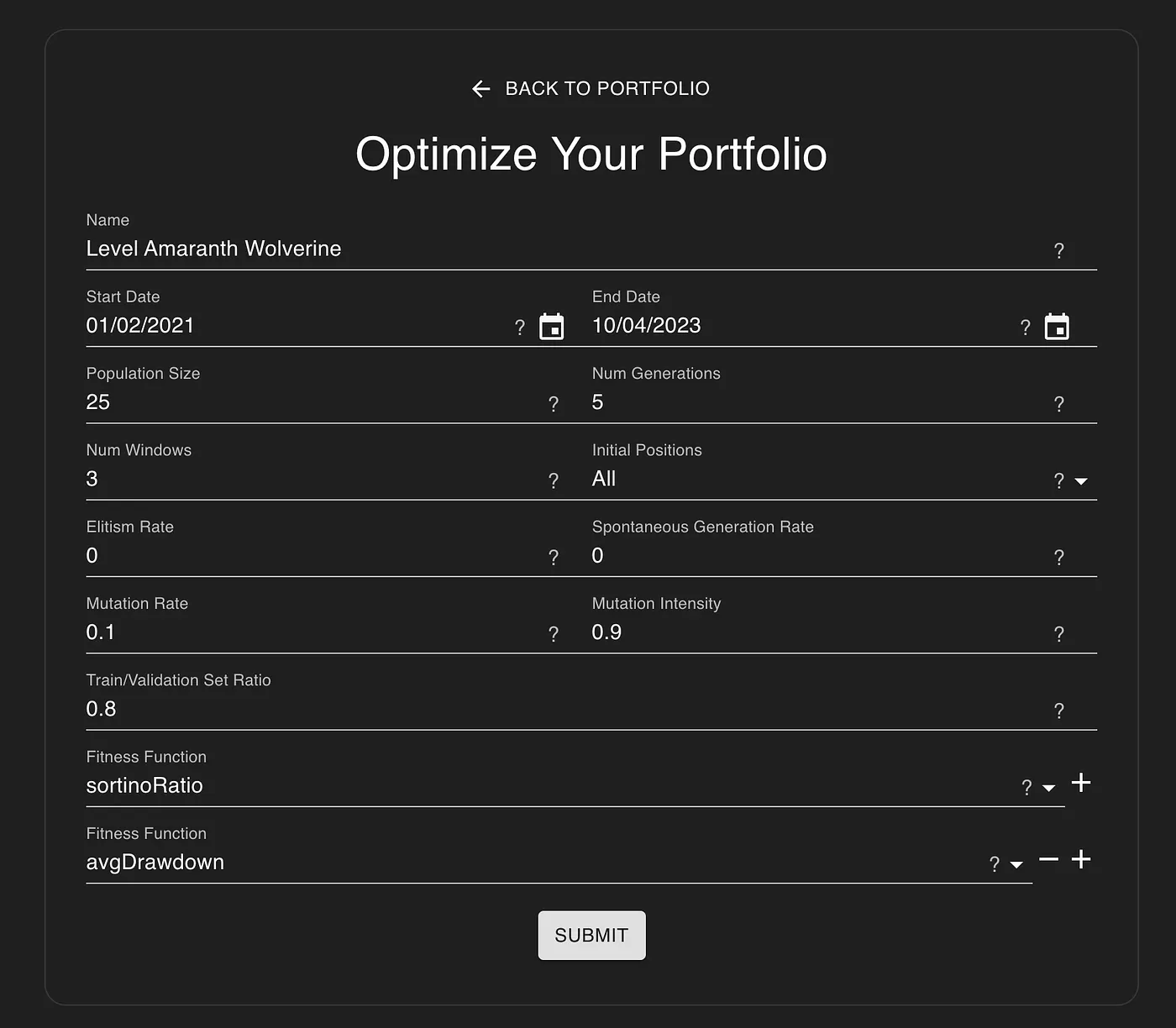 The Genetic Optimization
Configuration in
NexusTrade
The Genetic Optimization
Configuration in
NexusTrade
The Date Range
To start, let’s look at the start date and end date. This defines the range that the genetic optimization will act under. If the user thinks that more recent data is relevant for their portfolios, they can choose a narrow start and end date. If the user thinks all available data is relevant, they can choose a wider range. NexusTrade gives the users flexibility to optimize over what time period they want.
Our Population Characteristics
Next is the population size and the number of generations. These attributes dictate how many new portfolios will be generated, and how long the optimization process will occur for. The bigger these numbers are, the more computation that these portfolios will undergo. That means it’ll take longer for the optimization process to terminate. However, theoretically, we should generate better solutions the longer this optimization runs for.
Out-thinking Overfitting
Number of windows splits the development data into segments and averages their historical scores. This lets you inspect sensitivity to the chosen segments. It does not establish that the selected parameters are robust outside development data; repeated checking and choosing against a validation period makes it part of selection.
Initial positions changes the starting holdings used in the simulated test. Compare those choices to inspect sensitivity; varying them is not proof against overfitting.
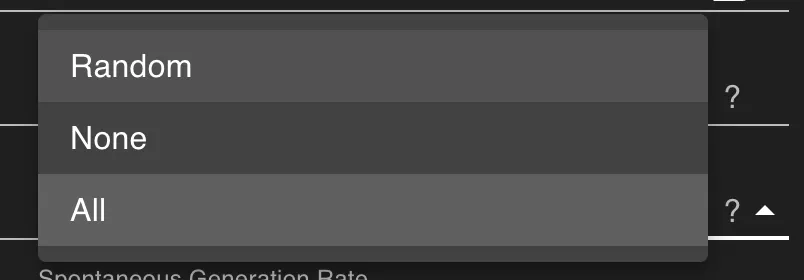 The different options for
“Initial Positions”
The different options for
“Initial Positions”
When running a genetic optimization, we run backtests on historical data. The positions in those backtests can be configured: we can choose to copy the same positions that our portfolio has right now (All), make the portfolio start with no positions (None), or we can choose to randomize our initial positions. Each option serves a different use-case, and the savvy trader might pick a different option depending on current market conditions.
Improving Our Population
Next, we have two special options that affects our population. Elitism rate defines how many of our best individuals will automatically make it to the next population. Typically, because genetic algorithms favor elite individuals, we don’t need this number to be particularly high, and the higher it is, the more likely it is for our population to converge prematurely.
Next is spontaneous generation rate. In genetic optimization, typically all new individuals are born from their parents, just like in the real-world. Spontaneous generation is a unique option that allows us to generate a completely random individual de novo. This individual will then be added to the population. This is a way to increase the diversity of our population, and continuously add new individuals by increasing our potential solution space. However, genetic algorithms work by continuous improvement, and thus, this number typically doesn’t exceed 10% of the population.
Next we have our mutation parameters: mutation rate and mutation intensity. Mutation rate defines the probability that a new individual will experience a mutation. Think of it as a random variation in the strategy. Mutation intensity defines how strong a mutation is if it occurs. A high intensity will completely change a parameter in the individual semi-randomly, while a low intensity will only make small changes in an individual, as if nothing had occurred at all. These parameters are also useful to improve the diversity of a population.
We’re almost done! Stick with me here! If you find this article useful so far, please give it a round of applause, and share it on your personal social media account!
The Statistician’s Secret Weapon
The train/validation ratio sets how much data contributes directly to the search and how much is reserved for comparison. A large performance gap can reveal a weak candidate. Similar results do not guarantee future performance, especially if repeated inspection led you to select the candidate using that validation period.
Our Fitness Functions
The last configuration option available to NexusTrade users is the most important: out fitness functions.
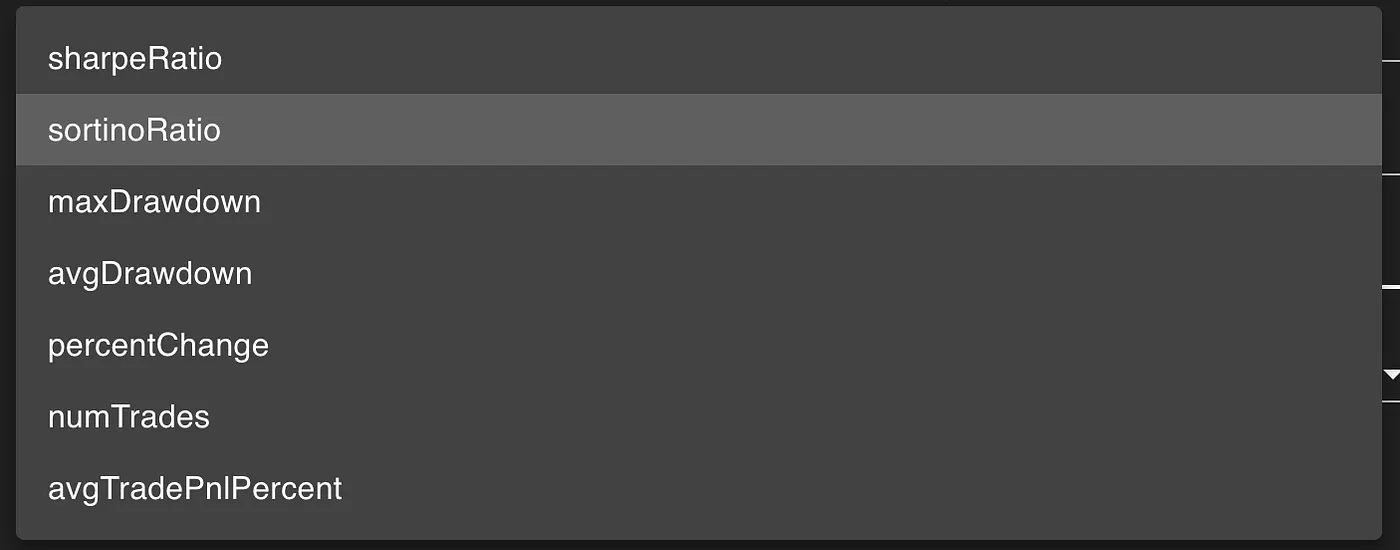 Fitness Functions in the
NexusTrade platform
Fitness Functions in the
NexusTrade platform
When optimizing our portfolio, we have to make a decision: how will we optimize it? What is important to reach our goals? Should we focus on improving our percent gain, and earning the most amount of money possible? Or, should we focus more on minimizing our drawdown, so we don’t lose the money that we gained? NexusTrade gives users the flexibility to perform multi-objective optimization, which means we can select as many fitness functions as we want. Typically, we tend to select 2, but with larger population sizes, we can get away with selecting 3 or 4.
Fitness functions specify what the search rewards on the chosen historical dates. They do not guarantee that a candidate improves every metric or future performance. Record the baseline and candidate on the same dates, inspect validation tradeoffs and reject candidates whose relevant risk or unseen-period behavior fails your stated criteria.
Summary and Conclusion
Most traders never make it past Category 2. Before the advent of Large Language Models, it was nearly impossible for a non-technical trader to utilize these advanced algorithms for their portfolios.
Use the guide to understand the historical controls, then inspect the later META search example. The January 2024 article does not record one full starting rule, control set, dated train/validation ranges and before/after results, so those missing settings cannot be reconstructed from these definitions alone.
NexusTrade offers a paradigm shift in how traders approach the market. Gone are the days where you’re hopping on WallStreetBets to gamble your money away. It’s time to take your trading to the next level, and use sophisticated algorithms to your advantage.
🤝 Connect with me on LinkedIn
👨💻 Explore my projects on GitHub
📸 Catch me on Instagram
🎵 Dive into my TikTok
Respond on Medium View story
No comments yet.