Pssst, You! The original story is on Medium! Please clap 50 times and share the article with a friend interested in investing, finance, or AI.
|
Foundations of Artificial Intelligence
|
My journey into the world of AI didn’t begin when OpenAI released a sophisticated autocomplete model; it started with a course at Cornell University — Foundations of Artificial Intelligence. I took the course because I was into trading. I had found academic articles, that promised to give traders unprecedented returns, if you understood the technical jargon. I was determined to develop an algorithm that could trade stocks for me.
|
In the course, we learned all about AI, including its history, the boom and bust cycles, and “the AI Winter”. We studied different algorithms: A* Search, which paralleled the trader’s quest for the most profitable path; Monte Carlo Tree Search, reflective of the probabilistic nature of market forecasting; and Genetic Optimization, which distilled the essence of market adaptation.
|
Then there was Reinforcement Learning, teaching machines through trial and error, mirroring a trader’s journey of refining strategies. And Neural Networks — the closest semblance to a trader’s brain, pattern-seeking, and complex.
|
From this course and the rest of the courses that I’ll discuss, I’ve become proficient at understanding the different subfields within AI. This article is a reflection of my path into understanding the vast world of artificial intelligence through the lens of algorithmic trading.
|
Fundamentals of Reinforcement Learning
|
After my initiation into the realm of AI at Cornell, I was drawn to the potential of Reinforcement Learning (RL) for AI-powered algorithmic trading. Its promise in the domain of sequential decision-making and adaptability made it an irresistible area for deeper exploration.
|
The course was a deep dive into the core concepts of RL. I grasped the delicate balance between exploration of new strategies and exploitation of known strategies, pivotal in both RL and trading. Through the multi-armed bandit problem, I saw firsthand how an algorithm could smartly navigate the trade-off to maximize rewards — a clear parallel to selecting profitable trades.
|
I became familiar with Markov Decision Processes (MDPs), the framework for modeling decisions where outcomes are partly random and partly under the control of a decision-maker, much like the unpredictable markets. Other fundamental concepts, such as the Bellman Equation, Value Functions, and Policy Optimization, were part of the curriculum, each adding layers to my understanding of how RL algorithms learn and improve.
|
A noticeable gap, however, was the absence of deep reinforcement learning, the cutting-edge confluence of deep learning and reinforcement learning. This initial course didn’t cover the neural networks that are now pivotal in the stock trading algorithms used to parse vast amounts of market data for predictive insights.
|
On completing the course, I received a certificate — a testament to my newfound proficiency in RL, and a building block for my future ventures in AI and algorithmic trading.
|
Data Science for Software Engineering
|
After graduating from Cornell, I went to get my Masters in Software Engineering from Carnegie Mellon University. CMU has a specialized campus in Silicon Valley, which doesn’t teach CS fundamentals, but rather focuses on teaching people how to become proficient software engineers.
|
One of the courses I took here was Data Science for Software Engineers. This course was different. It wasn’t about algorithms in abstraction but about equipping software engineers with actionable data science skills. It covered a spectrum of techniques, but one stood out for its raw potential: genetic optimization.
|
My background in computational biology primed me for an appreciation of the elegance of evolutionary strategies in algorithms. The concept of algorithms evolving and optimizing over time, akin to biological organisms, was more than just intellectually stimulating — it was a powerful tool waiting to be leveraged.
|
And so, I did just that. I integrated genetic optimization into my trading platform, NexusTrade. This feature empowered traders with the ability to refine their strategies through a process reminiscent of natural selection, but within the digital ecosystem of the financial markets.
|
This capability became a cornerstone of NexusTrade’s value proposition, setting it apart in a sea of trading platforms. The user interface made this sophisticated process accessible, allowing even those with limited technical expertise to harness the power of genetic algorithms to hone their trading strategies. This was a tangible, competitive edge realized through the fusion of data science and software engineering.
|
The Most Influential Course I’ve Taken — Introduction to Deep Learning at CMU
|
One of the hardest, most interesting, and most important courses I’ve ever taken was at CMU — Introduction to Deep Learning. This course wasn’t just about feeding data into a pre-built library function and calling it a day. It was about understanding the gears of neural networks, beginning with the foundational Multi-Layer Perceptron (MLP). We built these networks from the ground up, learned to train them in PyTorch, and dived into the Universal Function Approximation Theorem — the incredible concept that a one-layer MLP can approximate any continuous function to arbitrary precision.
|
The progression was natural but challenging. From MLPs, we branched out to the specialized architectures tailored for diverse data types: CNNs for image analysis, RNNs for sequential data, attention mechanisms for enhancing memory in RNNs, and GANs for generating new, synthetic images.
|
A cornerstone of the course was the capstone project — a carte blanche to choose a problem and solve it with a Deep Neural Network. With my background, I was naturally inclined towards a project in Deep Reinforcement Learning, aiming to navigate the financial markets.
|
We trained LSTMs to predict next-day stock prices, engineered ResNets to decode price movements from graph images, and even ventured into a hybrid model amalgamating RNNs, CNNs, and Reinforcement Learning. Yet, despite the sophistication of our approaches and the substantial compute resources invested, our results fell short of the age-old “Buy and Hold” strategy for the S&P 500. It was a disappointing confrontation with reality, vastly different from the promising research papers I had encountered.
|
Graduation and The Release of ChatGPT
|
After graduating from Carnegie Mellon, a new AI model was released by a company called OpenAI. This model was called GPT-3, a sophisticated Decoder-only transformer model that’s trained to predict the next word in a sequence. Despite its simplicity, it could generate text with astonishing accuracy.
|
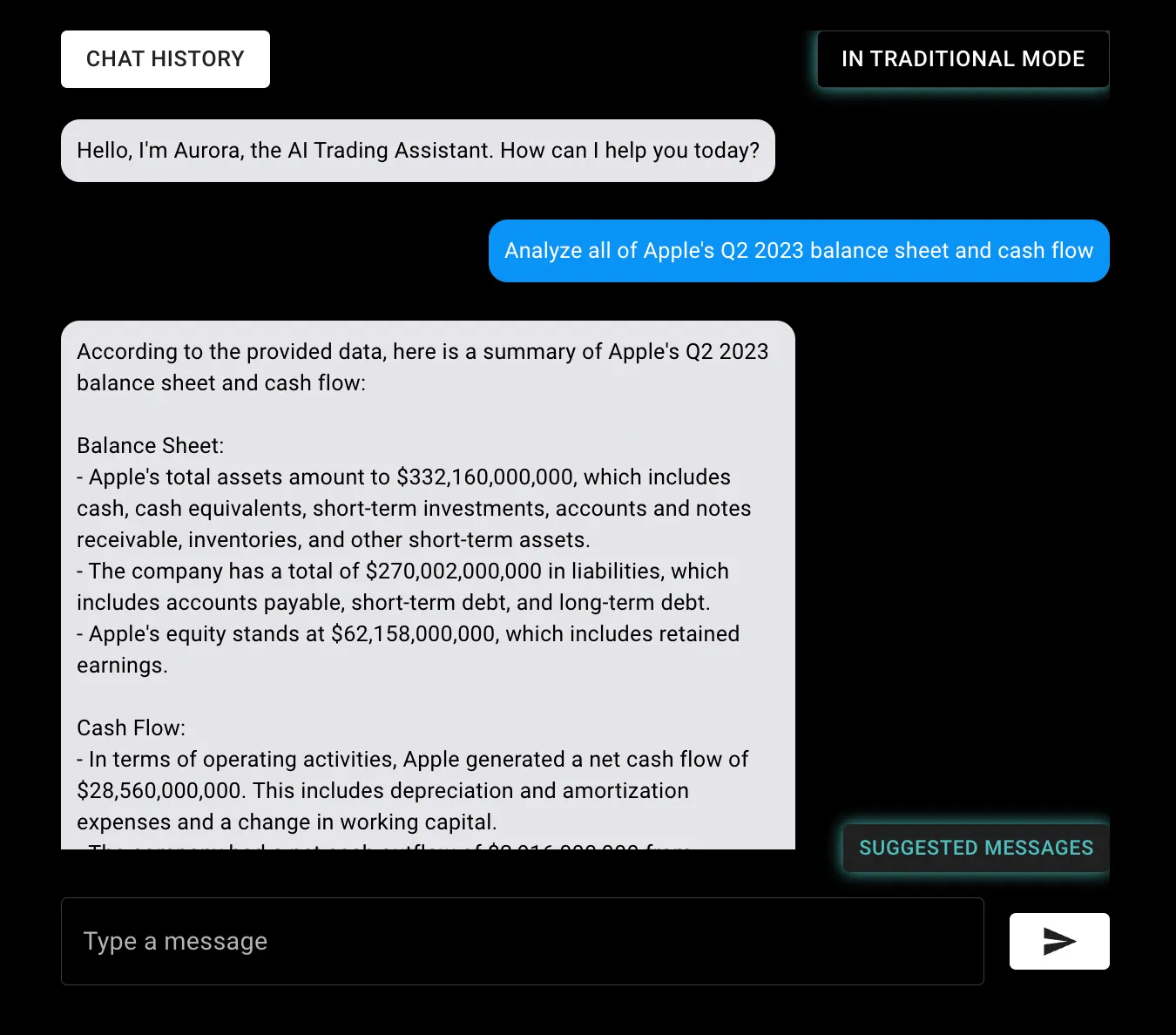
The release of GPT brought my trading platform to the next level. Users didn’t have to manually configure their ideas in a UI, but rather express their ideas to an AI that’s trained to understand them. This significantly expedites the configuration and testing process of algorithmic trading strategies, and allows a trader to test more ideas than ever before possible. Moreover, a trader could do other things they couldn’t before do, like perform financial research, by asking the AI to analyze a company.
|
NexusTrade’s integration of AI-driven conversational interfaces significantly enhances the platform’s usability, providing equitable access to users regardless of their technical expertise, including novice investors. The utility of such AI-enhanced communication systems is not confined to the financial sector; they hold transformative potential within educational domains, business process automation, and client engagement services.
|
In recognition of the current landscape where the deployment of AI-powered conversational agents is often limited to individuals with extensive technical knowledge, we are in the process of establishing NexusGenAI. This initiative is dedicated to democratizing the adoption of AI technologies, enabling users with varying degrees of technical acumen to leverage AI-driven models for a spectrum of personal and professional applications.
|
My journey into learning AI was untraditional. From the onset, I had one goal — creating an auto-adaptive, self-learning stock-trading algorithm. While I haven’t developed the Wall Street Killer, I have created a sophisticated no-code algorithmic trading platform. A trader can log on and create intricate strategies with generative AI, optimize them with genetic algorithms, and deploy them to the market with the click of a button.
|
My journey, however, has not ended yet. There is still so much I have yet to try, like incorporating fundamental data sources into these AI algorithms. What started as an interest in trading has blossomed into a passion for artificial intelligence.
|
This passion has of course resulted in the development of NexusTrade. But it also resulted in something else — a next-generation generative AI configuration platform. NexusGenAI will allow even non-technical users to utilize AI with complex workflows and automation.
|
Thank you for reading! Please subscribe to my newsletters to stay up-to-date on my journey and learn more about AI and Finance.
|
|


No comments yet.