I used AI to analyze every single US stock. Here’s how you can use it to make data-driven investing decisions
 6 min read
In a previous article, I described how I used AI to analyze every single US stock.
I used AI to analyze every single US stock. Here's what to look out for in 2025.
I can already feel the vitriol from the anti-AI mafia, ready to jump in the comments to scream at me about "stochastic…
nexustrade.io
At a high-level, I took the fundamentals of each stock (provided by a high-quality data provider, EODHD), computed some metrics like CAGR and YoY growth, and supplied this information to a large language model.
The end result was a detailed analysis for every single US stock.
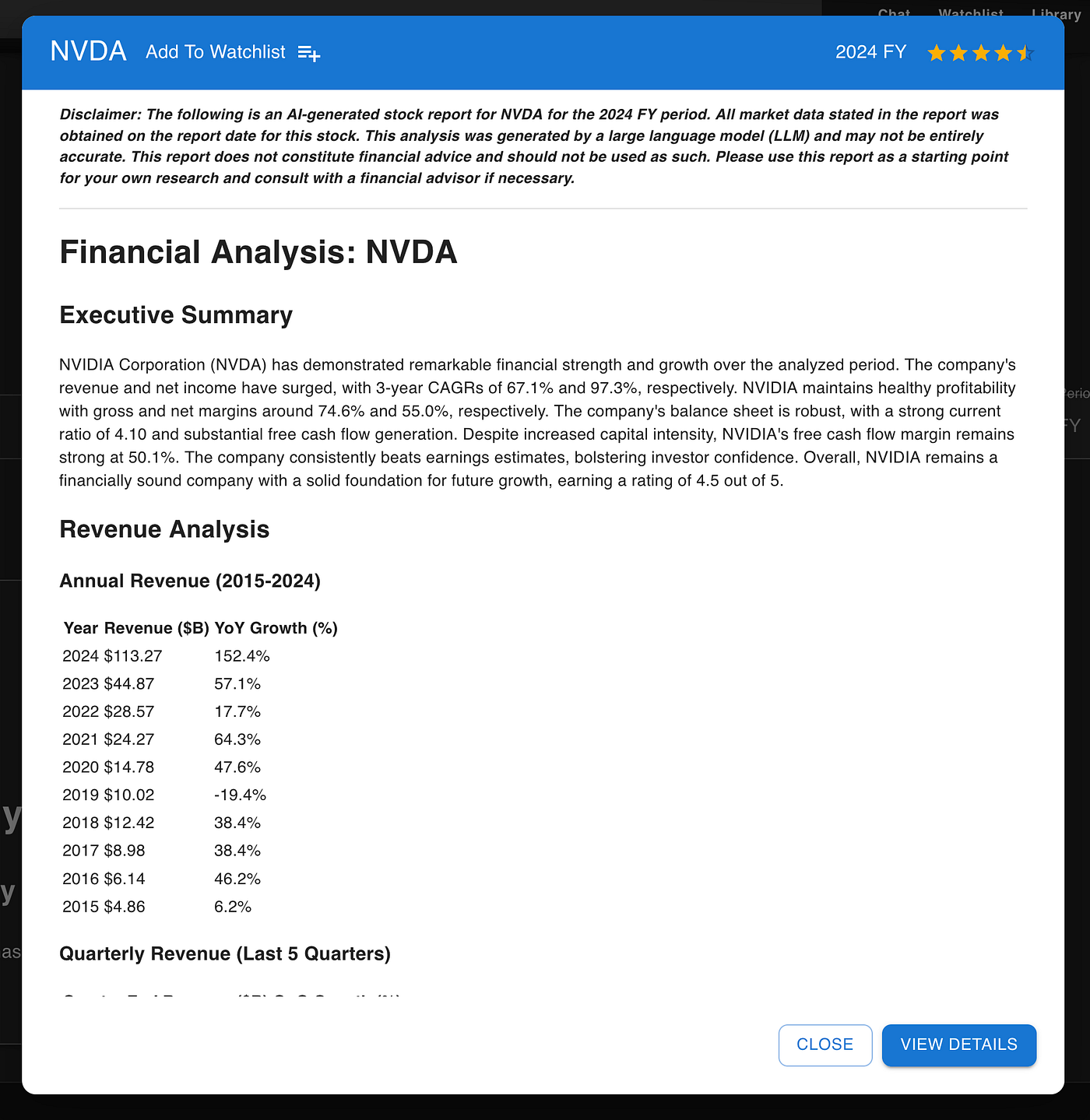
This analysis is extremely useful, especially because I’ve integrated the results into the NexusTrade AI, allowing you to find fundamentally strong stocks using natural language.
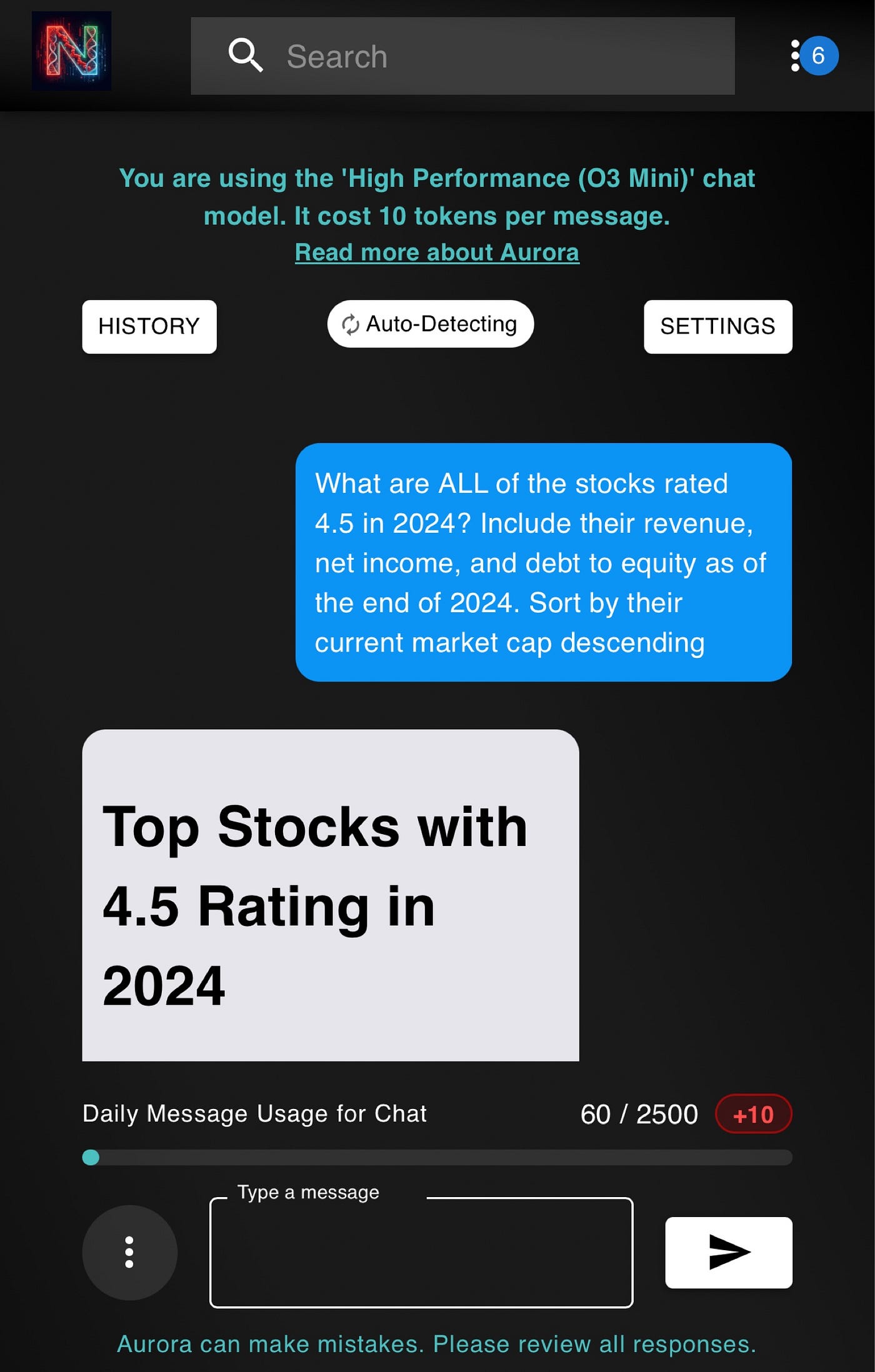
But, most retail investors don’t have a clue on how to make use of this comprehensive analysis.
This article will show you how.
Turning financial analysis into an investment thesis
You can use this list of stocks to find stock trends that hold over time. Here’s how.
The question here is whether historically highly rated stocks with low positive price-to-earnings ratios had useful later returns. P/E divides the share price by earnings per share; TTM means the trailing twelve months, so check whether the denominator covers four quarters or the single quarter being compared. P/B compares price with book value per share. A 4.5 rating is a threshold on NexusTrade’s AI-report scale, whose maximum is 5; inspect its model analysis and fiscal-period identity rather than treat it as an analyst consensus or a return forecast.
To test this idea:
- You can fetch a list of stocks with a high rating and low P/E ratio in the past
- You can backtest these stocks for the following year
- You can repeat this for as many years as you want
I use fundamentals labelled 2021 to select a list and inspect its 2022 backtest, then repeat with 2022 fundamentals and a 2023 backtest. Those are retrospective examples. Before treating either as an investable historical test, verify when each filing and AI rating became available: a 2021 label does not mean that information was known on January 1, 2022. The article does not provide that availability ledger.
However, for a comprehensive analysis, you should do this for at least 5–10 years of data. For the sake of brevity, I won’t do this in this article, but you can do it yourself here.
NexusTrade - No-Code Automated Trading and Research
Perform financial research and deploy algorithmic trading strategies
nexustrade.io
Additionally, if you want to read the full analysis, you can do so by clicking my “shared conversation” link.
Financial Analysis and Stock Strategy for 2021 and 2022
Explore a comprehensive analysis of fundamentally strong stocks with a P/E ratio below 15 from 2021 and 2022, along…
nexustrade.io
To start this analysis, I asked the AI the following:
In 2021, what were the most fundamentally strong stocks that had a positive P/E ratio less than 15?
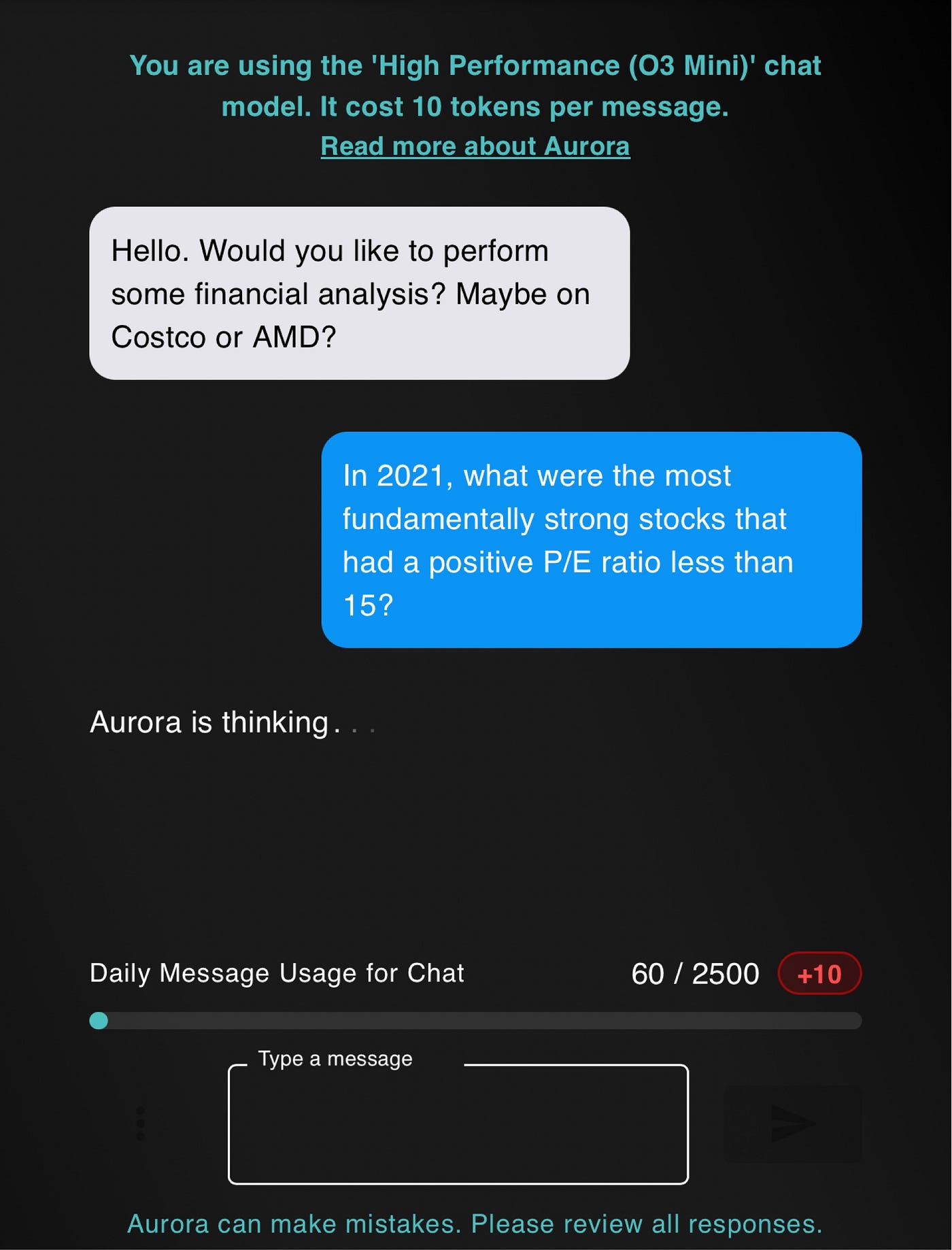
After a few seconds, we get this list of stocks.
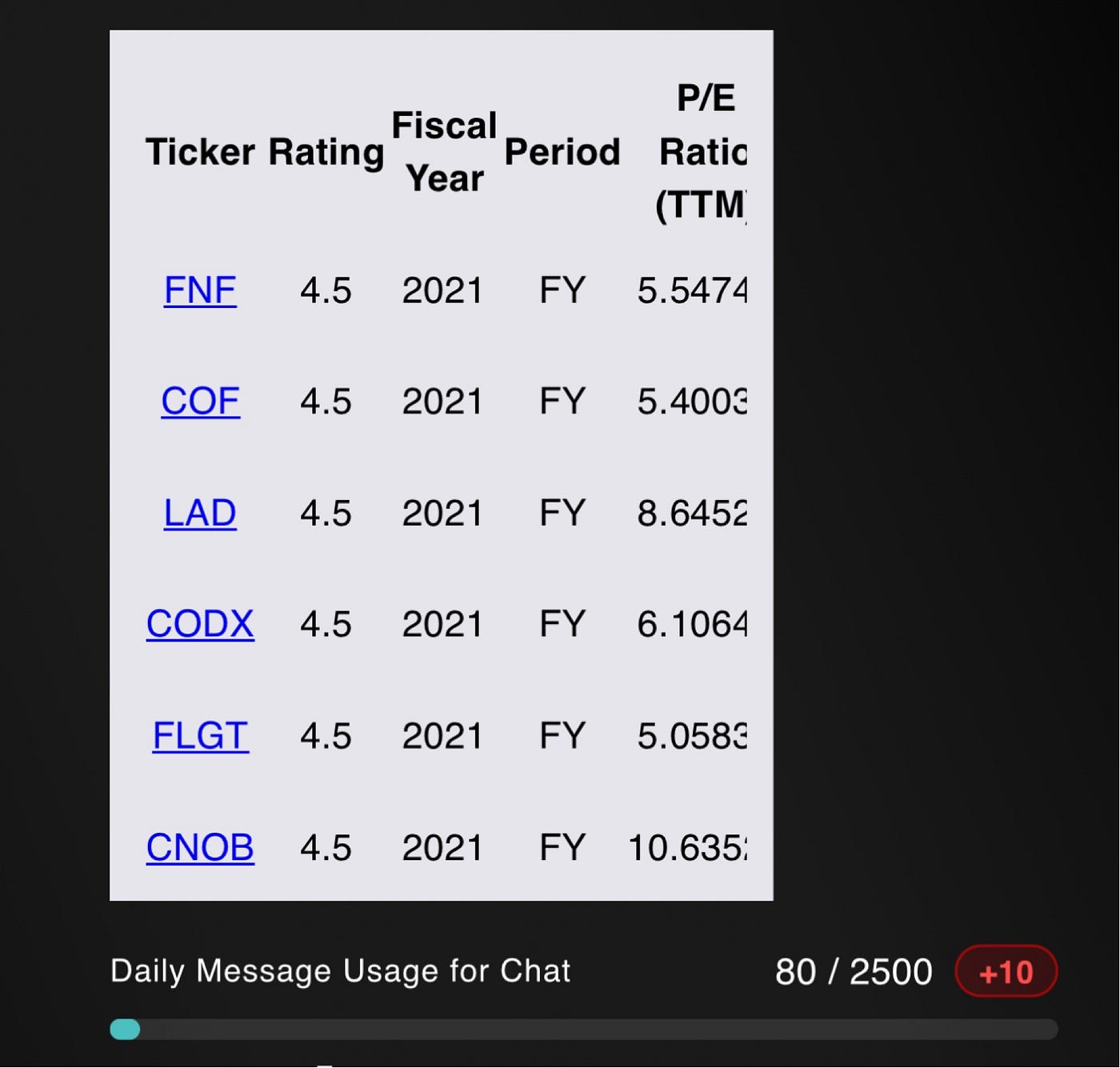
I then had a back and forth conversation to finally filter the list of stocks to only include stocks with a rating of 4.5 and a positive P/E ratio of less than 15.
I then used the AI to create a trading strategy.
Create a strategy to buy and hold this list of stocks
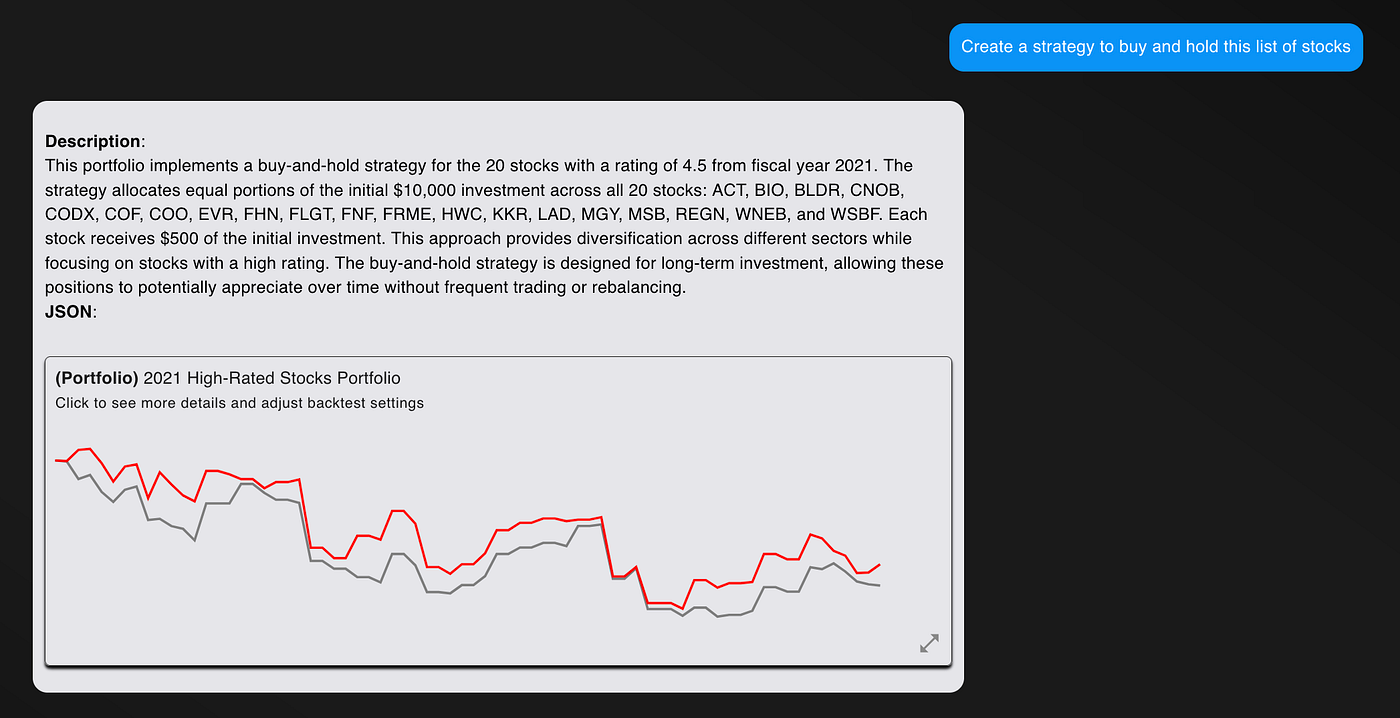
In this example, we see that this list of stocks with a low P/E ratio barely beat the market (to a negligible degree). Let’s repeat this exact thing for 2022.
In 2022, what were fundamentally strong stocks (rating 4.5+) that had a positive P/E ratio less than 15?
We get the following list of stocks.
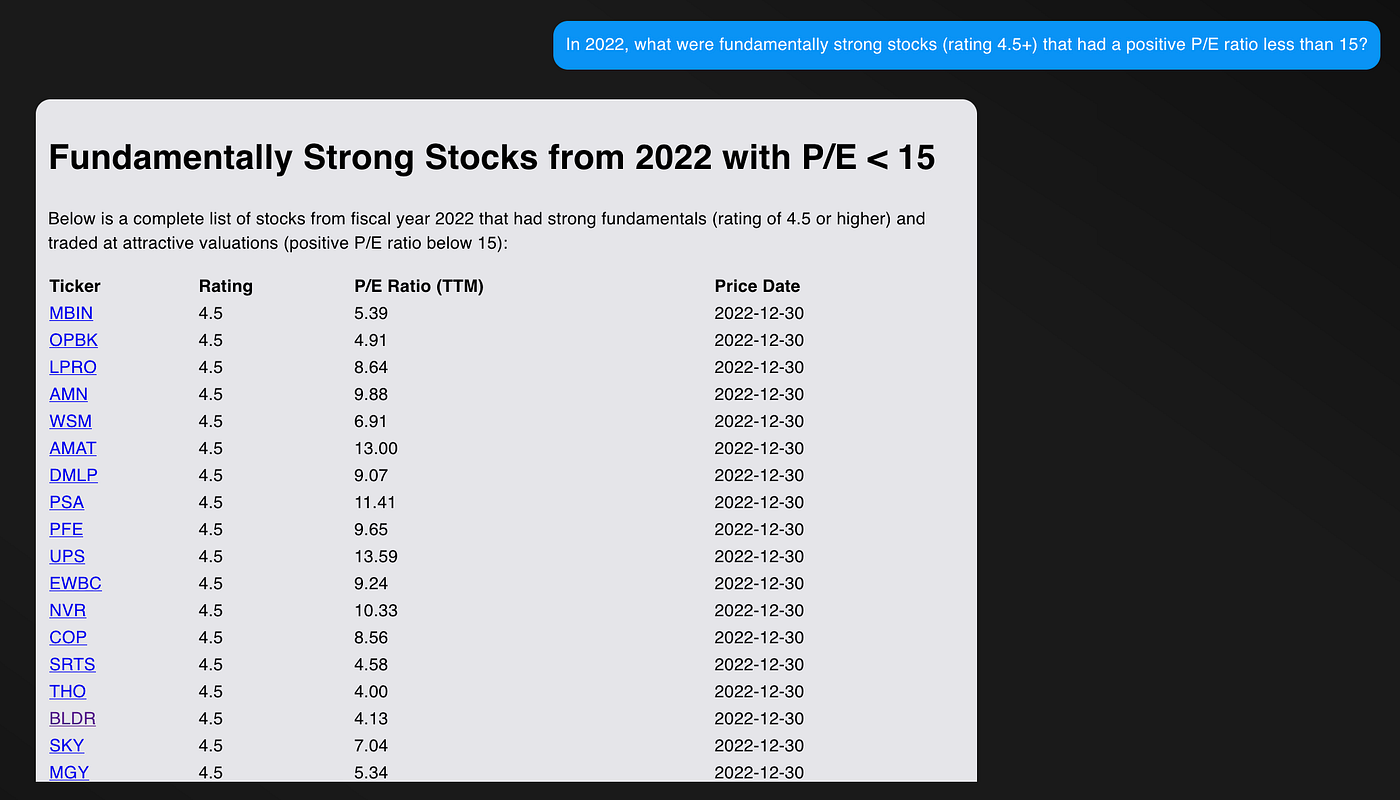
Then, like before, we can create another trading strategy.
Create a strategy to buy and hold this list of stocks
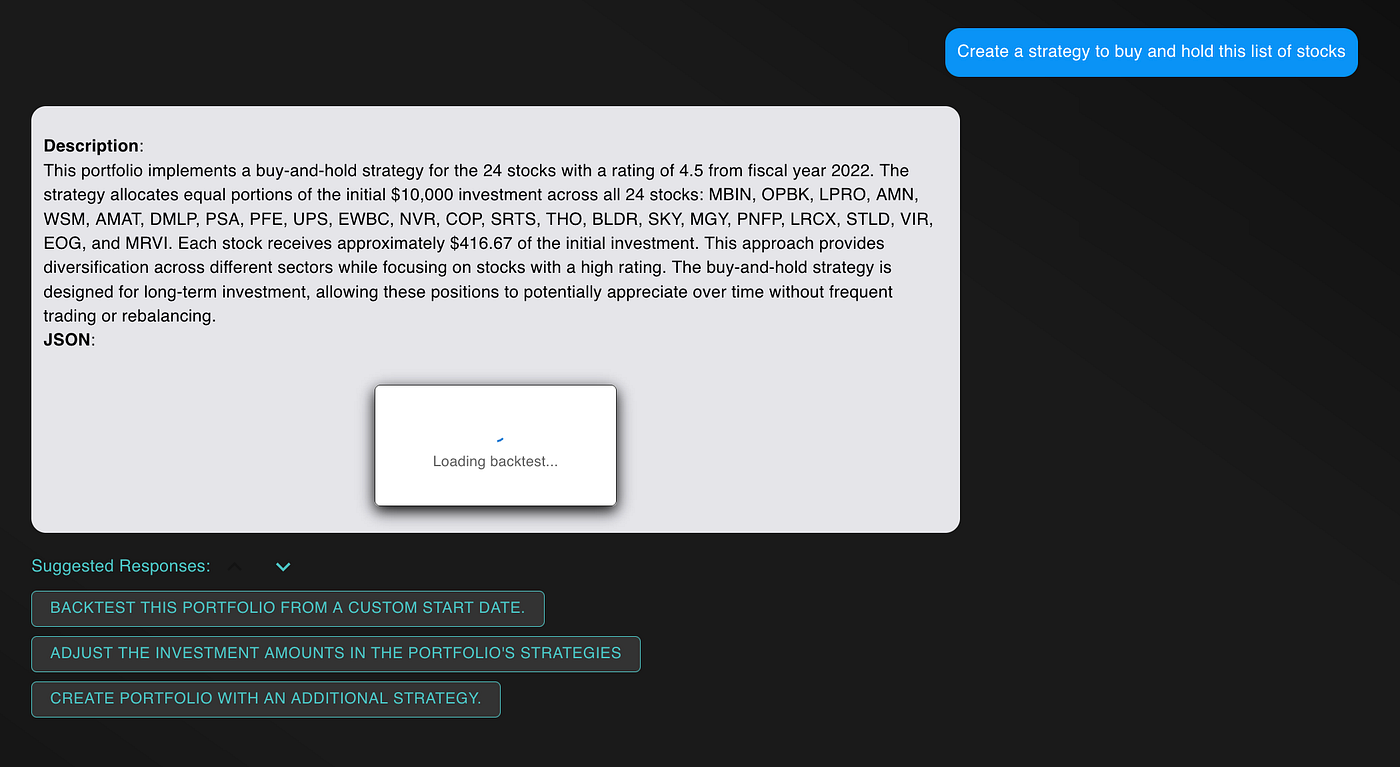
From here, we can either update the backtest settings manually.
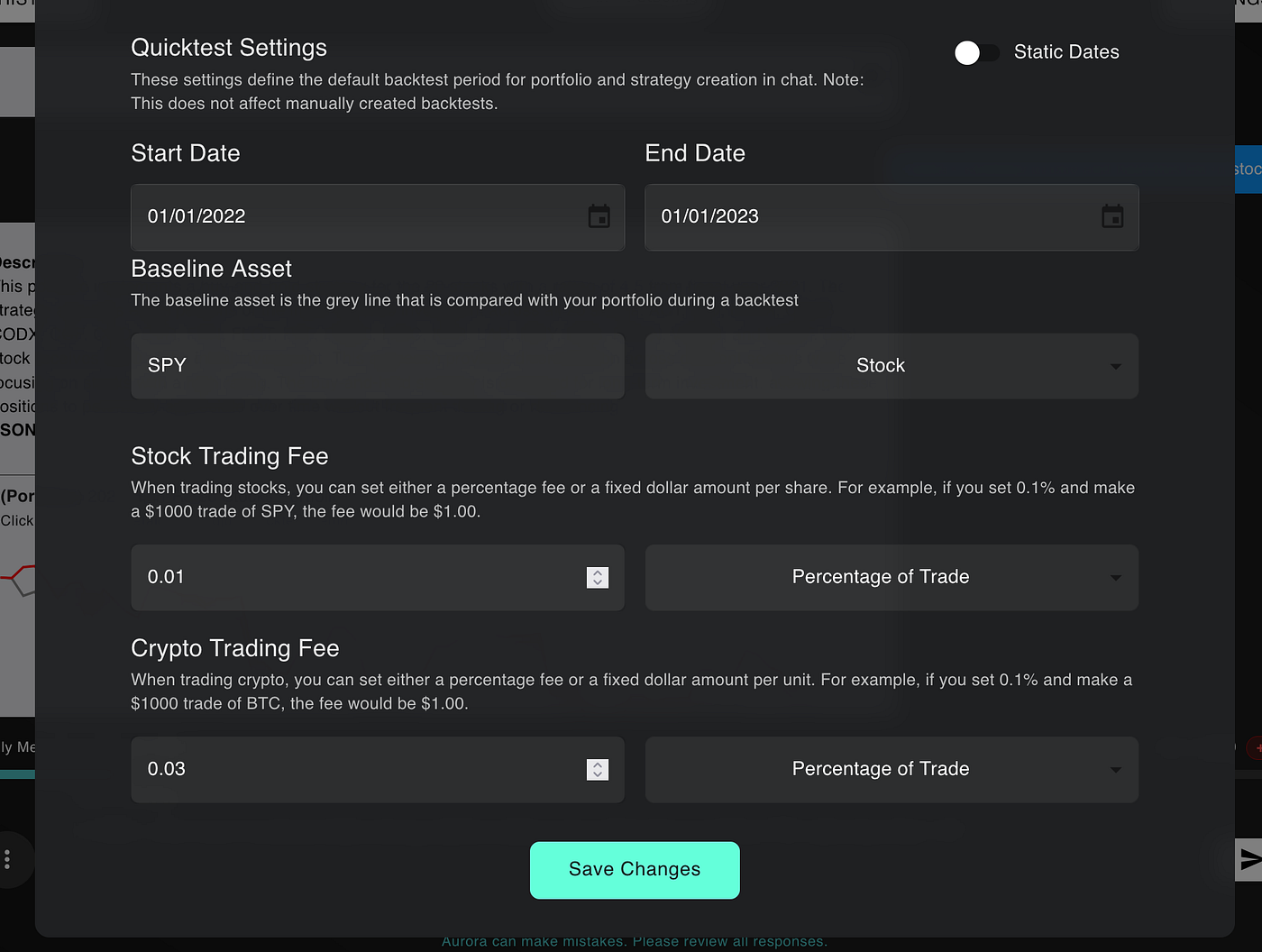
Or, we can launch the backtest by typing in the chat the exact period we want to simulate.
backtest this portfolio from Jan 1st 2023 to Jan 1st 2024
Regardless, you’ll get the following result.
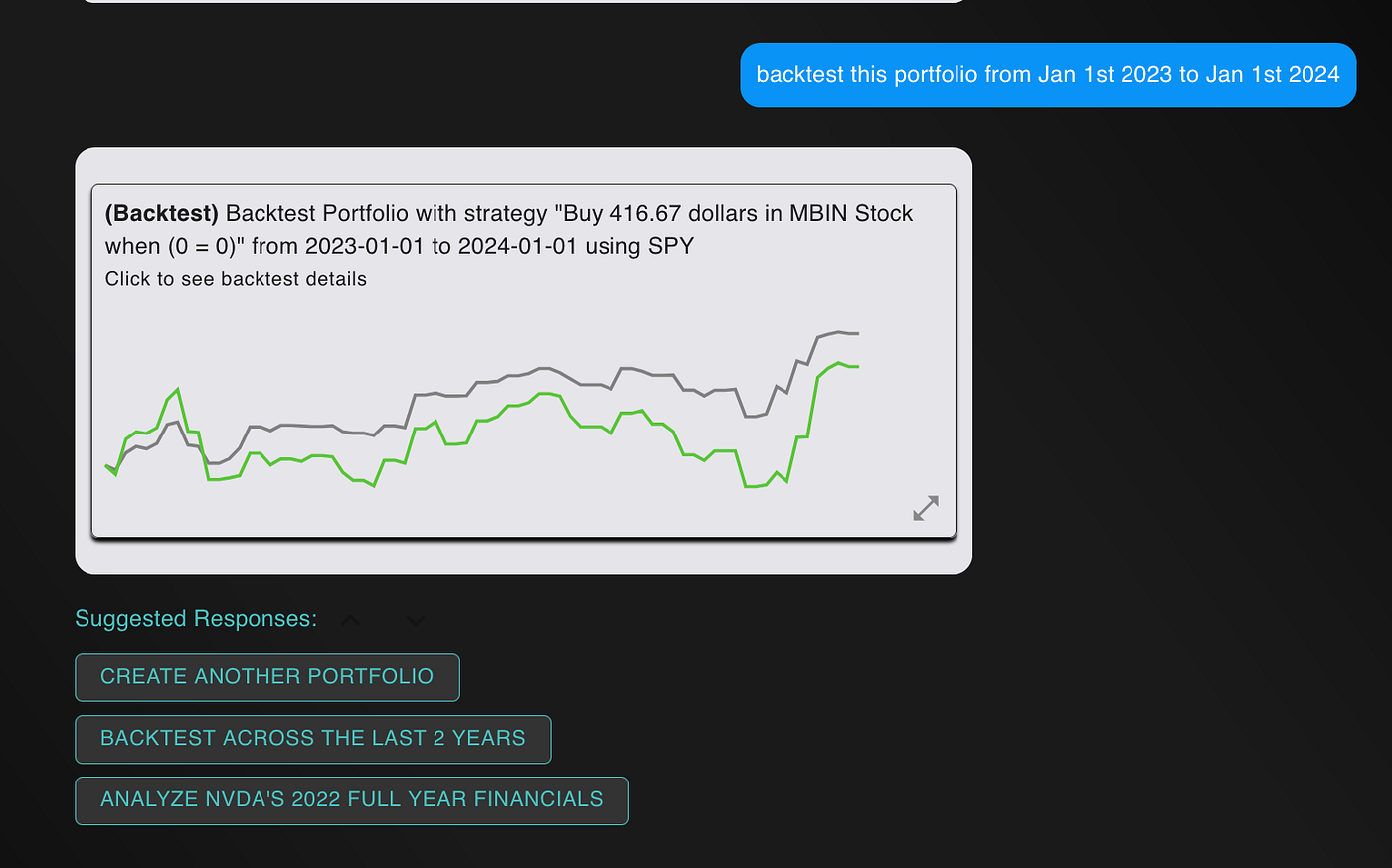
In this example, the S&P500 outperformed our list of stocks with low P/E ratios. This suggests that trying to buy “fundamentally strong” stocks with a low P/E ratio may not be a better idea than buying SPY.
This analysis is very informative. If your buddy comes to you next week and says “you should buy this stock; it has a low P/E ratio!”, you now have the practical experience to understand that P/E ratio alone is NOT a convincing argument to buy a certain stock.
And yet, even this analysis is incomplete. We can do better.
How to iterate on this analysis?
This analysis just showed ONE possible test. The results of this analysis were lackluster, but how could we do better?
I’ll leave this as homework for the curious reader. Some ideas include:
- What if we sorted by quarterly P/E ratio instead of TTM P/E ratio?
- What if we used P/B ratio?
- What if we chose the 5 lowest stocks by P/E ratio instead of the full list?
- What if we used market cap instead of P/E ratio?
- What if we did 3-year compound annual growth rate (CAGR) instead of P/E ratio?
- What if we filtered the range for stocks to be stocks with a P/E ratio between 15 and 25?
- What if we started backtesting in 2019? Or tested the robustness in 2025 (so far)?
- Better yet, what if we see if this strategy performs well in bear markets vs in bull markets?
Because of NexusTrade, we can test different trading strategies using pure natural language. We can test different technical and fundamental indicators, and gain insights into how they actually performed.
Pick one change from the list, state your hypothesis, and keep everything else fixed: selection date, universe, rating threshold, weights, rebalance rule, costs and test endpoints. Compare that one variant with the original and SPY. Keep the attempted variants in your notes so a lucky winner is not mistaken for the whole search.
Periods you have repeatedly inspected are development data. Freeze the selected rules and data-timing assumptions, then evaluate a later period you have not used to choose them. If the result remains useful after that check, observe the rules in paper trading and compare actual signals and fills with the intended behavior before considering a funded deployment. Passing a tuned Covid and bull-market test does not establish readiness.
Prepare one controlled fundamental-stock experiment. Review its dates, available inputs and rules before running it.
If you made it this far, then I know exactly which option you’ll choose.
And I can’t wait to hear about what you created in the comme
NexusTrade AI Chat - Talk with Aurora
Talk to an AI assistant to perform financial analysis and create algorithmic trading strategies.
nexustrade.io
No comments yet.