How I used this well-known technical indicator to beat the market by more than 100%
How to use the Simple Moving Average to Outperform the Market

I saw a “TikTok guru” make an outrageous claim.
And it turns out he was right.
In the Tiktoker’s video, he claimed that United Health (UH) is a great buy right now because its approaching its 200 day Simple Moving Average (SMA). He said that the 200 day SMA is like a trampoline, and that big stocks like this bounce tend to bounce back up.
I couldn’t wait to call him out.
I did my research, analyzed some stocks, and made a shocking (and humbling) discovery. He was right on the money. I then transferred these insights into a trading strategy that’s up over 140% in the past two years.
This isn’t theoretical. You can subscribe to the portfolio right now by clicking this link.
Here’s exactly what I did.
A Trampoline for Healthy Stocks
First, my goal was to see if stocks really act like a trampoline if it hit its 200 day SMA. I decided to some research with NexusTrade. More specifically:
NexusTrade’s AI is able to fetch historical data and answer questions about the stock market. I started with something simple. You can follow along with the full conversation by clicking this link.
What are the top 100 stocks by market cap?
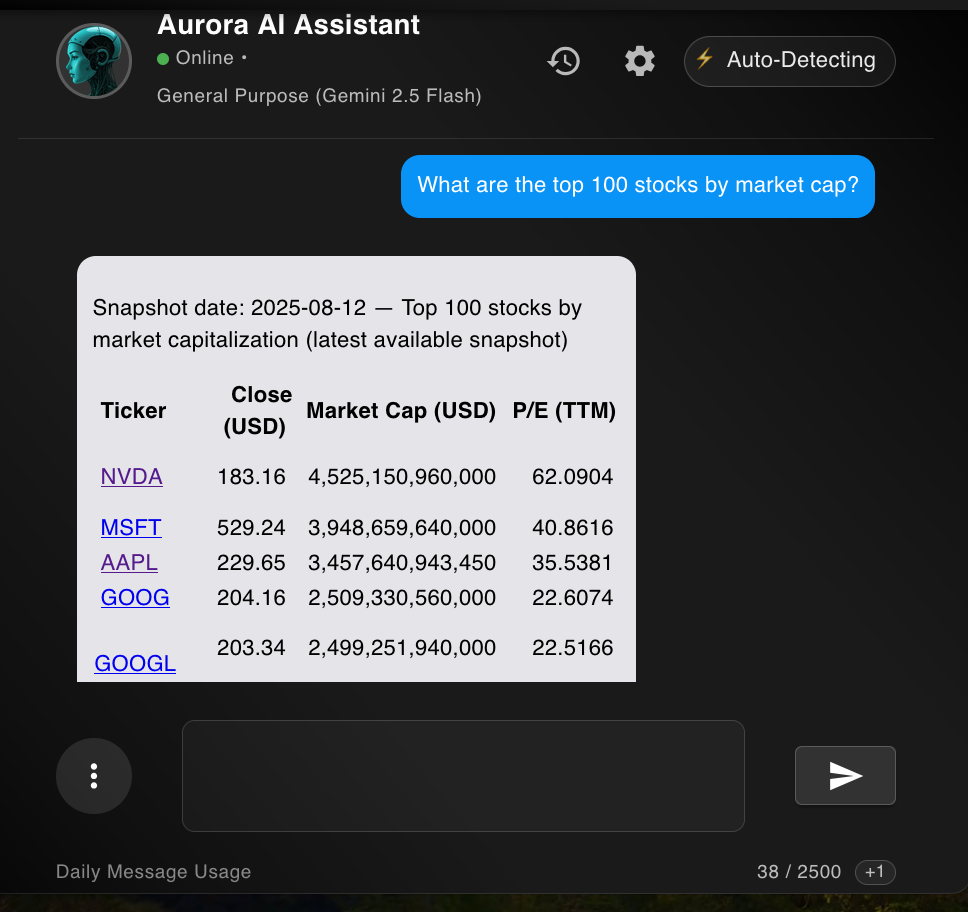
As expected, this list contained some of the household names we all know – NVIDIA, Microsoft, and Google.
However this list wasn’t the important thing we wanted to see… the next question was.
If a stock on this list falls below its 200 day SMA, in the past 10 years, what’s the probability that it will rise 10% or more from its SMA?
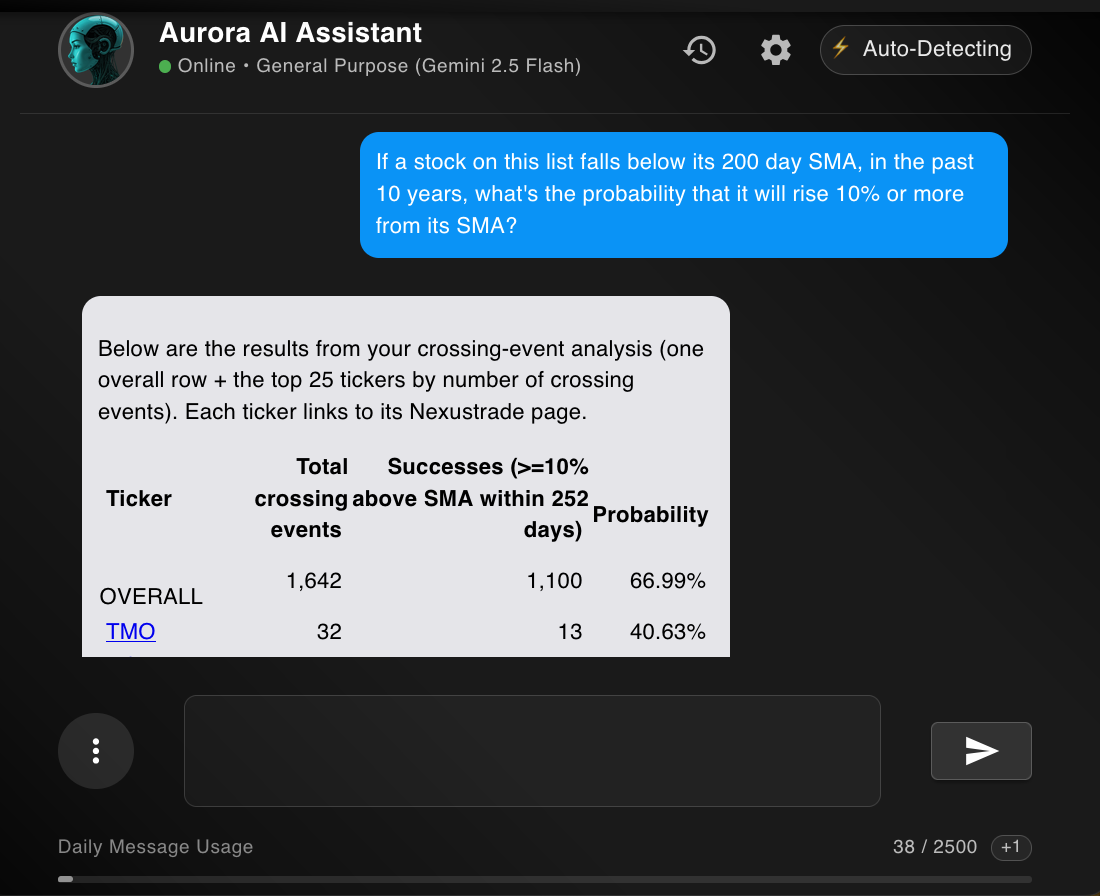
I used the top 100 stocks by market cap as a cheap filter for decent stocks. While not every single stock on the list is what we would call “fundamentally strong”, we also know that these aren’t cheap useless penny stocks either.
The result from the AI was shocking.
According to the data, there is a 67% chance that a stock will skyrocket 10% or more from its 200 day SMA within the next year. This acts exactly like a trampoline from the original video.
I was dumbfounded.
I followed up with another question to see how fast we can expect this bounce back.
If a stock on this list falls below its 200 day SMA, in the past 10 years, what’s the probability that it will rise 10% or more from its SMA within the next 90 days?
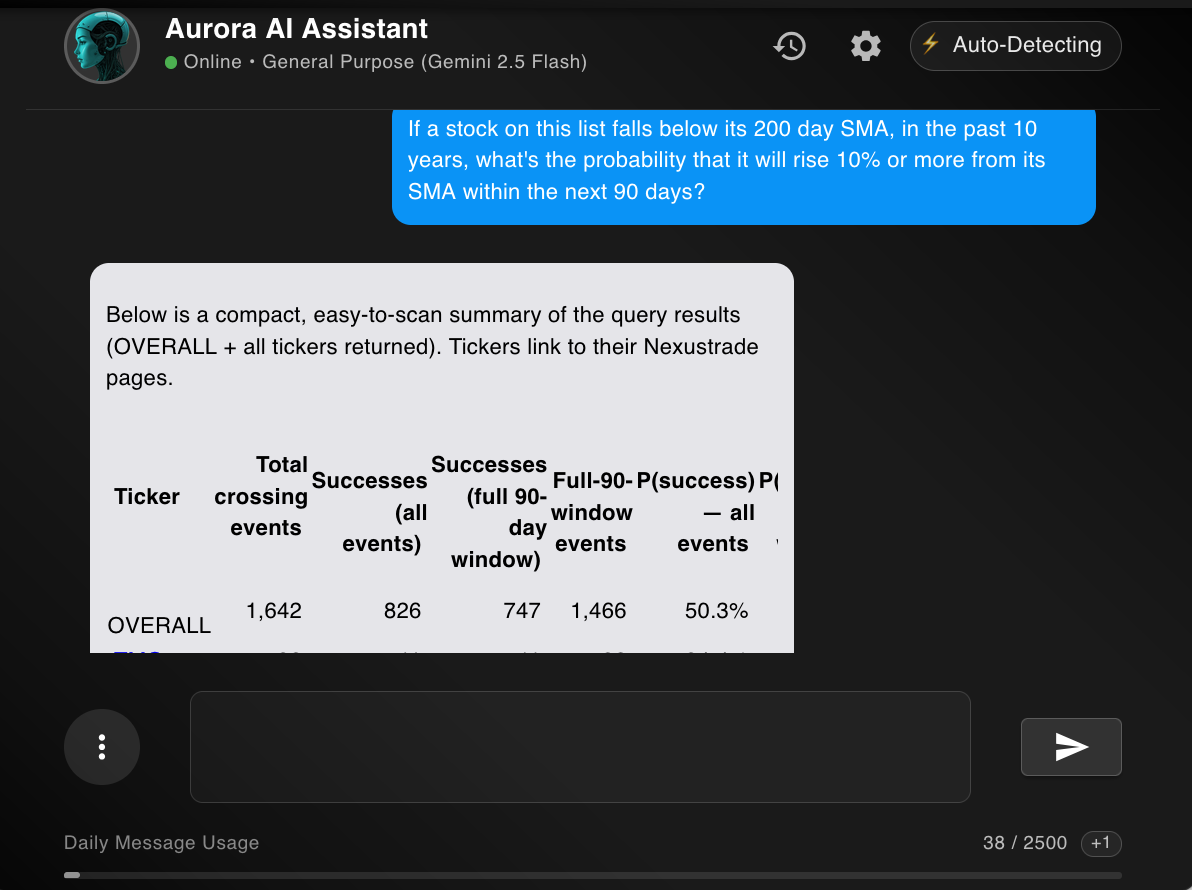
The results are impressive. The probability was 50%.
It would be one thing if the probability the stock goes up was 50%, but this is an entirely different thing — the probability goes up 10% or more.
That’s a huge jump.
From my research, I can say that the Tiktoker was kinda right. If a stock is below its 200 day SMA and its a large cap giant, there’s actually a decent chance that the stock will move up significantly shortly after.
But the question remains… how do I make money from this?
Transforming Insights into Trading Strategies
Using these insights, I transformed these facts into a trading strategy. Within NexusTrade, I did the following.
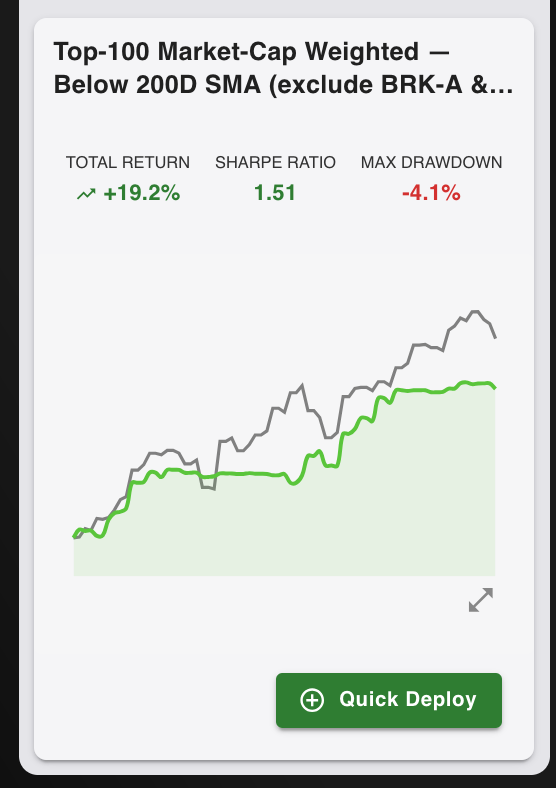
Create a strategy with the original top 100 stocks by market cap excluding BRK-A and GOOG (since we already have BRK-B and GOOGL). It should rebalance weighted by market cap every 90 days. We should filter to only include stocks below their 200 day SMA.

The strategy that was created was fairly decent. It had a very low drawdown, a very high sharpe ratio, and a modest percent return (even though it was less than SPY).
I thought I could do better.
Before continuing, I then thought about the first principles of backtesting. The current list of stocks in the portfolio were obtained from the most recent date – this introduces a tricky problem called lookahead bias.
Lookahead bias is when you backtest a strategy using future information. If we think about it, in 2022, we don’t know what the top stocks by market cap would be in 2025. But by using a list of stocks from the most recent date, it “taints” our backtest results.
Back to square one.
I then re-fetched the list of stocks from a specific date in the past. No, I didn’t cherry-pick.
What are the top 100 stocks by market cap as of 2022?
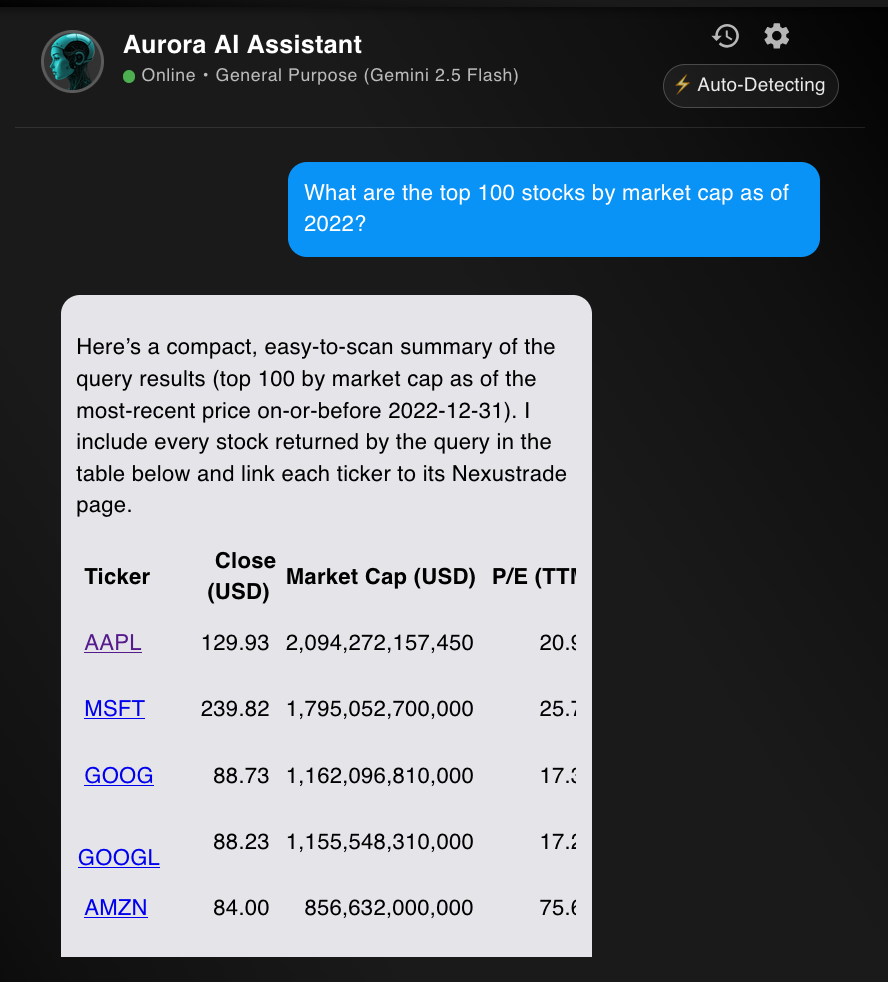
This time, the top stocks included Apple and Amazon. The list was now completely free of lookahead bias.
I then continued.
With the first portfolio above, we rebalanced the portfolio at regular intervals regardless of the positions within it. In practice, this means if we initiated a rebalance but haven’t quite profited from the position yet, we may sell too early to realized the gain.
I wanted to fix that.
For my last attempt, I asked the AI to create the following strategy. And wow, were the results impressive.
For the new list of stocks in 2022, create this strategy. Every month, rebalance the new 100 stocks by market cap excluding BRK-A and GOOG. Filter to only include
* stocks below the 200 day SMA OR
* we have positions in our portfolio and the positions percent gain is less than 10%Limit 7. The only condition is every 30 days
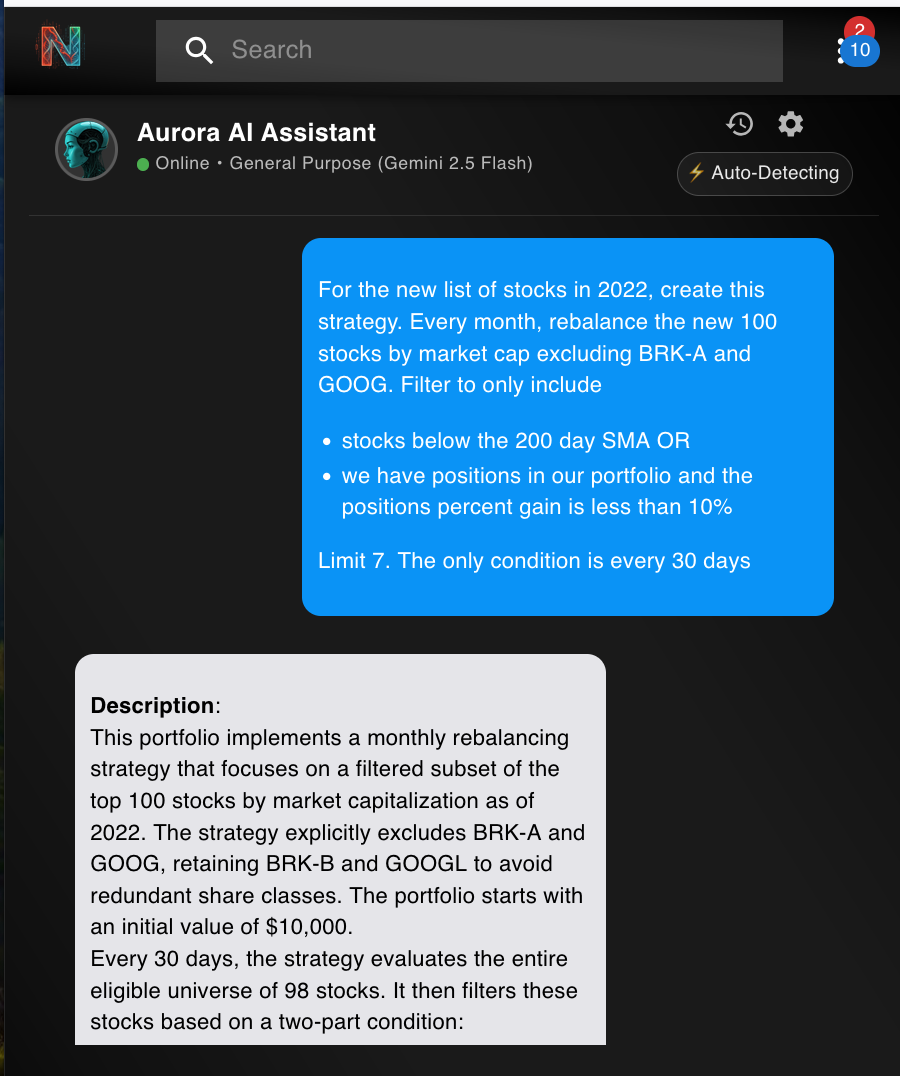
Seconds past and the backtest ran and ran. And then we saw something incredible.
A portfolio that signficantly outperformed the market by a wide percent.
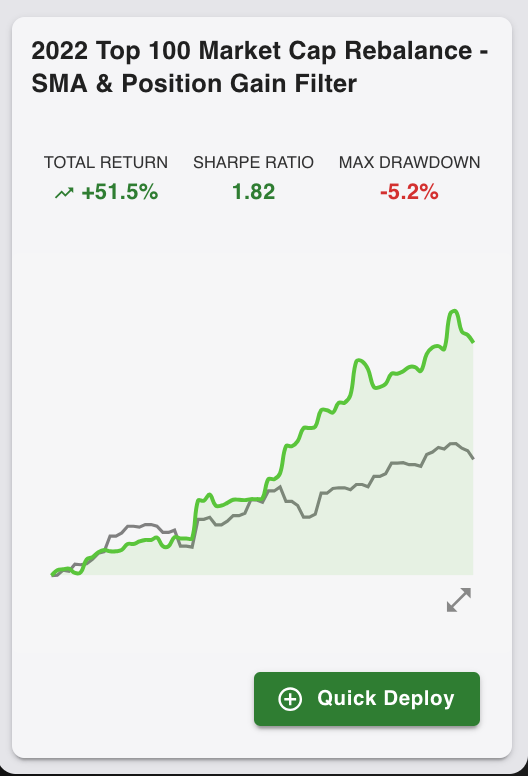
I backtested this portfolio for several more periods, including from 2023 to today and year-to-date. In each test, the strategy does incredible, withstanding market pullbacks and giving amazing returns.
More specifically, from 01/01/2024 to 01/01/2025:
- The strategy has a 51.50% gain (compared to SPY’s 25.72%)
- It has a higher sharpe ratio (1.82 vs 1.31) and sortino ratio (2.24 vs 1.49)
- It has a lower maximum drawdown (5.23% vs 9.42%)
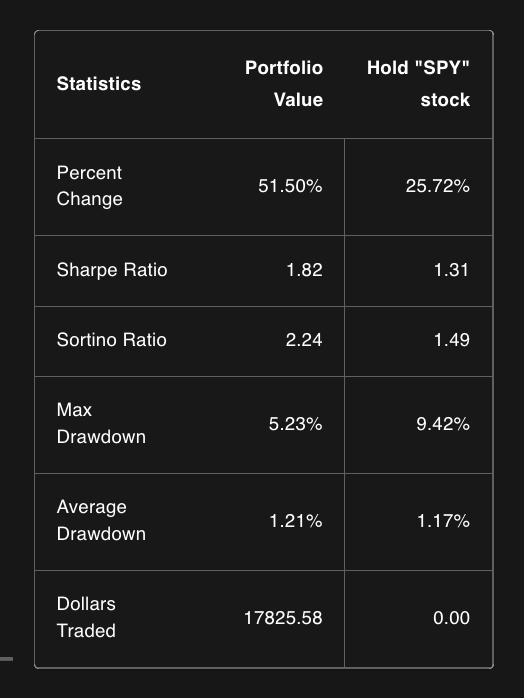
In other words, the drawdowns are never worse than SPY, but the returns (and the risk-adjusted returns) are always better.
That’s incredible.
I decided to launch two more backtests, and this pattern of outperformance holds over time.
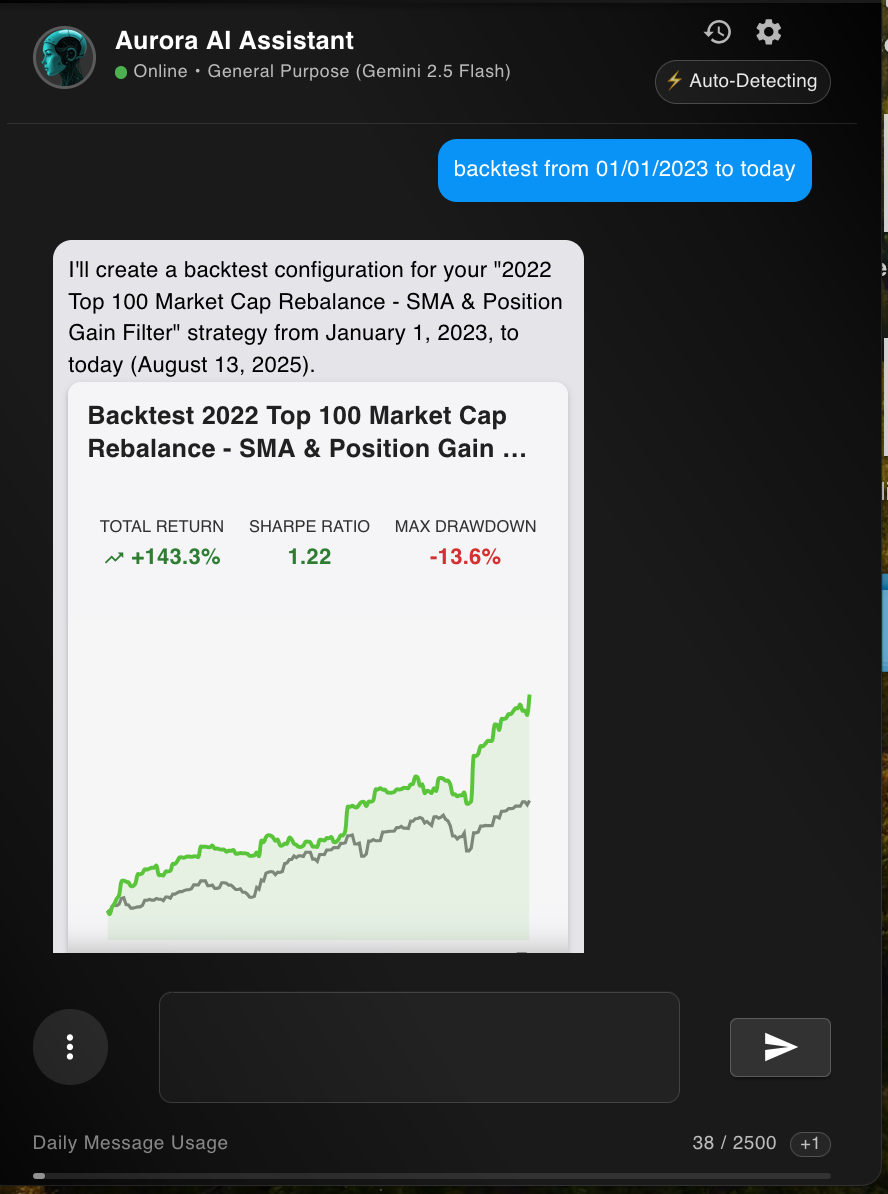
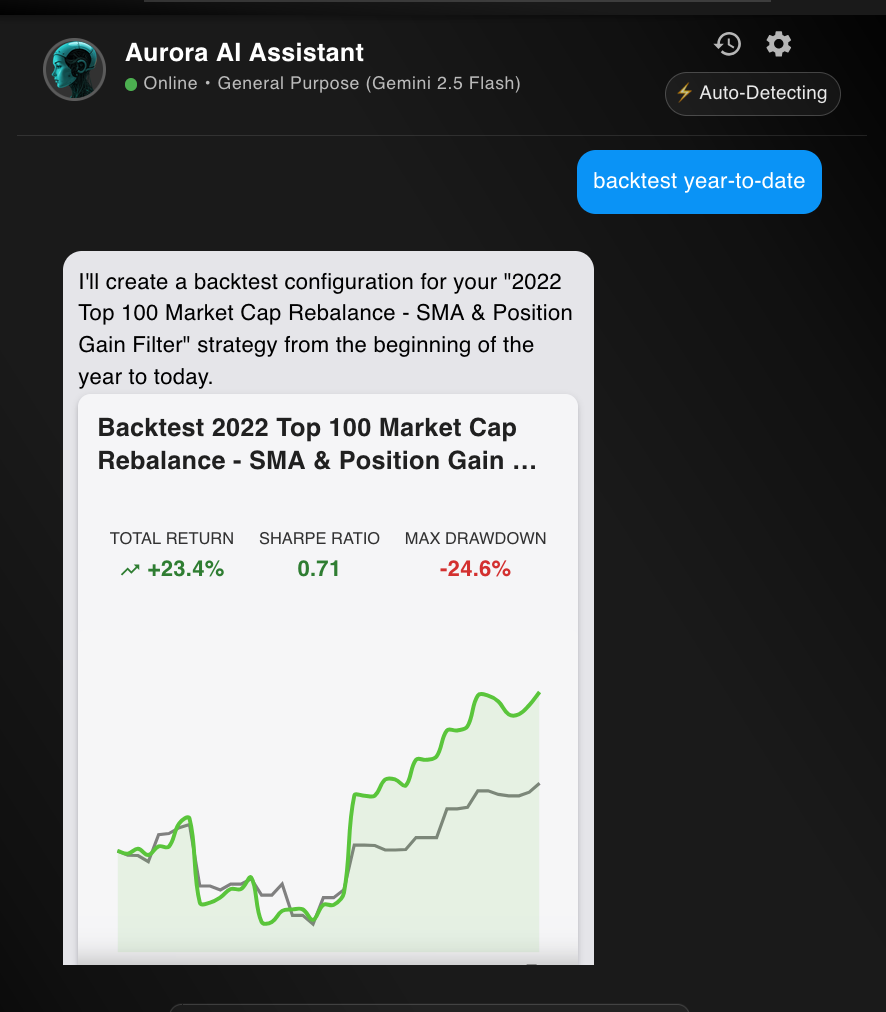
While getting a strategy to be this good on recent historical data is a significant challenge in of its own, the real question is if a trading strategy fares well over time.
So I tested that too.
Expanding our test horizon
Just like before, I decided to fetch a list of the top 100 stocks by market cap in the past. This time, I chose 2018 so I can evaluate how this strategy does near the beginning of the Covid pandemic. Follow along step-by-step here.
What are the top 100 stocks by market cap as of 2018?
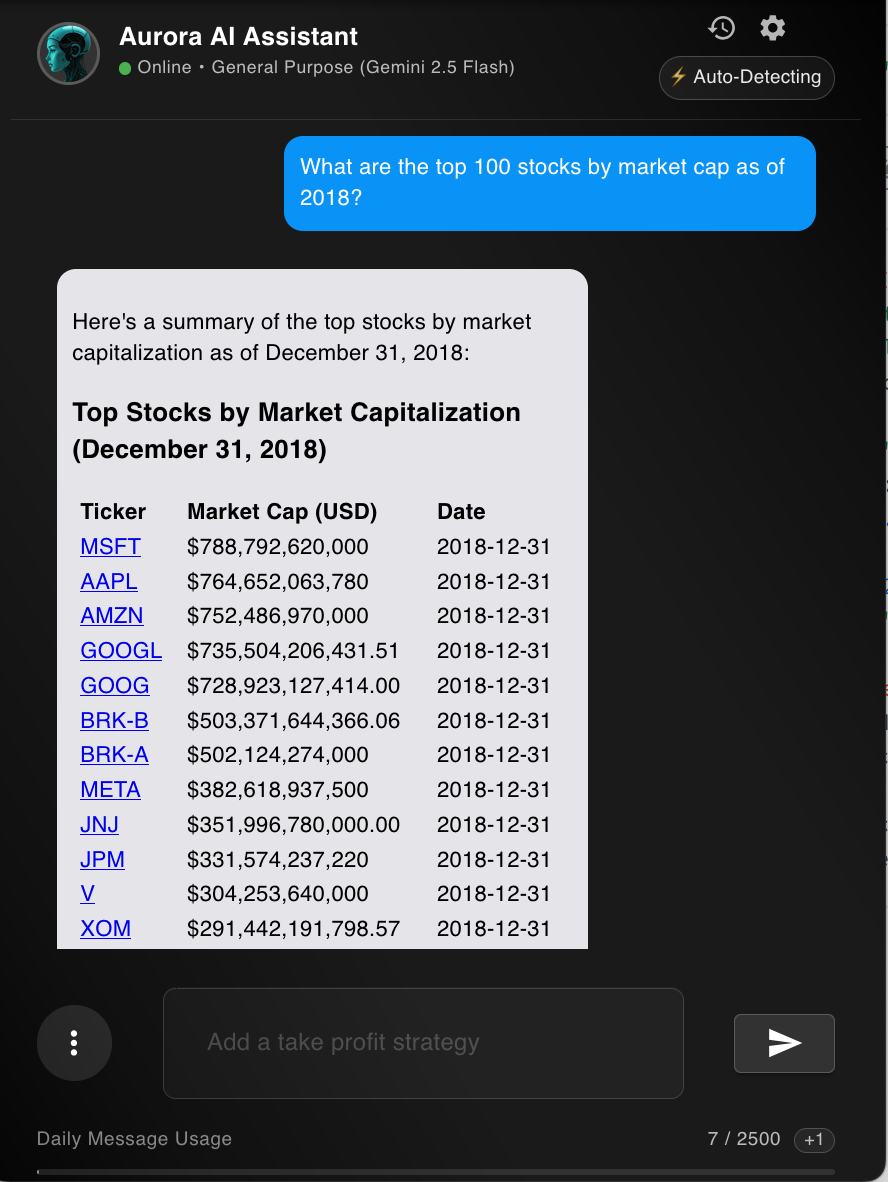
Then, I transformed this list of stocks into a trading strategy.
Create this strategy. Every month, rebalance the new 100 stocks by market cap excluding BRK-A and GOOG (because we have BRK-B and GOOGL). Filter to only include
* stocks below the 200 day SMA OR
* we have positions in our portfolio and the positions percent gain is less than 10%
Limit 7. The only condition is every 30 days
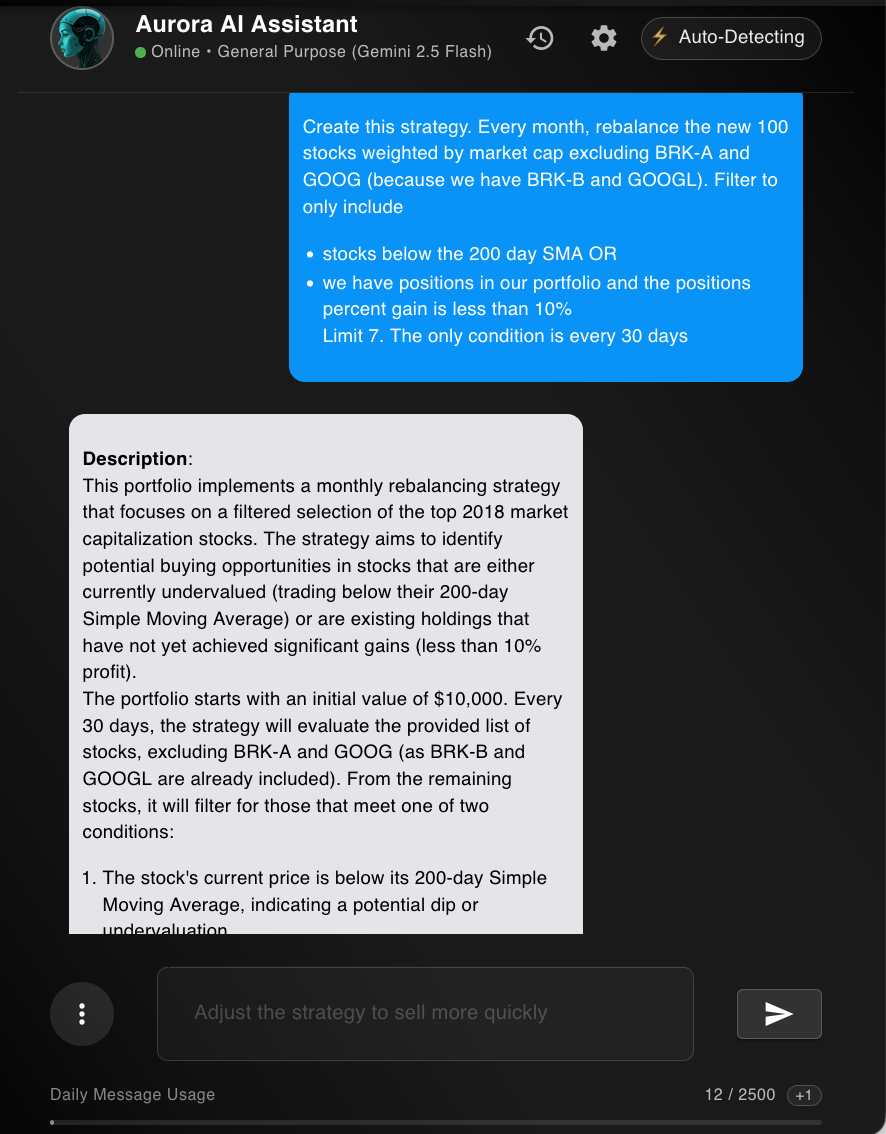
Because of my chat settings, the AI automatically performs a backtest from 01/02/2024 to 01/01/2025. It still does exceptionally well, despite the fact that the list of top stocks is “stale”.
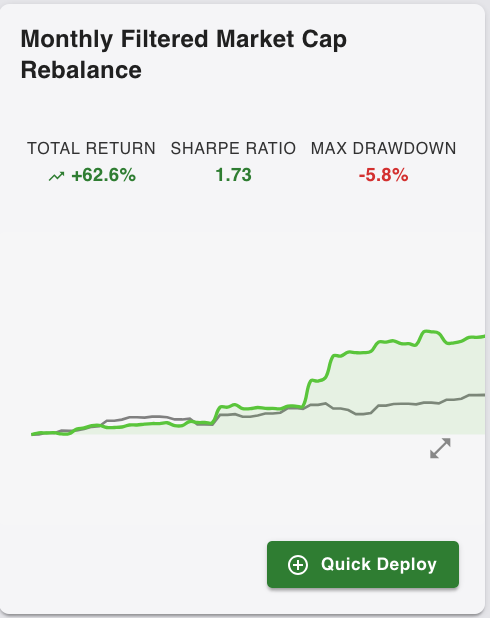
However, that’s not the goal of this particular test. The real test is to see how this strategy does during periods in the past. Using the AI, I tested this easily, and again, the results stood the test of time.
Create these backtests:
* 01/01/2018 to 01/01/2019
* 01/01/2018 to 01/01/2020
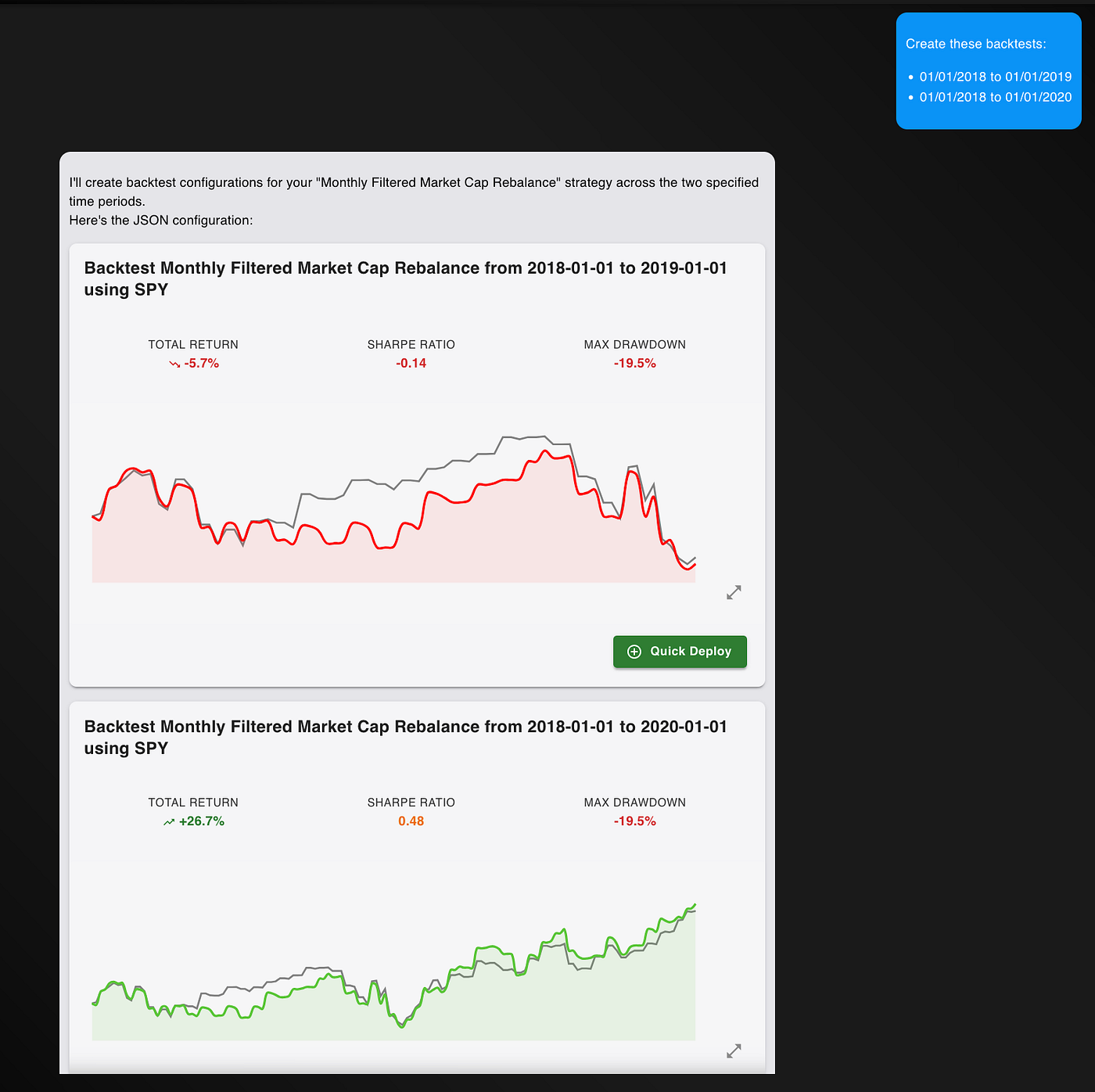
During these periods, our strategy roughly matched the performance of the market. The total return, sharpe ratio, and max drawdown were within a few percent of holding SPY.
Redoing the whole experiment for 2018 stocks (fetching the list, creating the portfolio, and running the backtest), we got similar, (but slightly worse) results.
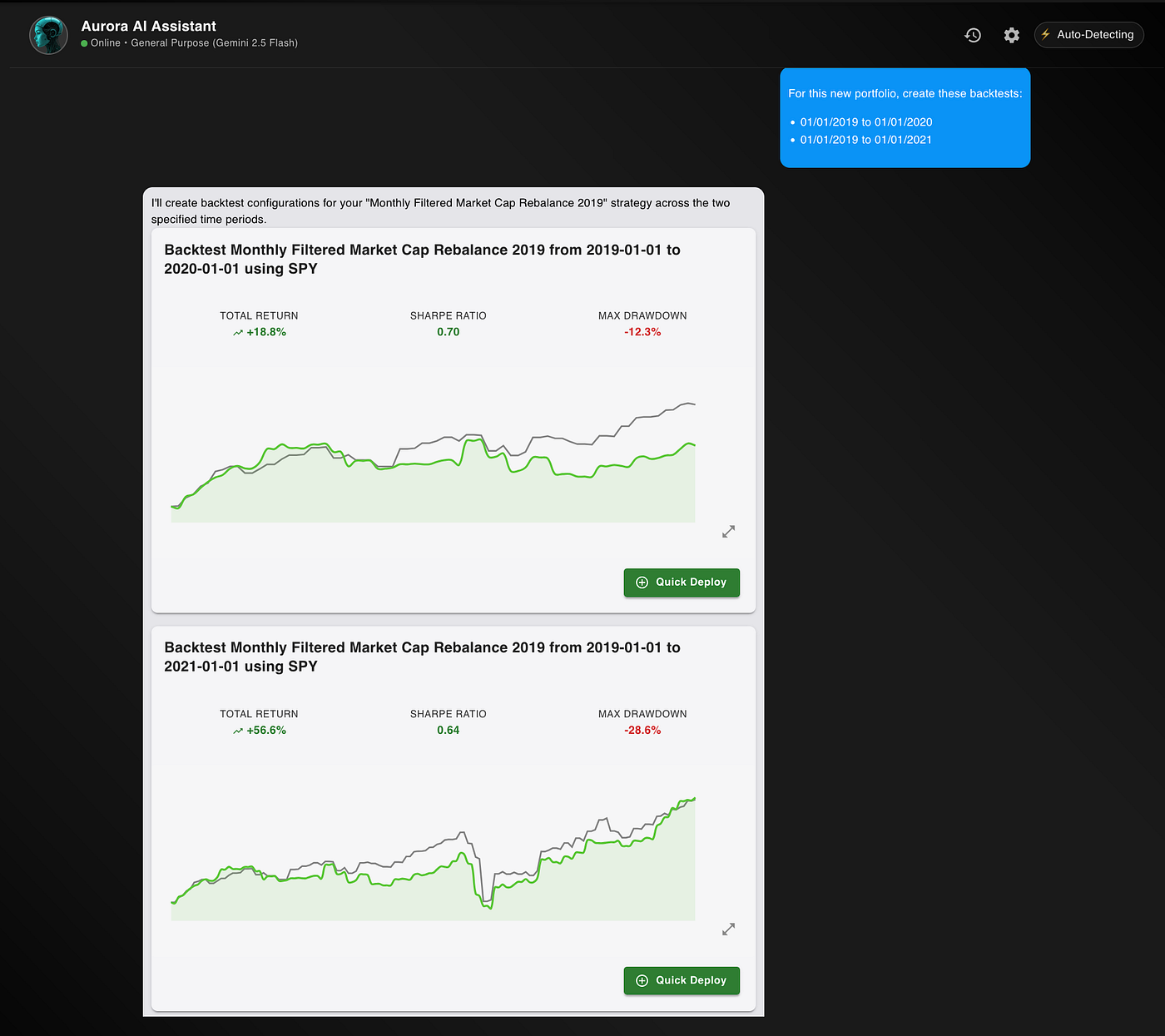
In this run, the list of stocks does well but fails to outperform the broader market in the backtest from 01/01/2019 to 01/01/2020. In the other test, it successfully matches the performance of the market with less volatility.
In total, out of the 8 backtests, it matches the performance of SPY in 3, underperforms the market in 1, and significantly outperforms the market in 3. That makes it a fairly robust strategy that can stand the test of time for multiple years. But clearly, it isn’t perfect.
So what now?
Caveats of these results
This article shows that its possible to create a market beating strategy using the most basic technical indicator (ie, the 200 day SMA). However, it also shows that the strategy isn’t perfect, underperforming in certain (highly bullish) market conditions and matching the market in other conditions.
The strategy is not a silver bullet.
There are some important caveats that need to be stated. To start, the past does not equal the future. Even if we found that this strategy outperforms in every single market condition, that does not mean the strategy will continue to fare well over time. Past performance does not guarantee future results.
This fact is what makes trading so hard.
Nonetheless, this strategy represents a brilliant and easy-to-implement starting point for algorithmic trading. The rules in this strategy are very simple; we just blindly took the top 100 stocks by market cap at certain time period.
Can we do even better?
What if we added additional filters?
What if we rebalanced at equal weight instead of by market cap?
Or what if we used P/E ratio as a filter to exclude potentially overvalued stocks?
Thanks to AI, the possibilities are limitless. We can use AI to perform in-depth financial analysis and test out algorithmic trading strategies. What started as an experiment to disprove a TikToker ended up teaching me about a surprisingly effective and easy-to implement trading strategy. The next time you see a stock that you like is down massively, take another look at it.
You might’ve just hit the jackpot.
Want to subscribe to this exact portfolio? Check it out here on NexusTrade!
No comments yet.