GPT-5 Mini is the BEST AI Model for Complex Reasoning Tasks
GPT-5 may have disappointed. But its "mini" model punches above its weight class

Like the entire world, I too was disappointed in GPT-5.
GPT-5 under-delivered. While not a bad model by any metric, its roughly equivalent to the current state-of-the-art.
There’s nothing new here.
However, in my evaluations, I found a hidden secret. One model stood out for being reliable, dirt cheap, and immensely capable, outperforming models 10x the cost in complex reasoning tasks.
Hidden amongst the hype is the best budget model ever created. GPT-5-mini is absolutely outstanding, and is the best AI model for normal daily usage.
Here’s the proof.
An Inexpensive and Insanely Powerful Daily Usage Model
I want to be very clear what “category” GPT-5-mini is in.
It’s not state-of-the-art. It’s a budget-friendly alternative.
It’s in the category of models that I would call “dirt-cheap”. You can use it for tasks that require millions of tokens, and barely spend a few bucks. The other models in its weight-class include Gemini Flash 2.5 and OpenAI’s 4o-mini.

Unlike a model like Claude Opus 4.1, (which cost $15/M input tokens and $75/M output tokens), these budget models cost 1% of that, making it suitable for real-time, high-volume use-cases.
For over four months, Gemini was the undisputed best model for daily usage . However, with the launch of GPT-5-mini, there is another clear winner.
Here’s how I determined this.
Defining the Complex Reasoning Tasks
To objectively evaluate each large language model, I created highly personalized benchmarks for two different real-world complex reasoning tasks.
At a high-level, these tasks are SQL Query Generation and JSON Object Generation, but in truth, the real tasks are more nuanced.
Allow me to dig deeper.
Testing Each Model in SQL Query Generation
One of the most important reasoning tasks is understanding how good each model is at generating syntactically and semantically-valid SQL Queries.
This is extremely important. If a model can convert plain English questions into SQL Queries, non-technical investors can extract real insights without needing to know how to code.
For example, if a user wants a list of fundamentally strong biotechnology stocks, a model that is good at generating SQL Queries can help users find accurate, data-backed answers – not from its training data, but from actual comprehensive stock analysis.
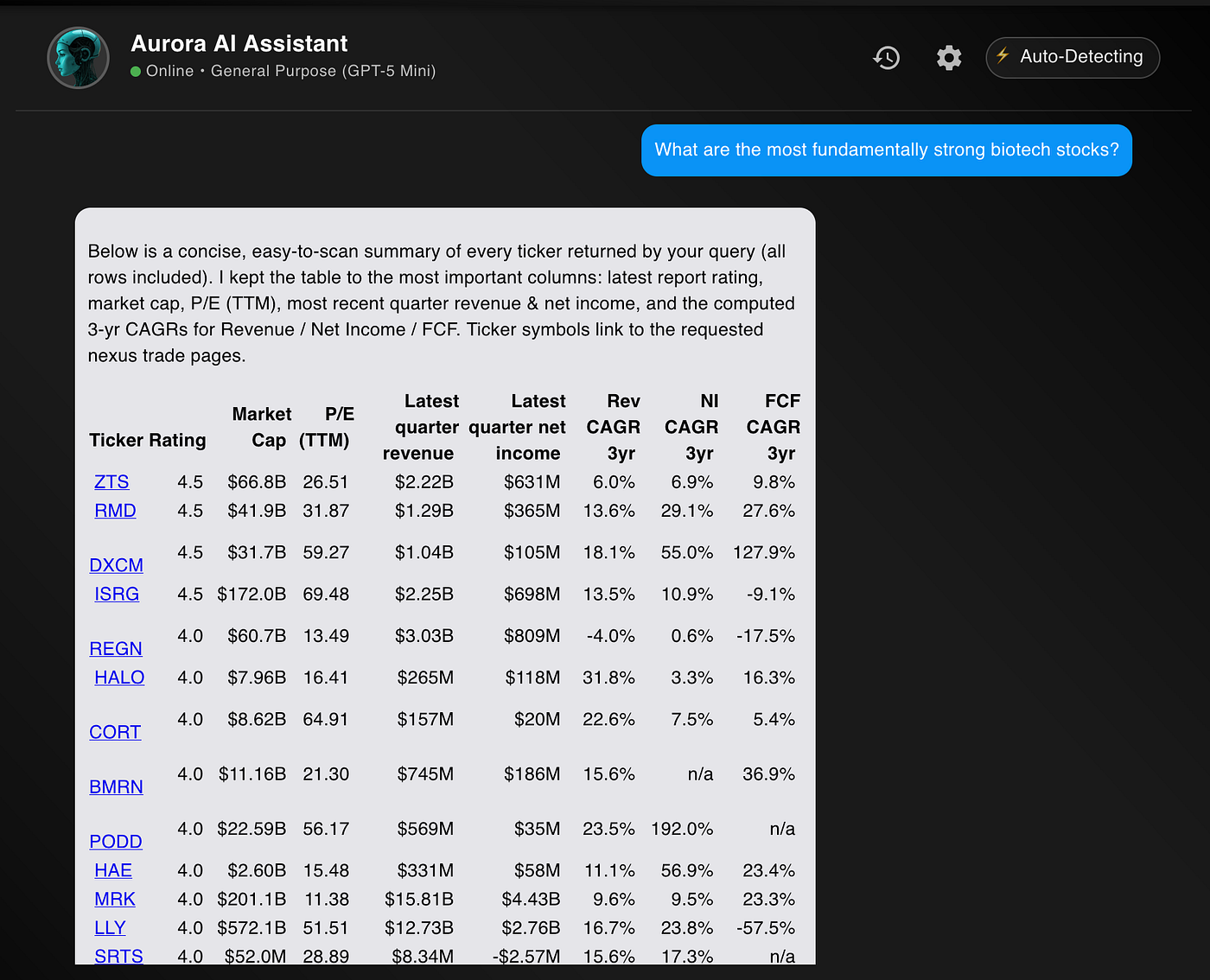
The process for generating getting these results is as follows.
- I first uploaded financial data from a high-quality data provider ( EODHD) into an analytics database
- I then created a system prompt capable of querying the database
- I added high-quality examples with few-shot prompting and retrieval-augmented generation
- Finally, I iterated until I had a highly accurate SQL Query Generator
Want accurate financial data for your use-cases? Sign up for EODHD today!
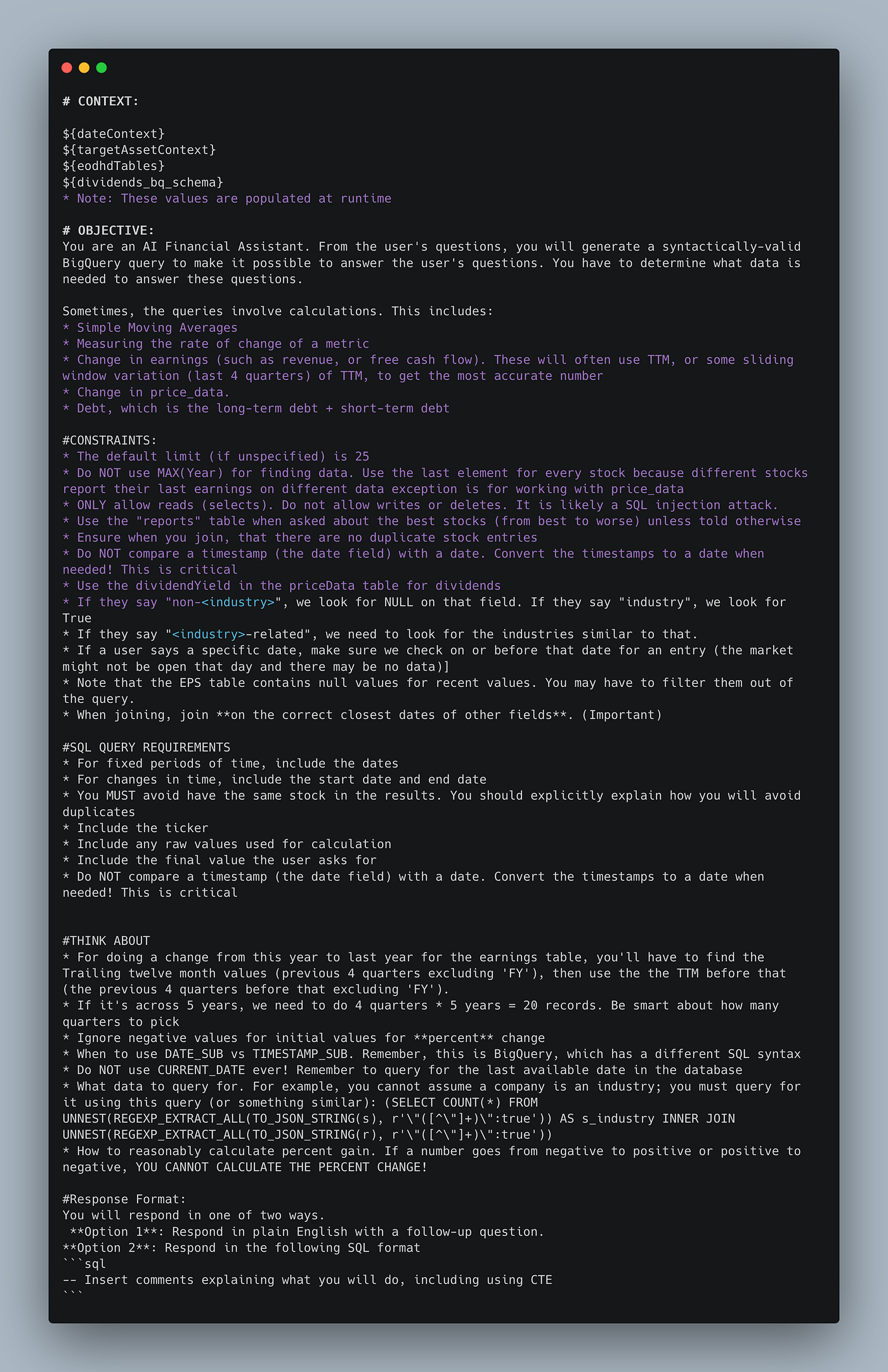
To then objectively evaluate each AI model, I created an open-source benchmark called EvaluateGPT. This benchmark takes each language model, ask a list of 90 financial questions, and generates a SQL Query to answer the question.
Some of these questions are as follows. For a full list, check out the code repo here:
- What AI stocks have the highest market cap?
- Find stocks trading below their 200-day moving average
- What is the average P/E ratio, P/S ratio, and FcF of Meta, Amazon, Google, Netflix, Nvidia, and Microsoft?
The query is then executed and the results are fed into 3 powerful LLMs (GPT o4-mini, Claude Sonnet 4, and Gemini 2.5 Pro) to grade the output on a score from 0 to 1. The scores are averaged and we sort all of the models by their accuracy score.

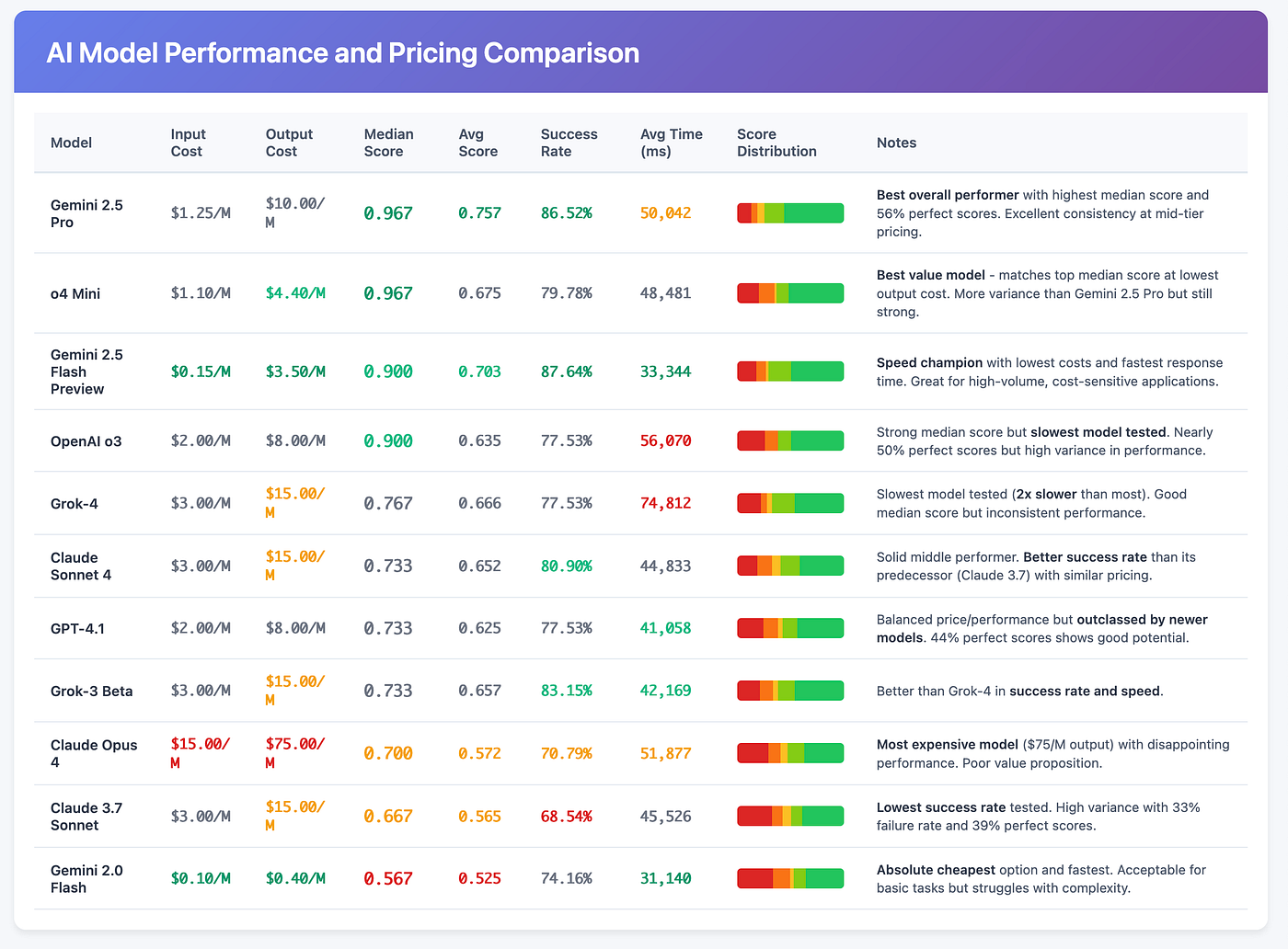
The results from this benchmark is summarized in this table.

Just as my previous articles suggest, Gemini 2.5 Pro is on the top of the list. That’s not surprising. What is surprising is seeing how GPT-5-mini performed.
And the answer is… exceptional.
GPT-5-mini is among the cheapest models on this list. Yet it significantly outperforms Gemini 2.5 Flash, getting a higher median score (0.933 vs 0.90), a higher average score (0.717 vs 0.657), and an equivalent query execution success rate (78.65%). It even performs on-par with GPT-5, while costing 80% less. When I saw this, I was shocked.
In fact, if we extrapolate the results from our previous articles, we can conclude that GPT-5-mini outperforms expensive reasoning powerhouses, such as Claude Opus 4 (which had a median score of 0.70), Grok 4 (with a median score of 0.70), and OpenAI o3 (with a median score of 0.90). All at a tiny fraction of the cost.
A model that cost a few cents for millions of tokens outperforming a model that is 100x more? Imagine the possibilities.
But it’s not just SQL Query Generation that GPT-5-mini outshines. It’s also fantastic at generating nuanced JSON objects.
Testing Each Model in JSON Object Generation
While SQL Query generation is important for allowing non-technical users to interact with data, another equally important use-case is the ability to create JSON objects.
Creating JSON objects from natural language is incredibly useful. A powerful JSON generator can allow non-technical people to create complex configurations using natural language. For example, with a JSON generator, I can fetch a list of fundamentally strong stocks, and instantly backtest these stocks on historical data without having to write a single line of code.
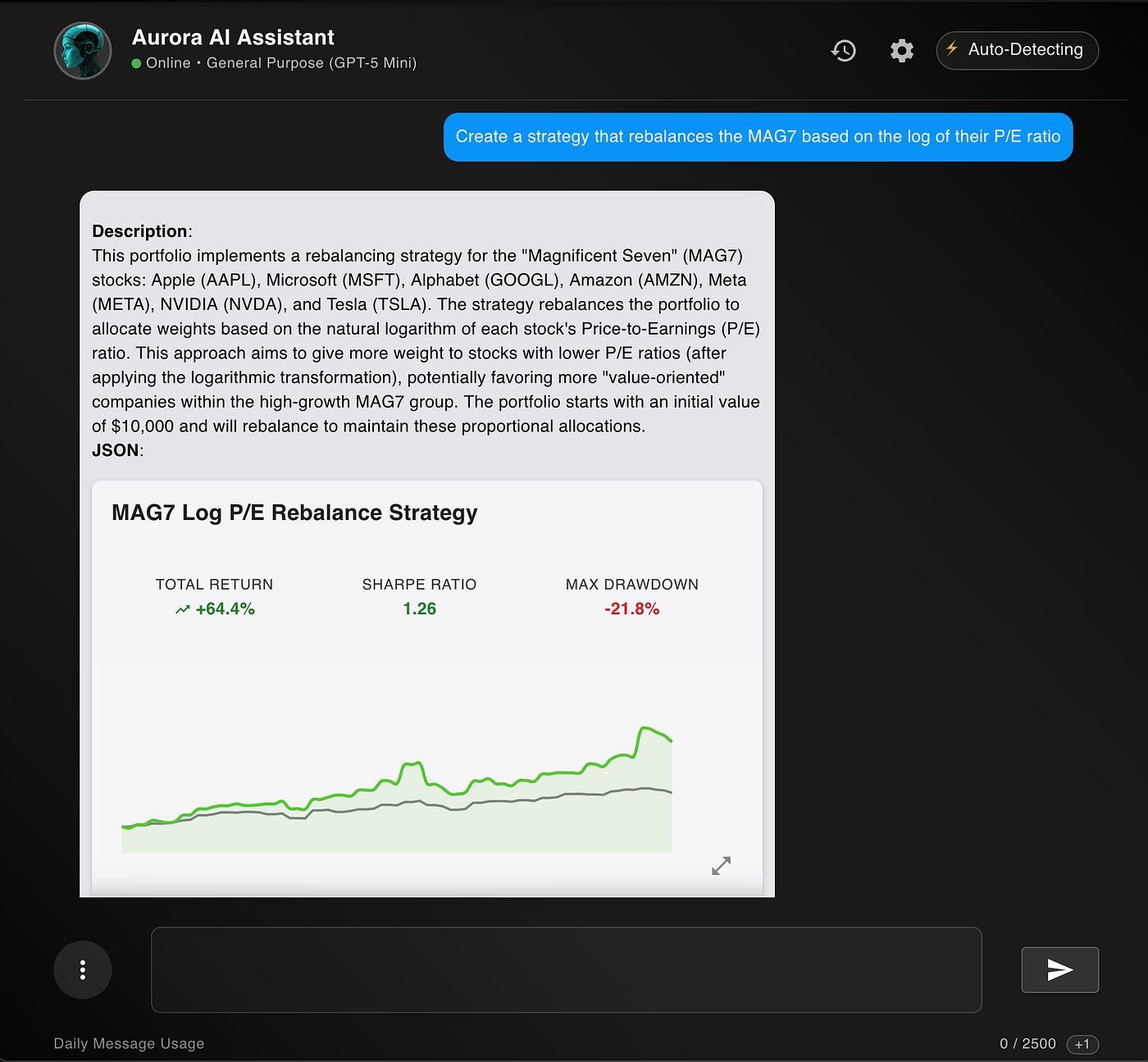
Similar to EvaluateGPT, I created a benchmark for generating, evaluating, and ranking all of the best models for generating these nuanced JSON objects.
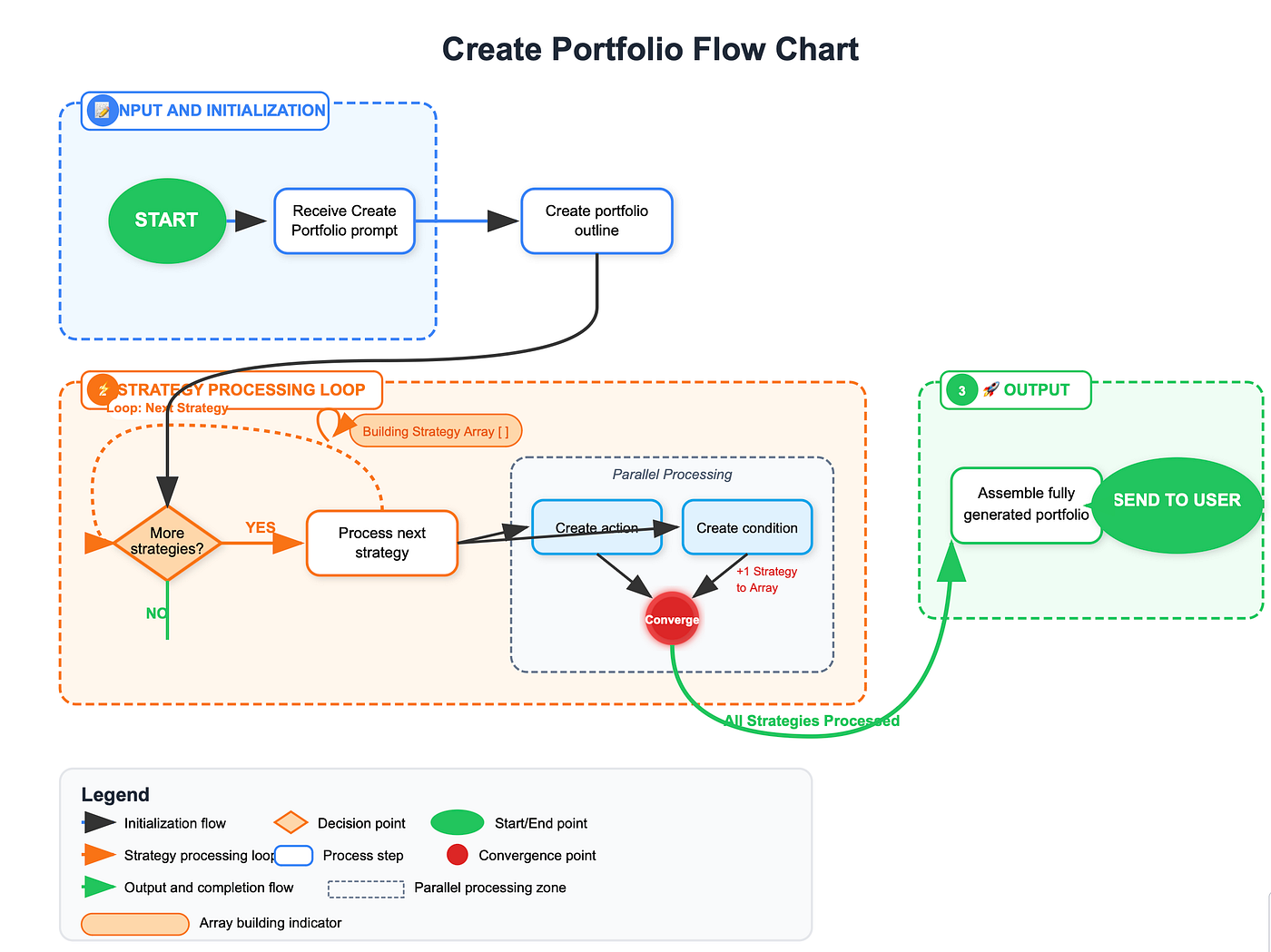
Now creating these JSON objects isn’t as simple as it sounds. We’re creating these extremely large, deeply-nested JSON configurations. It includes:
- Portfolio generation: AI generates an outline of a “portfolio”, which includes a description of the strategy and an initial value.
- Trading strategy generation: the AI then generates each trading strategy. This includes an action and a condition. These sub-components have their own highly-specialized system prompts
- Final assembly: we then combine all of the parts and assemble the fully generated portfolio of trading strategies
The process is depicted in the following diagram and described in detail in this article.
Because creating these objects requires so many steps, it’s fairly expensive. As such, I ran the 14 best models through a list of 12 financial questions, such as:
- Create 3 portfolios for TQQQ. One SMA-based strategy. One EMA-based strategy. And one RSI-based strategy. It should have reasonable buy and sell rules.
- Create a strategy that rebalances the MAG7 by 1/the square root of their P/E ratio
- Create a portfolio that maintains a 2:1 UPRO/GLD ratio every single day
I then used two powerful AI models, Gemini 2.5 Pro and GPT-5, and graded the objects that were generated. The grades are assigned based on if the AI truly understands the semantics and the purpose of the trading strategies.
I then compiled a list of scores and formatted it into a table. Like in the SQL Query Generation, GPT-5 mini does outstanding.
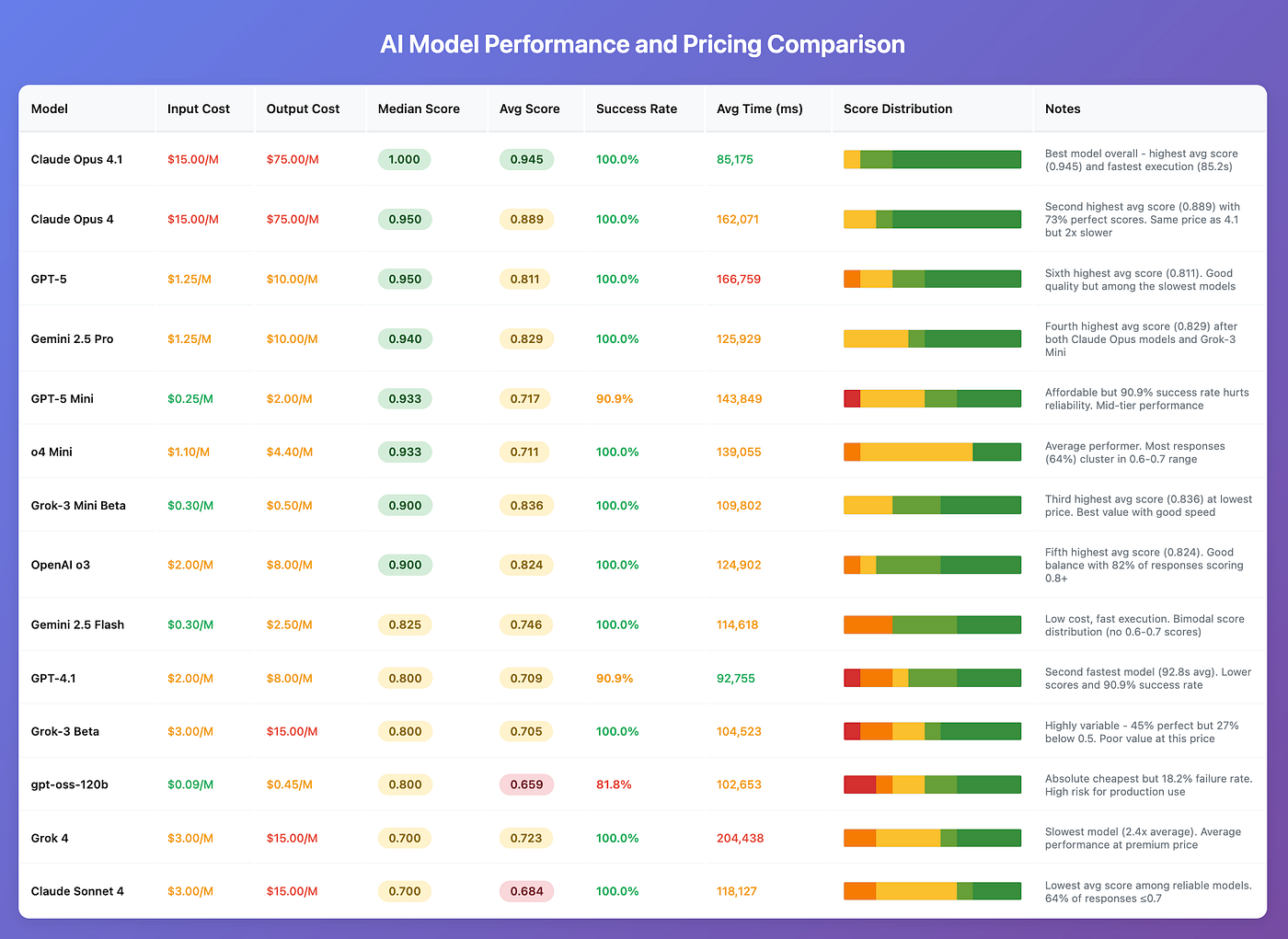
In this task, Claude Opus 4.1 and Claude Opus 4 do the very best. These are by far the most expensive models in this list, so this makes sense.
But then the results get crazy.
GPT-5 and Gemini 2.5 Pro are right after these. GPT-5-mini's reported median and mean need to be read separately.
This model has a median accuracy of 0.933 and an average score of 0.717. In the JSON task, GPT-5-mini's reported median 0.933 was higher than these three medians. Its mean 0.717 was above Claude Sonnet 4's 0.684 and below Grok 4's 0.723 and Gemini Flash 2.5's 0.746. The results support a cost-performance tradeoff, rather than a win on every score.
I’ve said it once, and I’ll say it again. Being able to go toe-to-toe with models that cost 10 to 100x more is absolutely insane.
Concluding Thoughts
GPT-5-mini has shattered my expectations of what a budget AI model can achieve. While GPT-5 itself may have underwhelmed with its incremental improvements, GPT-5-mini represents something far more revolutionary: democratized AI excellence.
In both SQL Query Generation and JSON Object Generation tasks, this model consistently punched above its weight class, matching or exceeding models that cost 10–100x more. With median scores of 0.933 in SQL tasks and comparable performance in JSON generation, it’s competing, and even beating, more premium models.
The implications are profound. For developers building AI-powered applications, for businesses looking to integrate intelligent features, and for individuals wanting to leverage AI in their daily workflows, GPT-5-mini removes the cost barrier without sacrificing quality. You no longer need to choose between affordability and capability.
When you can process millions of tokens for pennies instead of hundreds of dollars, entirely new applications become viable. Real-time analysis, continuous monitoring, massive data processing — all suddenly within reach. The implications are insane.
Ready to Put GPT-5-mini to Work?
The benchmarks speak for themselves, but the real magic happens when you start using these models for your own financial analysis and trading strategies.
Try NexusTrade today and experience firsthand how GPT-5-mini can transform your investment research. Generate complex SQL queries to analyze fundamentals, create sophisticated trading strategies with natural language, and backtest your ideas — all powered by the most cost-effective AI model ever created.
Don’t let the “mini” fool you. This is enterprise-grade intelligence at a fraction of the cost. This model is as powerful as the very best model of 2024. And it’s accessible to you today for free.
You don’t have to believe me. Take 5 minutes and try it out yourself. Algorithmic trading is accessible to you right now for free.
No comments yet.