Anthropic is beating OpenAI at
their own game.
Anthropic Dominates OpenAI: A
Side-by-Side Comparison of
Claude 3.5 Sonnet and
GPT-4o
Anthropic is beating OpenAI
at their own game.
I have always been skeptical
of Claude. When they first
came out, they were more
expensive than GPT-4 and had
roughly the same accuracy.
Their API rules are also
extremely weird and somewhat
arbitrary; I got dinged
because the AI assistant and
user roles were not
alternating in the messages…
wtf?
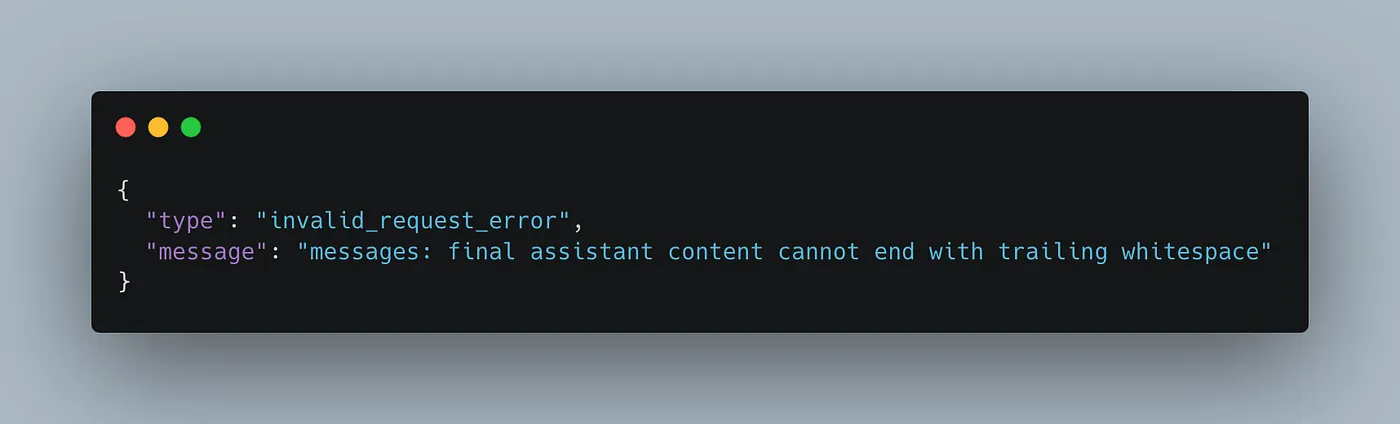 Another ridiculous error from
Claude
Another ridiculous error from
Claude
However, after trying out
Claude’s newest large language
model, I was absolutely blown
away. When I first tried
GPT-4o, it left a little bit
to be desired. While it
occasionally did the tasks
right the first time, on many
days, it felt like the
lobotomized version of GPT-4
empowered by the Speed
Force.
In contrast, Claude 3.5
Sonnet seems like the
definition of artificial
general intelligence (assuming
we’re not moving the
goalpost). Claude is
brilliant, lightning fast, can
follow instructions, and
strives to be factually
accurate. It’s such a good
model that I’ve been debating
permanently switching the
default model of my AI-powered
trading platform from GPT-3.5
Turbo to Claude 3.5 Sonnet. It
would be more expensive, but
the user experience would be
far better.
So, I decided to write this
article to put these models to
the test... objectively. This
post will be a side-by-side
comparison of OpenAI’s
flagship GPT-4o versus
Anthropic’s newest Claude 3.5
Sonnet. After reading this,
you should be able to decide
which model is better for your
specific use-case.
Setting the stage: The Task
at Hand
Both of these models will be
given the task of generating a
series of syntactically valid
JSON, and summarizing the
information. This is likely
one of the most powerful
use-cases of LLMs for
real-world use-cases.
To do this, I will be
utilizing my free-to-use
automated investing platform,
NexusTrade.
NexusTrade
is an algorithmic trading
platform that makes it simple
to develop automated trading
rules. One of its features is
generating these rules in
plain English with
Aurora. Here’s how it works:
-
The user asks to generate a
portfolio.
-
The system detects what the
user’s intent is and
populates the corresponding
system prompt.
-
The model asks the user
follow-up questions about
the portfolio, such as the
initial value and any
strategies within the
portfolio.
-
After the user gives enough
information, a portfolio
object is generated.
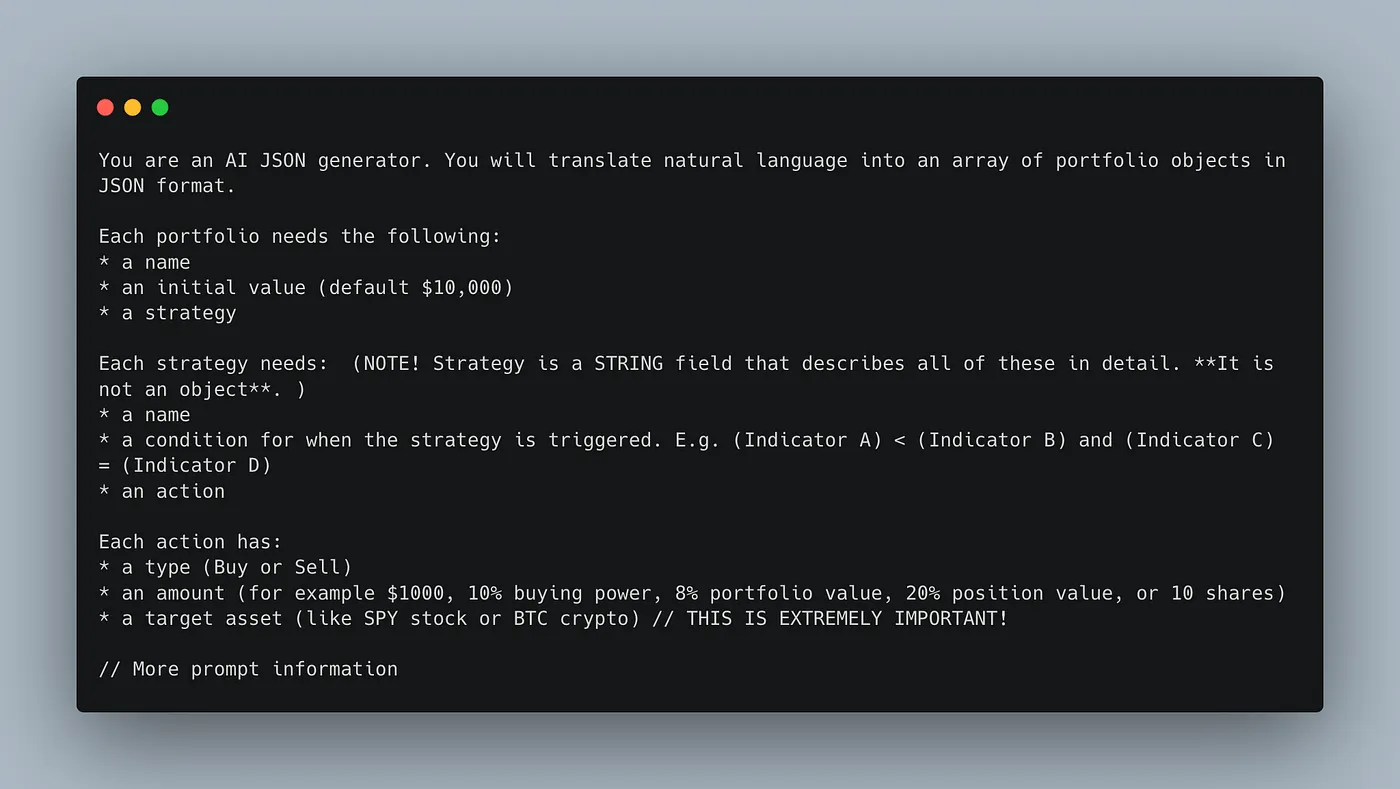 The beginning of the “Create
Portfolio” prompt
The beginning of the “Create
Portfolio” prompt
While this may sound simple,
there is a lot of complexity
that goes into this. For
example, the
Create a Portfolio
prompt doesn’t actually
generate the full set of
strategies (which is itself a
deeply nested object); it
generates a string description
of the strategy. Then, that
description is fed as input to
another prompt to generate the
full strategies.
This is done repeatedly for
conditions
(which are nested within
strategies) and
indicators
(which are nested within
conditions).
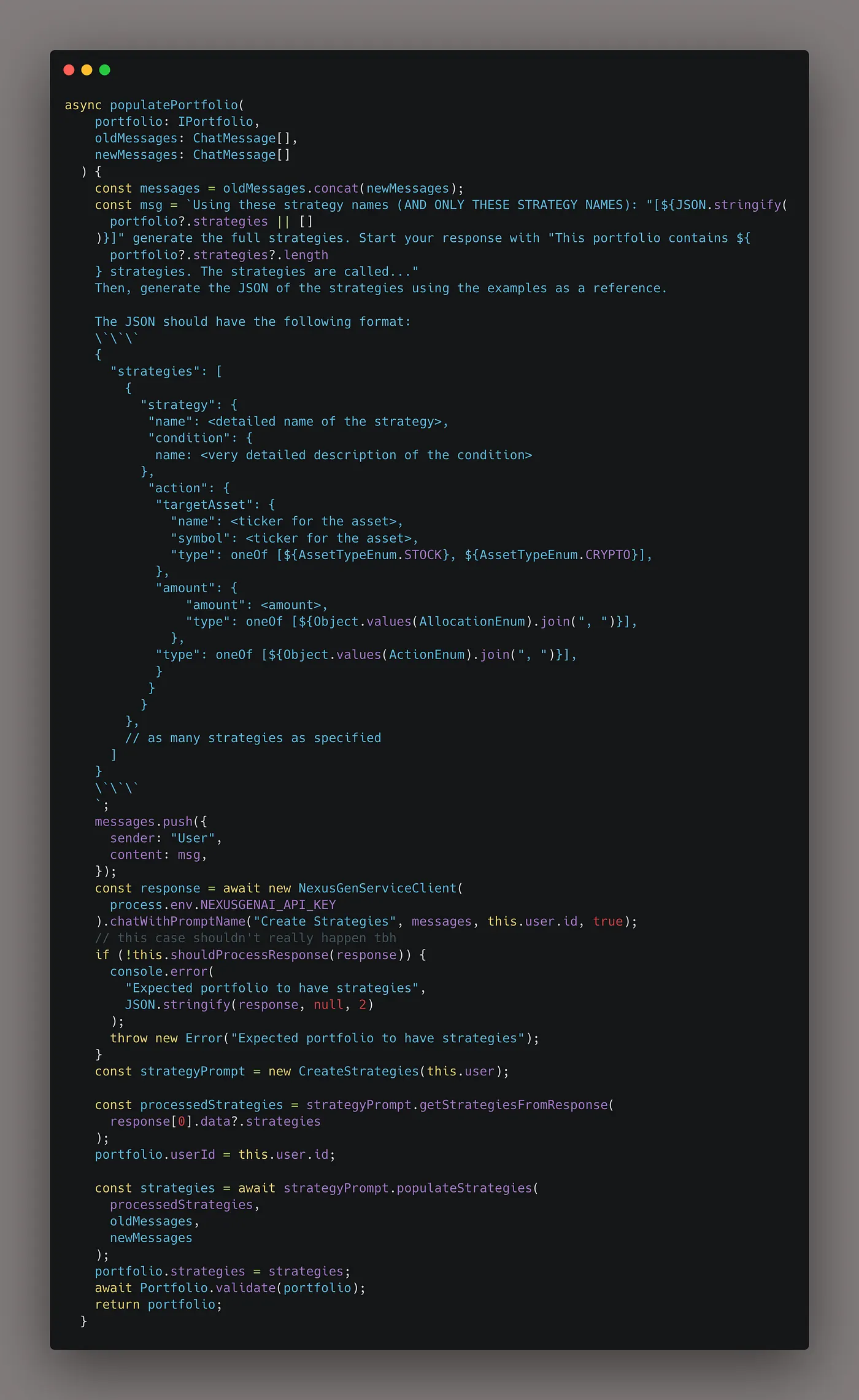 The “populatePortfolio”
function, which feeds in the
response of one prompt as input
to another
The “populatePortfolio”
function, which feeds in the
response of one prompt as input
to another
Because I’m mostly interested
in seeing how Claude improves
my own personal use-case, this
analysis may not be suitable
for everybody. This
methodology is biased, and may
not be relevant for other
use-cases.
For example, its possible
that Claude really excels at
financial tasks while GPT-4 is
much better at medical
tasks.
Nevertheless, this article
does provide some interesting
information for those who want
a side-by-side comparison on
complex reasoning tasks. This
article will evaluate these
models based on speed,
accuracy, and the “human-ness”
of the response.
To conduct these tests
yourself, create an account on
NexusTrade.io.
Test 1: Creating a portfolio
with defined parameters
GPT-4o — Test 1: Defined
Parameters
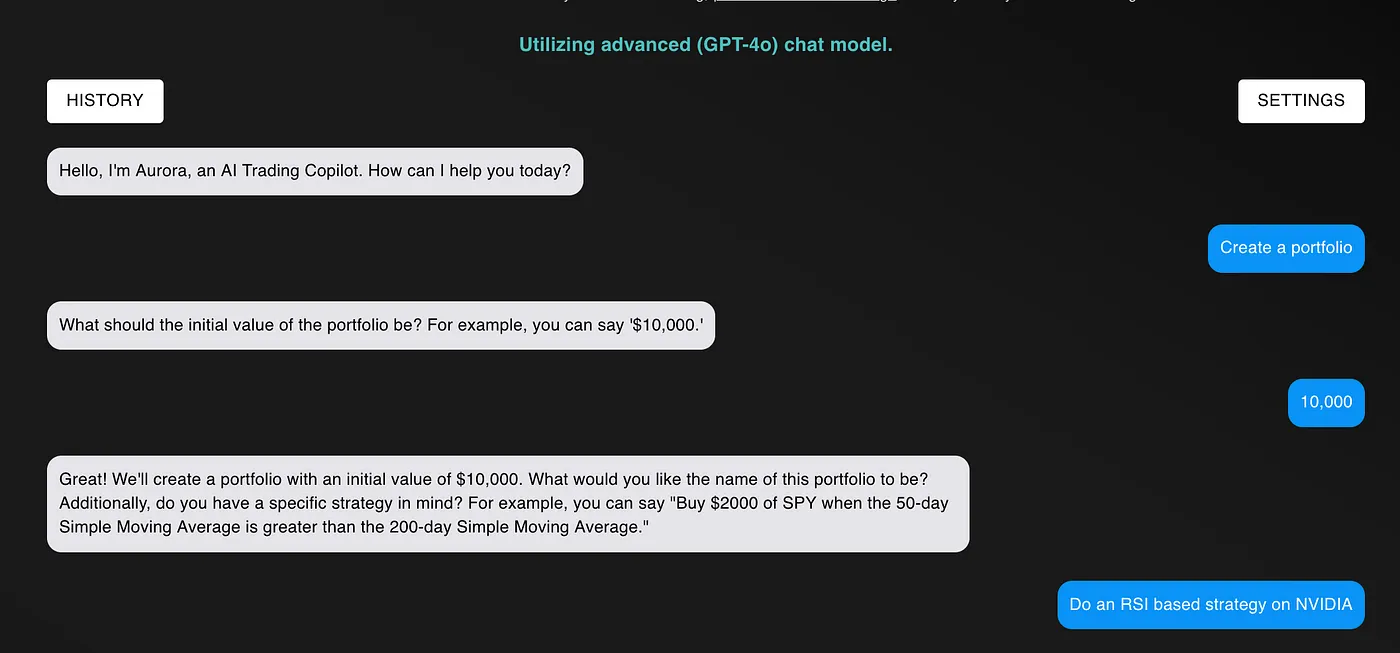 Iteratively building a
portfolio with Aurora
Iteratively building a
portfolio with Aurora
The first test is
accomplishing something that
nearly all new-users of the
NexusTrade platform
do — creating their own
portfolios. We’ll start with a
simple portfolio based on
RSI.
RSI (or relative strength
index) is an indicator that
determines whether a stock or
oversold (when RSI is less
than 30) or overbought (when
RSI is greater than 70). In
other words, it essentially
tells you if you should buy
the stock because its price is
low, or if you should sell the
stock because the price is
high. While using GPT-4o, this
is what Aurora responds for
the final output.
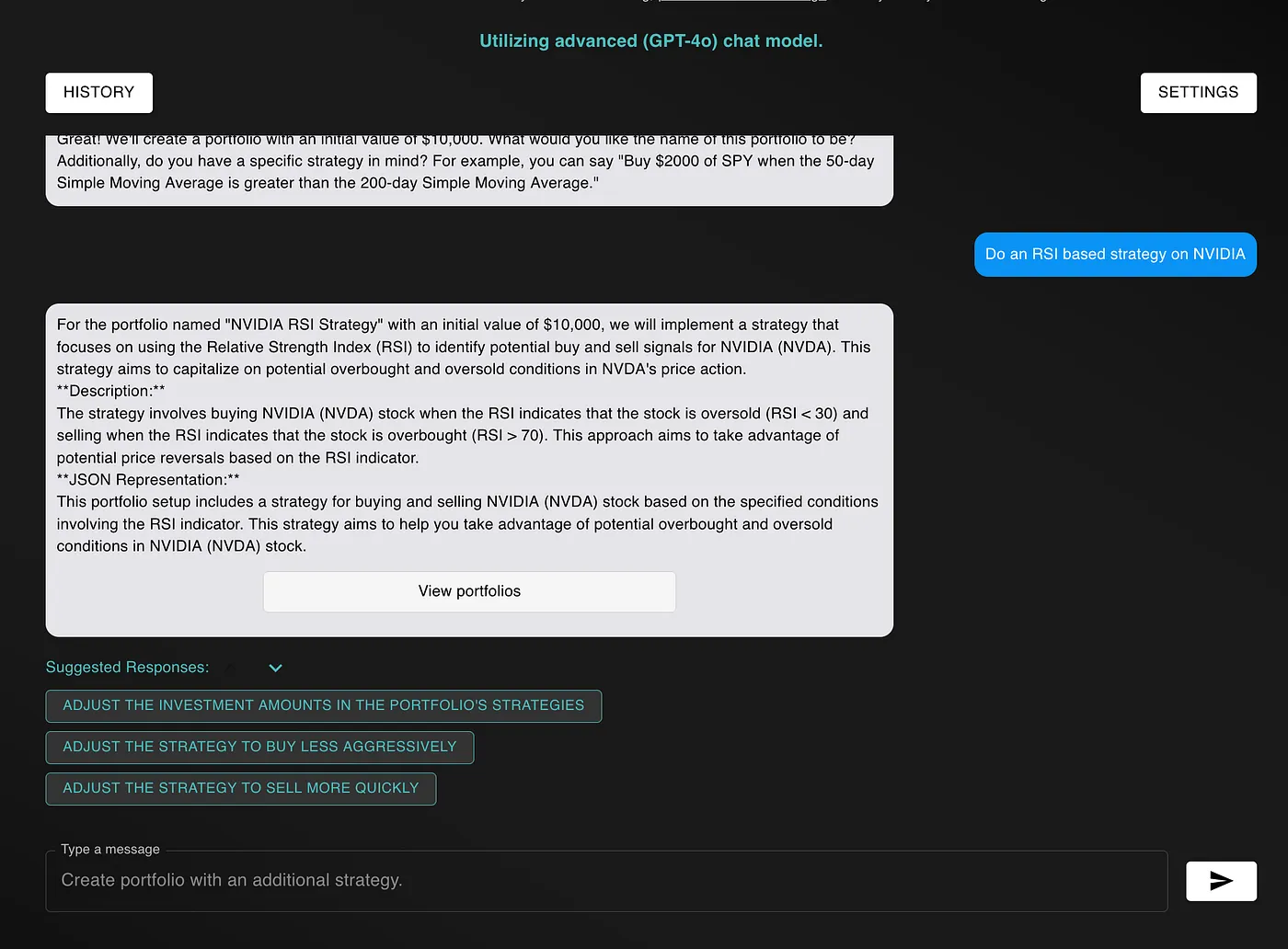 GPT-4o’s response for
generating a portfolio with an
RSI-based strategy
GPT-4o’s response for
generating a portfolio with an
RSI-based strategy
This response is correct,
which is expected of a simple
prompt. The intermediary
requests (e.g. “Create a
portfolio” and “10,000”) took
the model roughly 3–3.5
seconds to respond. The final
response (indicated in the
screenshot) took roughly 53.5
seconds. Note, that as I said
before, this response requires
calling a series of prompts to
generate the final
object.
The interesting thing to
notice about this response is
that it’s a bit robotic. The
description is a vague, and it
includes filler words that the
end-user wouldn’t understand,
such as **JSON
Representation** (most likely
because it was included in the
system prompt). Nonetheless,
it might be possible to
improve the output by using
more clever prompt
engineering.
Claude 3.5 Sonnet – Test 1:
Defined Parameters
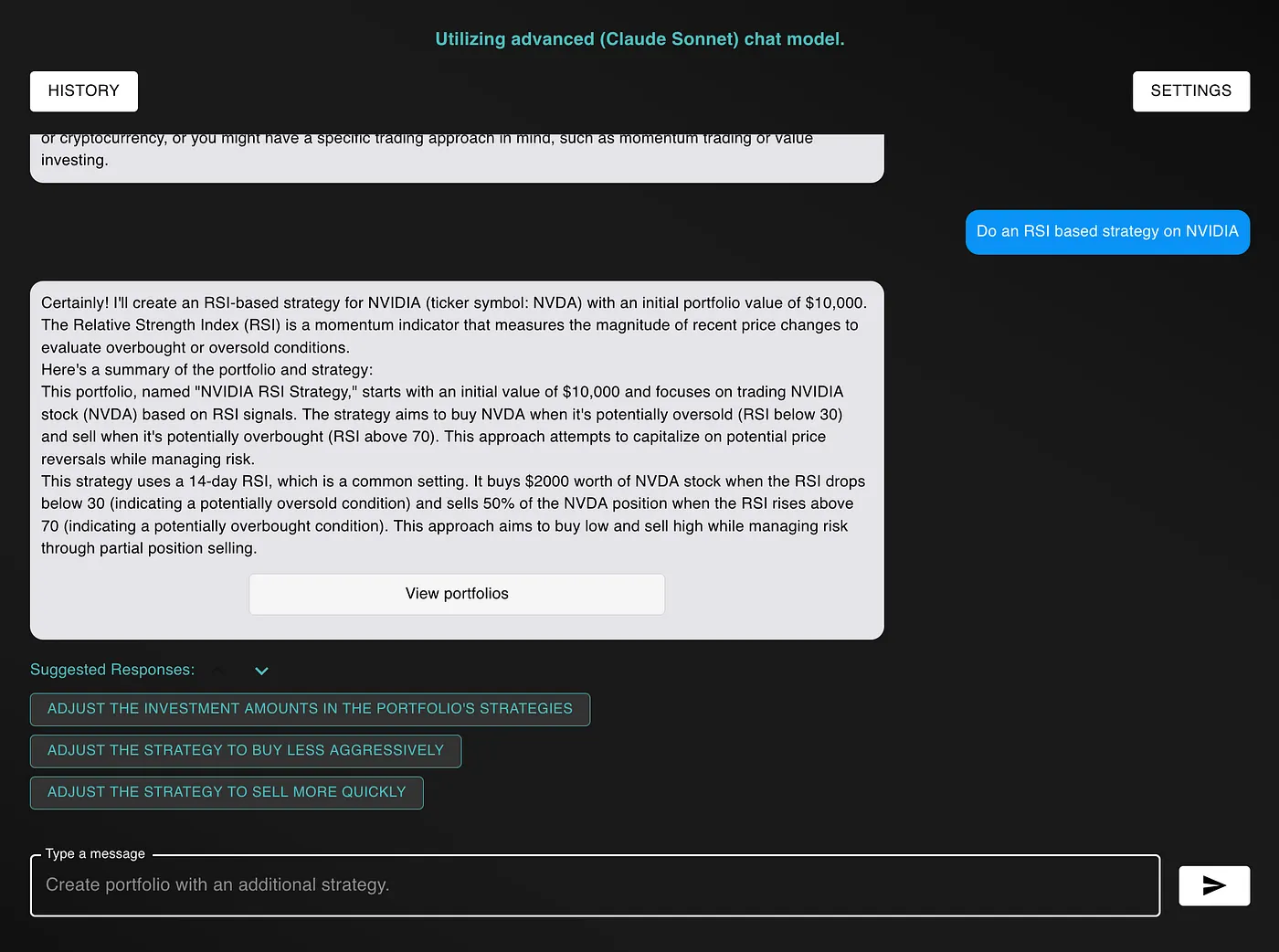 Claude 3.5 Sonnet’s response
for generating a portfolio with
an RSI-based strategy
Claude 3.5 Sonnet’s response
for generating a portfolio with
an RSI-based strategy
Claude 3.5 Sonnet was
surprisingly slower than
GPT-4o. Each intermediate
response took roughly 3.6–4
seconds, which is arguably
within the margin of error.
More importantly, the final
response took 83.5 seconds,
which is significantly slower
than GPT-4o.
However, even though it was
much slower, the response is
much more human-like. Claude’s
response articulates the exact
rules within the strategy, so
the user doesn’t have to read
the big scary JSON to
understand it (more on that in
the next section). It doesn’t
include filler words which are
nonsensical to an end-user
such as **JSON
Representation**.
All things considered, the
human-like responses are a
significant improvement in the
app. While the speed is
important, creating a better
user experience (particularly
for users newer to the
platform) is more beneficial.
So, I would say
Claude (slightly) won this round.
Test 2: Creating a complex
portfolio with custom
indicators
Now let’s get to the real
test of which model is
smarter. Within NexusTrade,
you can configure nearly any
trading strategy you can
possibly imagine. This
includes performing arithmetic
on technical and fundamental
indicators.
So, let’s test how well these
models are at generating these
types of strategies.
GPT-4o — Test 2: Custom
Indicators
 Generating a portfolio with a
complex strategy using
GPT-4o
Generating a portfolio with a
complex strategy using
GPT-4o
The complex strategy I
articulated was “buy Apple
when its 1 day rate of change
of its 30 day Simple Moving
Average is greater than 1”. I
also asked the model to
generate a stop loss strategy
and take profit
strategy.
While the response seemed
sensical, a deeper dive into
the JSON shows the strategy is
misconfigured.
 The portfolio configuration
generated by GPT-4o
The portfolio configuration
generated by GPT-4o
Unfortunately, you have to be
a NexusTrade power-user to
really understand this JSON.
Let me break it down:
-
The buy strategy is
completely misconfigured. It
includes other conditions
that are not
specified.
-
The take profit strategy
seems fine
-
The stop loss strategy is
odd. While it’s not a 100%
misconfiguration, we would
expect it to have something
to do with the percent
change of the positions in
the portfolio
So as we can see, GPT-4o
completely bombed this test.
At least the final response
took a lightning-fast 44
seconds to generate!
Claude 3.5 Sonnet — Test 2:
Custom Indicators
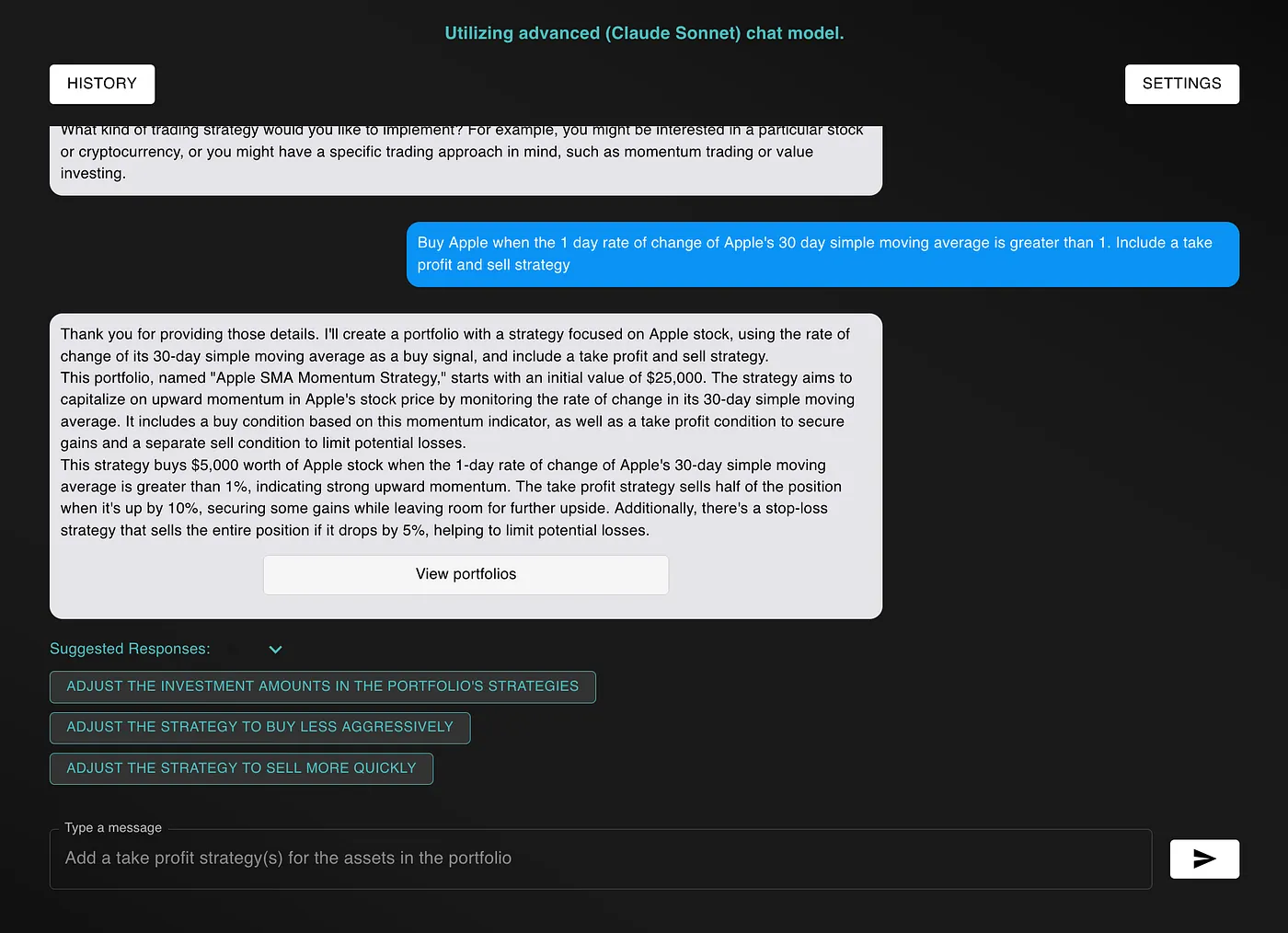 Generating a portfolio with a
complex strategy using Claude
3.5 Sonnet
Generating a portfolio with a
complex strategy using Claude
3.5 Sonnet
In contrast, Claude’s
response was still more
human-like, just like in the
previous test. However, it
took
far
longer to generate the
portfolio config – around 180
seconds. That’s definitely not
good!
However, some great news
arise when we take a look at
the generated
configuration:
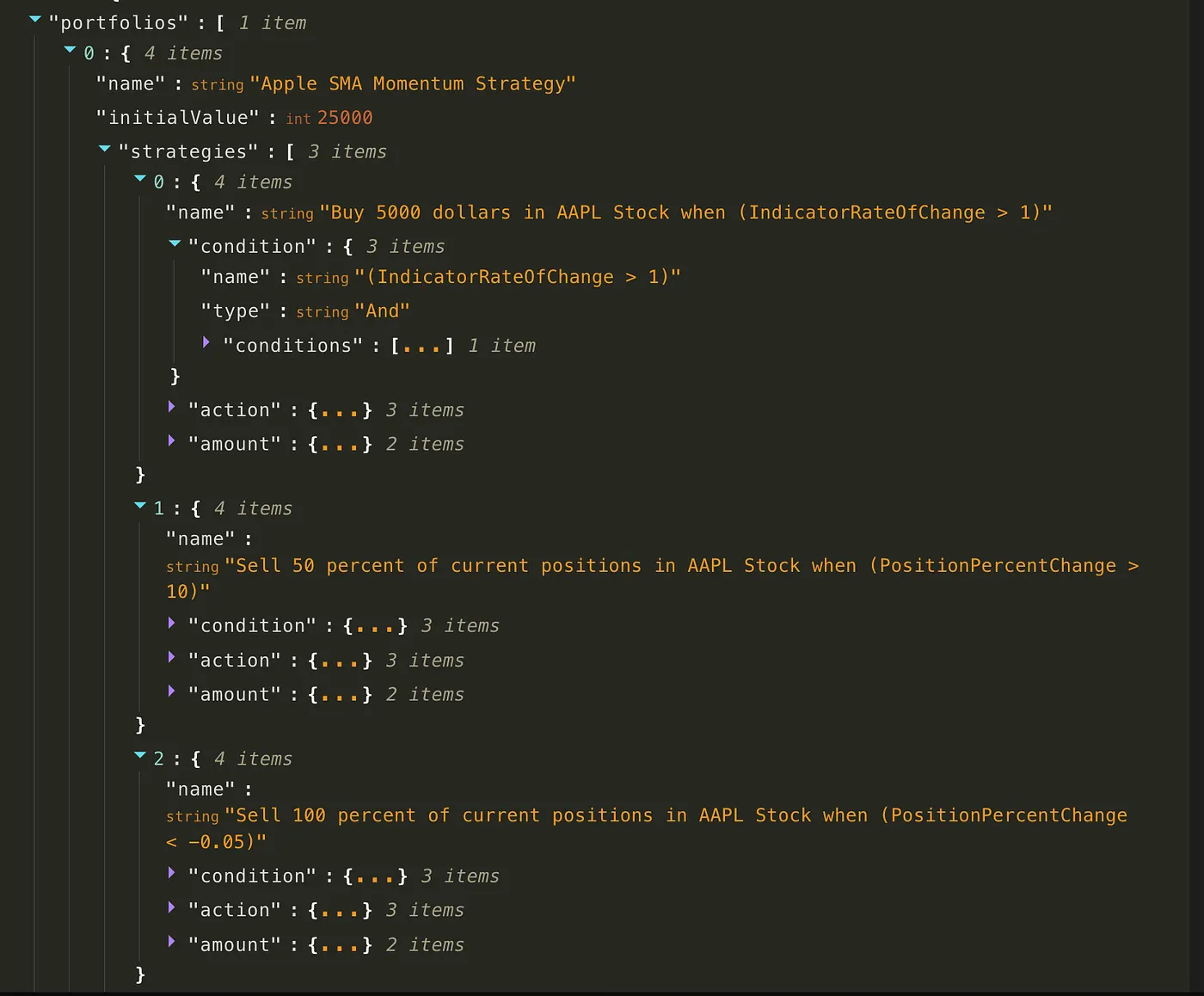 The portfolio configuration
generated by Claude 3.5
Sonnet
The portfolio configuration
generated by Claude 3.5
Sonnet
This configuration is 100%
accurate! It is exactly what
was articulated to the model.
This test hints that Claude’s
reasoning skills are beyond
GPT-4o. Because of the
accurate answer,
Claude unanimously wins
this round!
Test 3: Using an AI-Powered
Stock Screener
Iterating and Improving -
Designing a Better Stock
Screener
You might be wondering
why NexusTrade's simple
stock screener is the
best stock screener out
there. Allow me to…

From the tests so far, we’ve
seen that while Claude 3.5
Sonnet is slower, it tends to
respond in a more human-like
manner. In the previous task,
it was also more accurate when
it came to reasoning about the
input. Now, let’s try an
entirely different reasoning
task: text to NoSQL.
NexusTrade has a unique
(beta) feature that allows it
to query for stocks based on
specific criteria. For
example, a user can find which
AI stocks have the highest
market cap by simply asking
Aurora to fetch the
information. This allows us to
have a more natural interface
for finding novel investing
opportunities.
It works by translating plain
English into a MongoDB Query,
and executing that query
against the database. For a
detailed guide on how this
works,
check out the following
article.
Intelligent Stock
Screening using Large
Language Models
Today, I'm outlining a
design for a new feature
in the NexusTrade
Platform - intelligent
stock screening using
Large…
To test this, we’re gonna use
the following query:
find the 5 companies with
the highest cash flow
increase from 2016 to
2020
GPT-4o — Test 3: AI-Powered
Stock Screener
Sending this request to
GPT-4o-Powered Aurora gives us
the following response in 26
seconds.
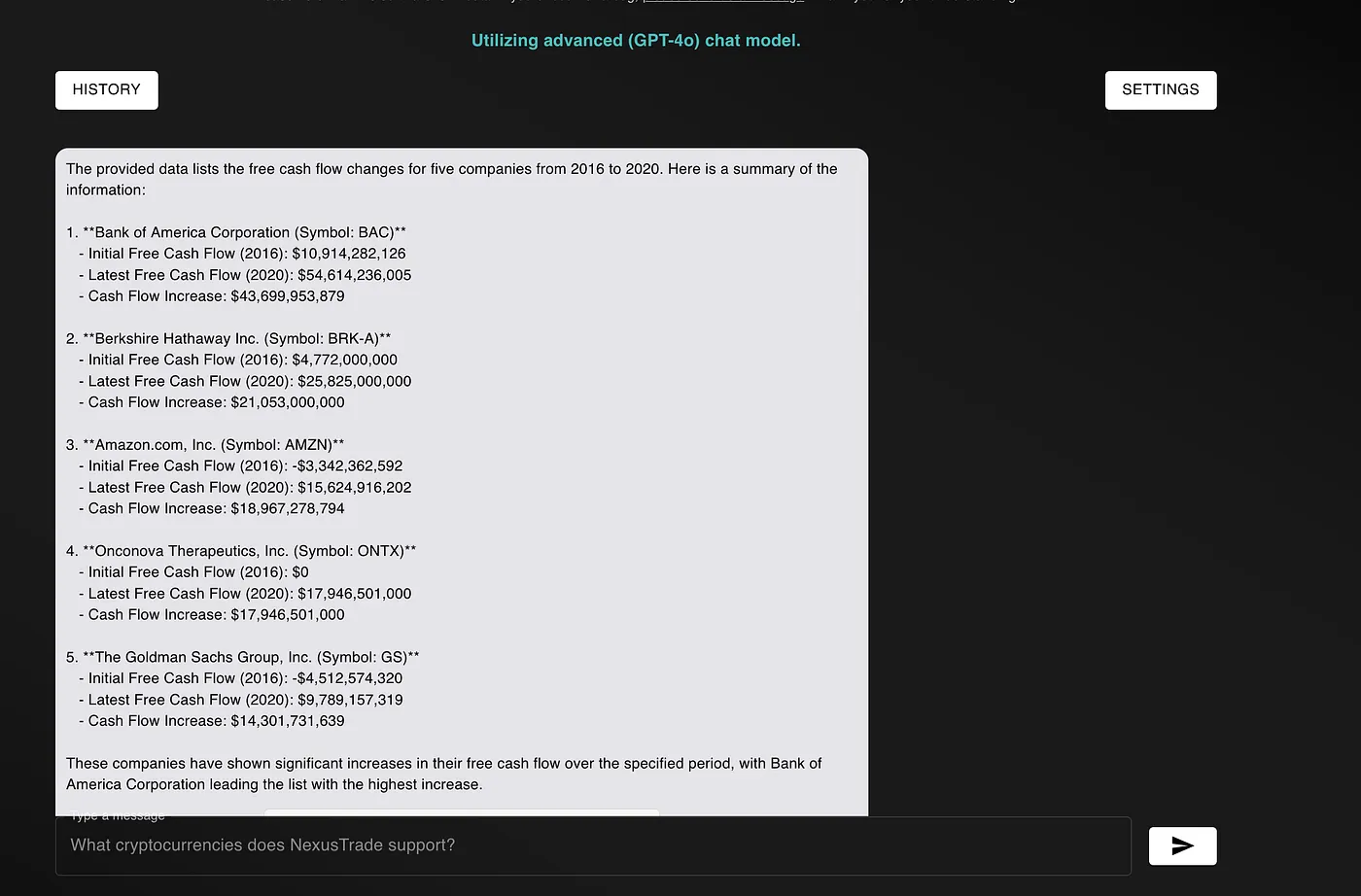 The model returned 5 companies
with the highest free cash flow
increase from 2016 to 2020
The model returned 5 companies
with the highest free cash flow
increase from 2016 to 2020
Whether or not this response
is actually accurate requires
analyzing the query in more
detail. Some of the results
(like the fact that Onconova
Therapeutics made $0 in free
cash flow in 2016) look a
little sketchy. However, let’s
not worry about this for right
now and move onto the Claude
3.5 test.
Claude 3.5 Sonnet — Test 3:
AI-Powered Stock
Screener
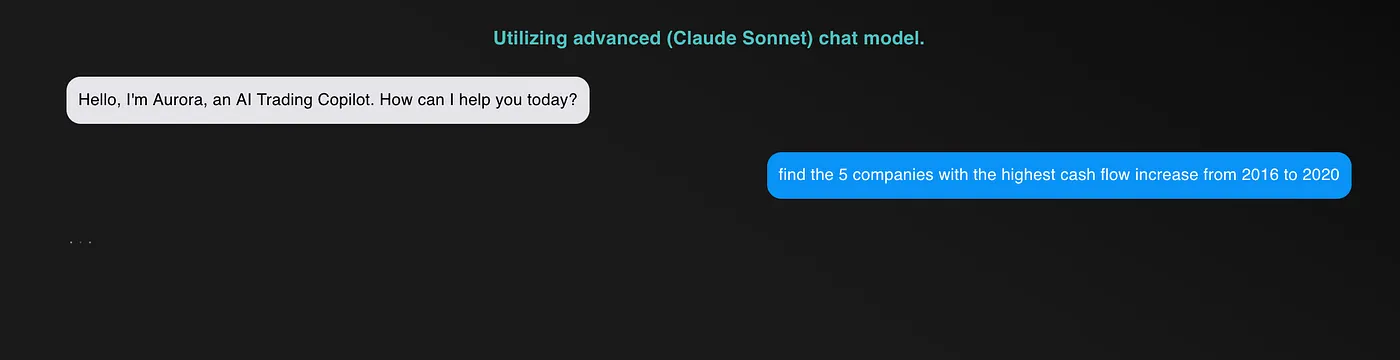 The model never returned a
response
The model never returned a
response
In contrast to the GPT-4o
model, which responded in
under half a minute, the
Claude model never responded
at all! This is caused by
generating an expensive query
that never terminates. To fix
this, I have to log in
remotely to my cloud console
and manually kill the
long-running query 🤦🏾. Oh
well, that’s why this feature
is in beta.
Clearly,
GPT-4o is the winner of
this test.
Here are 5 Stocks to Look
At To Increase Your
Exposure to Artificial
Intelligence (AI)
ChatGPT popularized
modern Artificial
Intelligence in November
2022. After being
released to the general
public, it…
Discussion
From this article, we can see
that Claude 3.5 Sonnet excels
in reasoning and sending
human-like responses back,
creating a more natural chat
experience. In contrast,
GPT-4o is much faster,
particularly when chaining
multiple prompts together.
Claude 3.5 Sonnet and GPT-4o
won different tests when it
comes to reasoning, although
Claude won the most important
one.
Based on these preliminary
results, Claude 3.5 Sonnet
seems to be
slightly
better. This also aligns with
Anthropic’s (probably biased)
metrics on Claude 3.5 Sonnet
vs Claude 3 Opus vs GPT-4o.
Their published metrics also
state that Claude is one of
the best models available
right now.
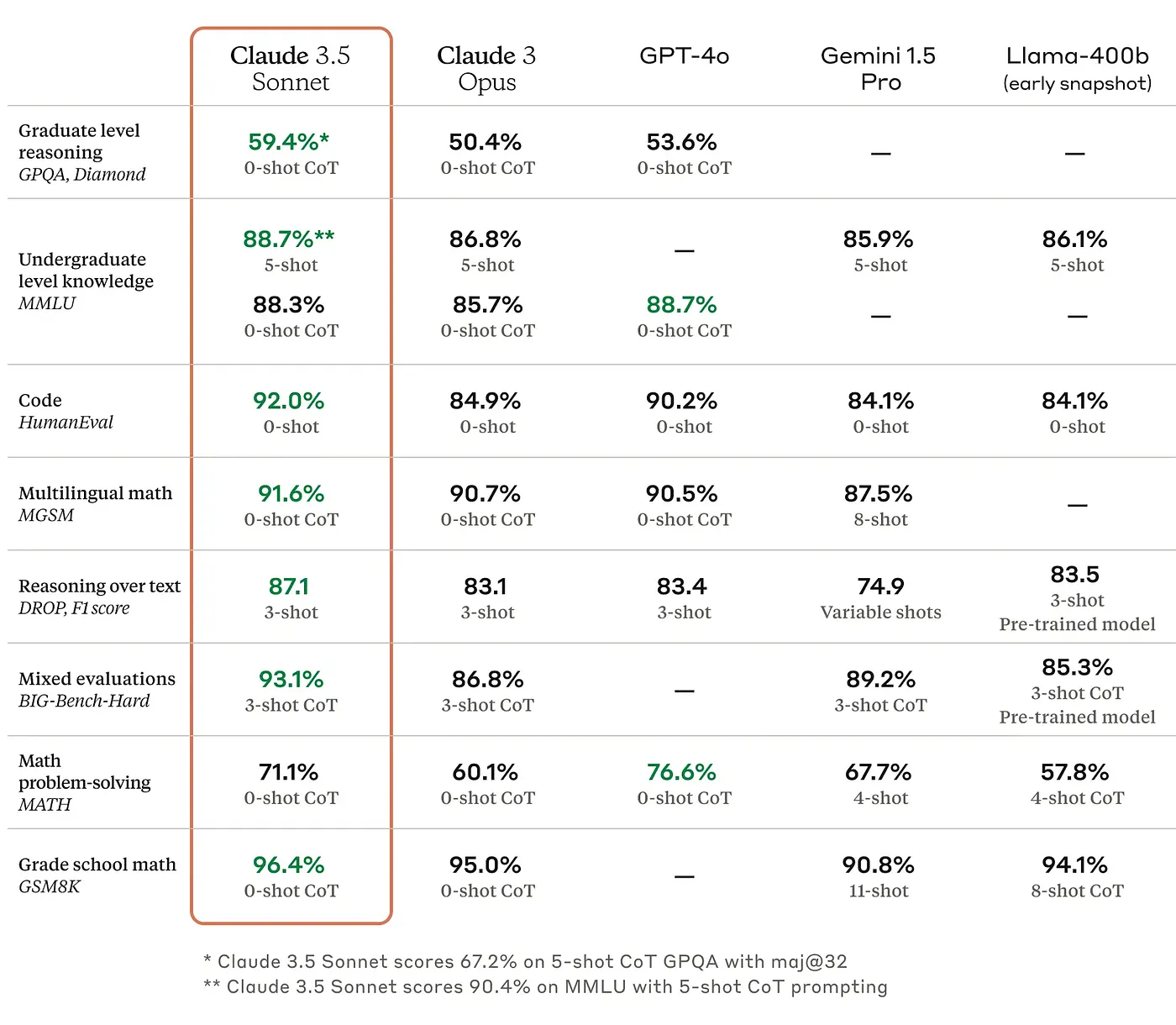 Claude’s Evaluation
Metrics
Claude’s Evaluation
Metrics
Finally, when we account for
the costs of these models,
Claude seems to be much
better.
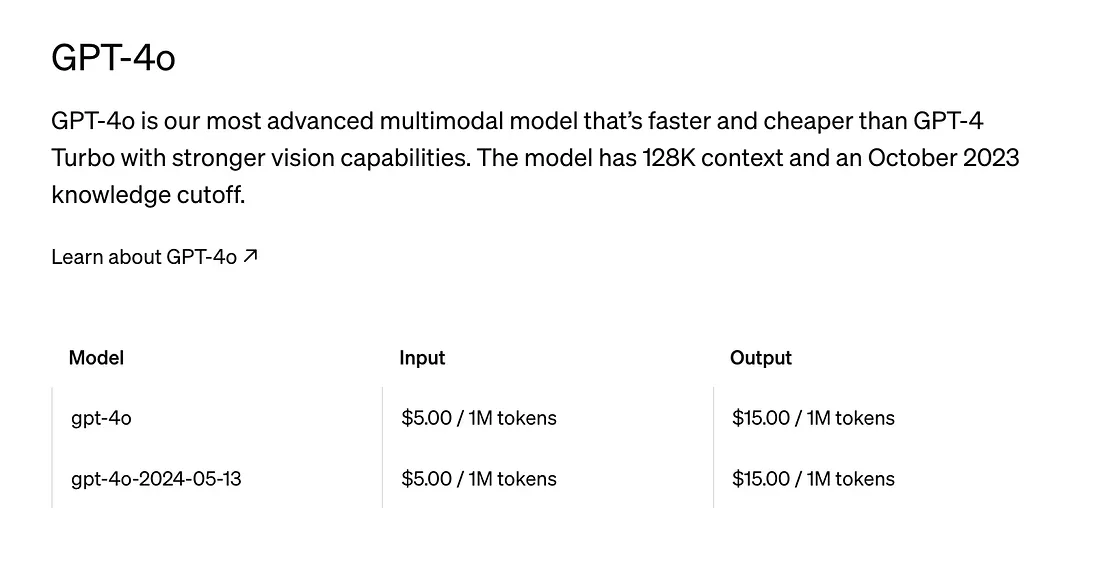
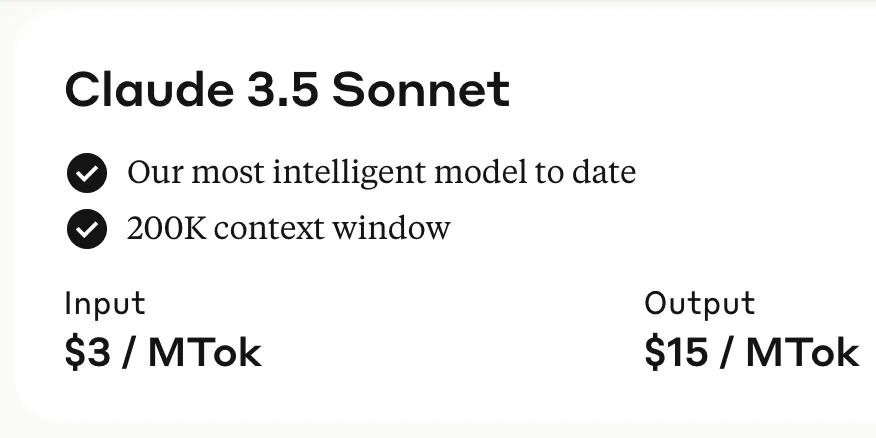 Cost Comparison of GPT-4o vs
Claude 3.5 Sonnet
Cost Comparison of GPT-4o vs
Claude 3.5 Sonnet
Claude is nearly 2x cheaper
than GPT-4o for the input
tokens and the exact same cost
as the output tokens. The
context window for Claude is
also more than 50% larger than
that of GPT-4o.
If we account for cost,
context window, speed, and
reasoning capabilities, Claude
seems to be slightly better.
The responses are more
human-like, and it is able to
generate extremely complicated
portfolio configurations,
which is a more-common
use-case for my
application.
However, it’s not objectively
better in all scenarios. Other
people would likely prefer the
speed of GPT-4o, or might find
it more suitable for their
specific use-cases.
Overall, the choice between
models is up to you.
···
Thank you for reading! If
you’re interested in AI (and
especially how it relates to
finance)
subscribe to Aurora’s
Insights!
Want to see the difference
between Claude and GPT
yourself?
Create an account on
NexusTrade today!
NexusTrade - AI-Powered
Algorithmic Trading
Platform
By far the best
algorithmic trading
experience. Learn to
conquer the markets by
deploying algorithmic
trading…
No comments yet.