A Case Study: Buy and Hold vs Dollar-Cost Averaging — Which is Better for the Medium-Term Horizon?
Austin Starks · Originally published
The original story is on Medium! Share it with your friends.
Introduction
This September 2023 experiment compares investing a $10,000 starting balance at once with buying gradually from that balance. The reported SPY returns are 63.72% for buy-and-hold and 21.78% for the gradual plan; their maximum drawdowns are 34.09% and 19.07%. The original article contains conflicting test-date descriptions, so the numbers below remain historical reported results with an unresolved measurement window.
Read the comparison in two parts: how the money is deployed and what the stored run actually measured. The gradual plan can leave cash uninvested, while buy-and-hold exposes the full starting balance. That difference matters alongside the return and drawdown figures.
Experiment
Intended five-year experiment; recorded test dates unresolved
In this experiment, we aim to unravel the long-standing debate between two popular investment strategies: Buy and Hold, and Dollar-Cost Averaging. To set the stage, let's break down the core tenets of each approach.
Buy and Hold Strategy: In this scenario, you receive a substantial sum of money, which you invest entirely in a single stock. Following the investment, you take a hands-off approach and do not touch the stock for the next five years.
Dollar-Cost Averaging Strategy: start with $10,000 and request purchases sized at 1% of current portfolio value when it is Friday and 28 days have passed since the last purchase. At an unchanged $10,000 total value, one purchase would be $100. This deploys existing cash gradually; the request does not add a new cash contribution every four weeks. The exact generated schedule, remaining cash and repeat-order behavior belong in the original saved configuration.
Stock Selection Criteria
For a comprehensive evaluation, we selected 3 diverse stocks:
- SPY (+51% for the Past 5 Years): Often considered the gold standard of ETFs, SPY is renowned for its steady yet significant growth.
- NVDA (+555% for the Past 5 Years): A high-growth tech powerhouse, whose performance has been nothing short of stratospheric.
- T (-38% for the Past 5 Years): A currently underperforming stock in the communications sector, offering a glimpse into how these strategies fare with lagging assets.
The selection aims to provide a balanced perspective by incorporating a growth champion, an underperformer, and a stable grower. While the experiment may not cover all the nuances, it aims to offer valuable insights into how various types of stocks respond to these investment strategies.
Dividend Disclaimer: It's crucial to note that this experiment focuses solely on capital gains, excluding the impact of dividend reinvestments.
Experimental Setup
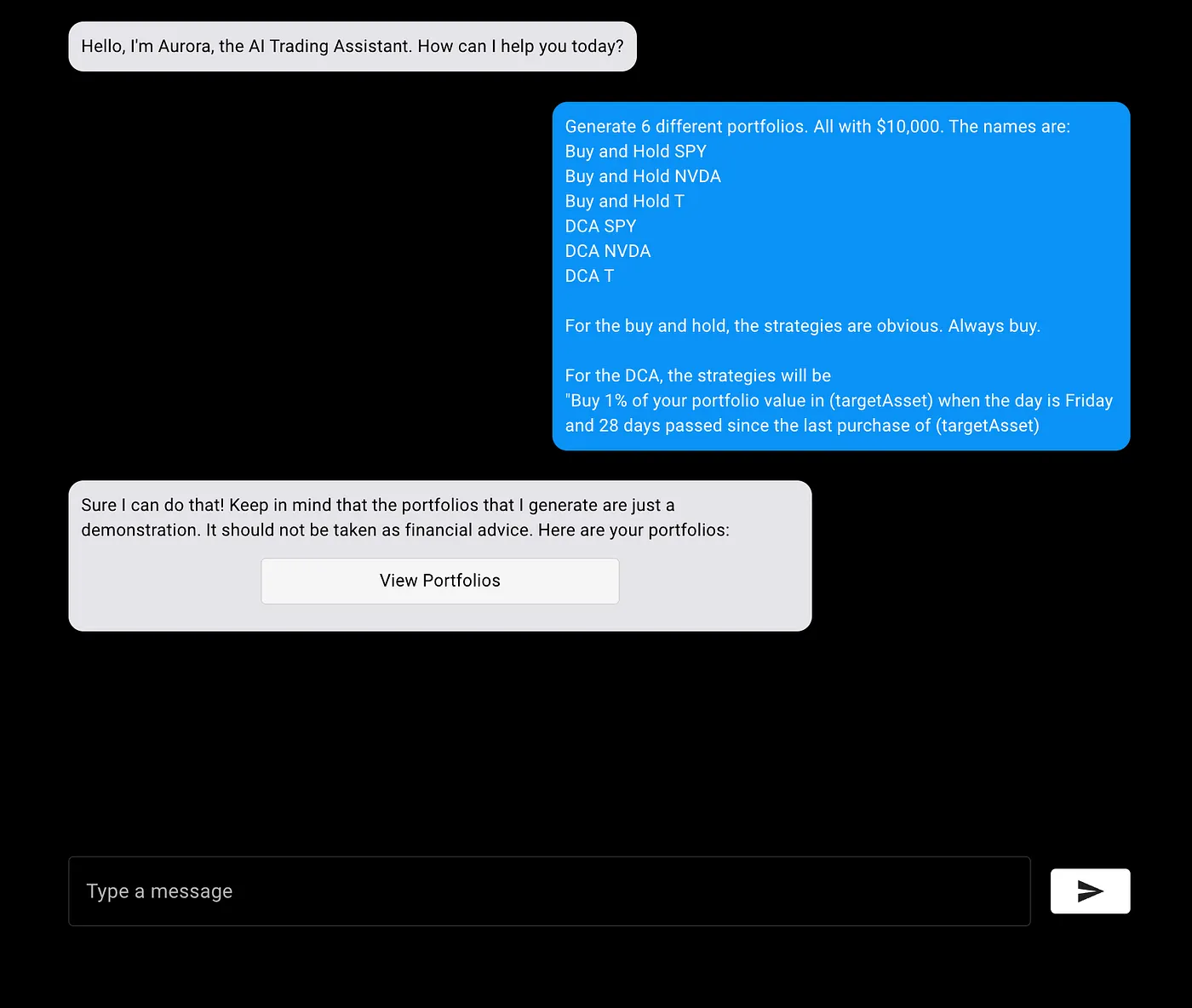
We’re going to use NexusTrade’s AI-Powered Chat to create and test these strategies. After creating a free account, we’re going to ask Aurora to do the following:
Generate 6 different portfolios. All with $10,000. The names are:
Buy and Hold SPY
Buy and Hold NVDA
Buy and Hold T
DCA SPY
DCA NVDA
DCA T
For the buy and hold, the strategies are obvious. Always buy.
For the DCA, the strategies will be
"Buy 1% of your portfolio value in (targetAsset) when the day is Friday
and 28 days passed since the last purchase of (targetAsset)
With this, wait around a minute for NexusTrade to do its magic, and generate your ideas from plain English. NexusTrade will read your input and generate all of the portfolios we’ll need to evaluate our results.
Results
Evaluating the results is as easy as sending a text message. Literally.
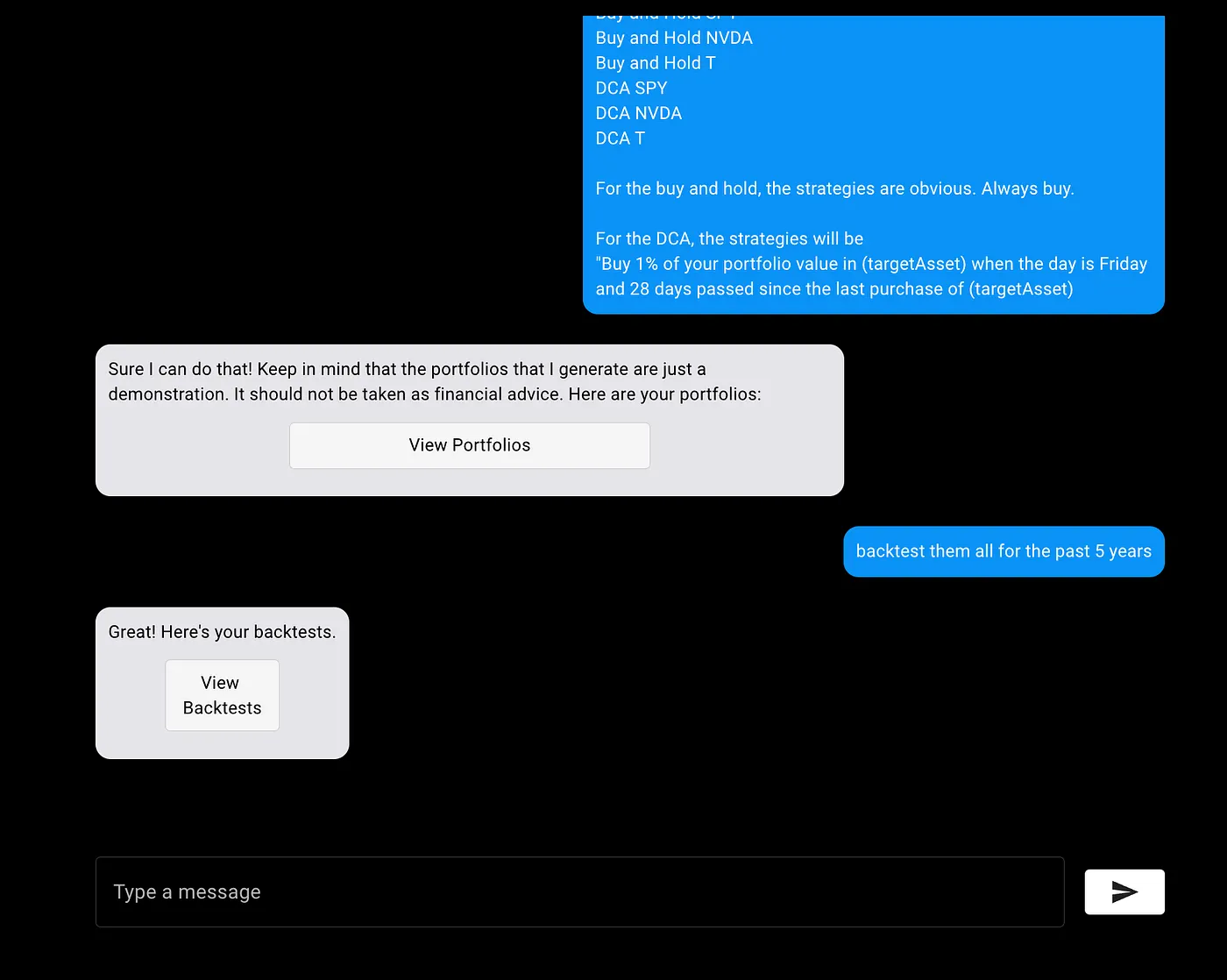
The request was for five years, but the original narrative says Aurora started the tests on January 1, 2023. The same narrative then describes the numbers as five-year performance. No exact start/end receipt is printed here to settle that contradiction. Keep every row below attached to that unresolved date status rather than inferring a period from its return.
SPY (S&P 500 Index ETF)
- Buy and Hold: The reported SPY buy-and-hold run returned 63.72%; its exact measurement window remains unresolved in this archived record. The strategy achieved a high Sharpe Ratio of 2.36 and a Sortino Ratio of 2.78, suggesting good returns for the level of risk taken. However, the strategy wasn’t without its drawbacks; it had a maximum drawdown of 34.09% and an average drawdown of 6.86%.
- Dollar-Cost Averaging (DCA): Taking the DCA approach yielded a 21.78% return over the same period — considerably less than Buy and Hold. However, it came with less risk, with a max drawdown of 19.07% and an average drawdown of 3.26%.
NVDA (NVIDIA Corporation)
- Buy and Hold: This tech stock was a windfall for those who chose the Buy and Hold strategy, bringing in a jaw-dropping 762.14% return. The Sharpe and Sortino Ratios were exceptionally high at 4.37 and 6.03, respectively. But the rollercoaster came with deep valleys — a max drawdown of 67.26% and an average drawdown of 21.64%.
- Dollar-Cost Averaging (DCA): Those who opted for DCA with NVDA still experienced robust growth of 329.12%, though not as astronomical as the Buy and Hold. The risk-adjusted metrics were also strong, with Sharpe and Sortino Ratios at 3.95 and 5.41, respectively. Interestingly, DCA had a slightly lower max drawdown at 63.39% but significantly lower average drawdown at 11.34%.
T (AT&T Inc.)
- Buy and Hold: Investors who adopted a Buy and Hold strategy with T would’ve faced a decline of 47.21% in their portfolio value. Risk metrics here are in the negative, with Sharpe at -1.43 and Sortino at -1.69. Additionally, the strategy saw a maximum drawdown of 55.00% and an average drawdown of 25.89%.
- Dollar-Cost Averaging (DCA): Choosing DCA for T would’ve still resulted in a loss but a significantly reduced one at 20.04%. Even though Sharpe and Sortino ratios remained negative at -1.59 and -1.76, the max and average drawdowns were far less severe at 30.13% and 8.35%, respectively.
Conclusion
So, what do these numbers tell us?
- Profitability: The Buy and Hold strategy outperformed Dollar-Cost Averaging in terms of overall percent change for both SPY and NVDA. Interestingly, even in the case of a losing stock like T, DCA managed to lose less.
- Risk: Both Sharpe and Sortino Ratios were generally higher for Buy and Hold, indicating better risk-adjusted returns. However, it’s worth noting that DCA had a significantly lower maximum and average drawdown in all cases.
- Volatility: Buy and Hold presented higher volatility and risks, as indicated by the maximum and average drawdown. In volatile markets or for risk-averse investors, DCA could be a safer bet.
In the reported rows, buy-and-hold returned more for SPY and NVDA. The gradual plans had lower maximum and average drawdown for all three assets, and lost less for T. Those are comparisons within the reported experiment. Resolving the dates and cash exposure is necessary before using them as a medium-term strategy conclusion.
To reproduce this comparison, open Aurora with the original six-portfolio request above and keep every draft inactive. Before testing, confirm the generated buy sizes and schedule, then use one explicitly chosen start date, end date, initial cash and dividend convention for all six. Save the rule export, run receipt and remaining-cash history with the result. This is a new comparison; it does not recover the dates of the September 2023 runs.
There you have it! If you’ve made it this far, you’re likely as excited about these findings as we are. Feel free to connect on LinkedIn, Instagram, and TikTok for more in-depth financial discussions. Here’s to making informed investment choices!
Go to NexusTradeRaw Results
If you want to see the raw numbers without creating an account on NexusTrade, then look below.
SPY
Buy and Hold
- Percent Change: 63.72%
- Sharpe Ratio: 2.36
- Sortino Ratio: 2.78
- Max Drawdown: 34.09%
- Average Drawdown: 6.86%
Dollat-Cost Averaging (DCA)
- Percent Change: 21.78%
- Sharpe Ratio: 1.84
- Sortino Ratio: 2.17
- Max Drawdown: 19.07%
- Average Drawdown: 3.26%
NVDA
Buy and Hold
- Percent Change: 762.14%
- Sharpe Ratio: 4.37
- Sortino Ratio: 6.03
- Max Drawdown: 67.26%
- Average Drawdown: 21.64%
Dollar-Cost Averaging (DCA)
- Percent Change: 329.12%
- Sharpe Ratio: 3.95
- Sortino Ratio: 5.41
- Max Drawdown: 63.39%
- Average Drawdown: 11.34%
T
Buy and Hold
- Percent Change: -47.21%
- Sharpe Ratio: -1.43
- Sortino Ratio: -1.69
- Max Drawdown: 55.00%
- Average Drawdown: 25.89%
Dollar-Cost Averaging (DCA)
- Percent Change: -20.04%
- Sharpe Ratio: -1.59
- Sortino Ratio: -1.76
- Max Drawdown: 30.13%
- Average Drawdown: 8.35%
📸 Catch us on Instagram
🎵 Dive into our TikTok
📚 Follow our thought pieces on Medium
🤝 Connect with me on LinkedIn
No comments yet.