Most Courses End in a Certificate. This One Ends With a Live Strategy in the Market
Learn to Trade For Free — No Coding Knowledge Required

Five years ago, I tried to build my first algorithmic trading strategy.
I was at Carnegie Mellon, surrounded by some of the smartest engineers in the country.
I still couldn’t get it to work.
I used QuantConnect. If you’ve never heard of it, it’s a platform that lets you write trading algorithms in Python or C#. The documentation was thorough. The community was helpful. The platform itself was powerful.
And I still failed.
I spent hours staring at the QuantConnect IDE, trying to figure out how to even start. I understood the concept perfectly. Buy when the short-term average crosses above the long-term average. I didn’t expect to become a millionaire from this; I just wanted to see what would happen.
And translating that into code? I just didn’t get it.
I stared at the documentation. I stared at example strategies. I stared at the blank editor. Nothing clicked. The gap between “I know what I want to do” and “I can make the computer do it” felt insurmountable.
The strategy I was trying to build would have taken maybe 30 seconds to describe to another human, and I couldn’t even get it to run.
I closed my laptop, went to bed, and didn’t touch algorithmic trading again for months.
That failure stuck with me. Not because I wasn’t smart enough — I was getting a master’s degree at Carnegie Mellon. The problem was that the tools weren’t built for people who wanted to trade. They were built for people who wanted to code.
The Old World
In 2020, if you wanted to trade algorithmically as a retail investor, here’s what you needed:
- You had to learn how to code well. At minimum, you needed Python, NumPy, Pandas, and the ability to connect to various APIs just to test a simple idea. Want to backtest a moving average crossover? That’s 200 lines of code before you see a single result. Iteration speed was brutal. And God help you if you hit a bug at 2am with no Stack Overflow answer in sight.
- You had to understand financial concepts nobody taught you. What’s the difference between gross profit and net income? How do you calculate free cash flow? What’s a Sharpe ratio and why does it matter? None of this is covered in high school. Most college programs skip it too. You had to teach yourself.
- You had to deploy your strategy and hope. Even if you did everything right, you needed to somehow port your backtesting code into a live-trading environment, then watched as your strategy failed because you didn’t account for lookahead bias.
This is why algorithmic trading stayed in the hands of quantitative hedge funds and prop trading firms. They had the engineers, the data scientists, the infrastructure. The average investor didn’t stand a chance.
What Changed
Two things happened: no-code algotrading tools started popping up and generative AI started to become genuinely good.
With no-code tools like Composer, Pluto, and NextTrade, people could create, backtest, and deploy trading strategies without writing a single line of code.
At the same time, ChatGPT was being released, and people realized that instead of configuring strategies with a bunch of form fields and buttons and tediously testing a strategy, you could just… describe it in plain English.
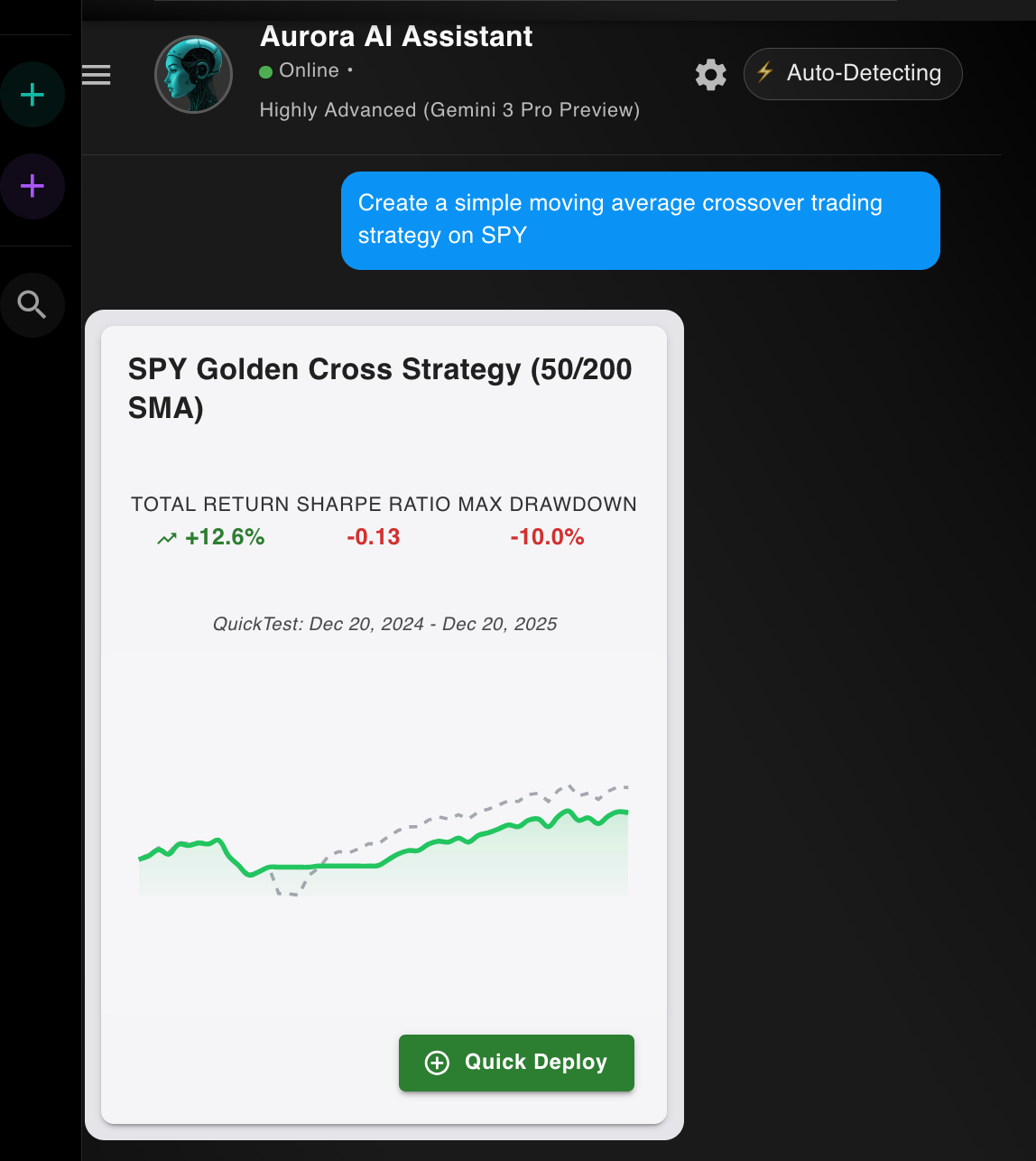
But even though the process can be done quickly, most regular investors were still paralyzed on what to do.
- They didn’t understand indicators. They don’t know the difference between technical and fundamental indicators. They can’t name 3 technical indicators or what they’re used for
- Even if they understand it conceptually, they don’t understand how to combine the indicators to generate signals
- They don’t understand backtesting, lookahead bias, or parameter optimization
- They don’t know that after you create a strategy, you need to deploy it, either with a real brokerage or a paper-trading demo
I wrote Medium articles to “show, not tell” how to create a strategy, and it worked to some degree. I grew to 55,000 followers, so clearly the message resonated.
But readers still didn’t fully grasp the fundamentals of building a trading strategy. I kept seeing the same pattern: people would sign up for NexusTrade, fail to create a strategy, and give up. Not because the platform didn’t work, but because nobody had taught them the fundamentals.
So I decided to fix that.
Why I Built a Course
I built a comprehensive learning management system for algorithmic trading. To launch it, I started with one course: Algorithmic Trading Fundamentals.
It’s 14 video lessons, hands-on activities, quizzes, and a certificate at the end. But more importantly, you finish the course with a real strategy that you’ve built, backtested, and deployed to paper trading.
Every lesson has a hands-on activity where you build something real.
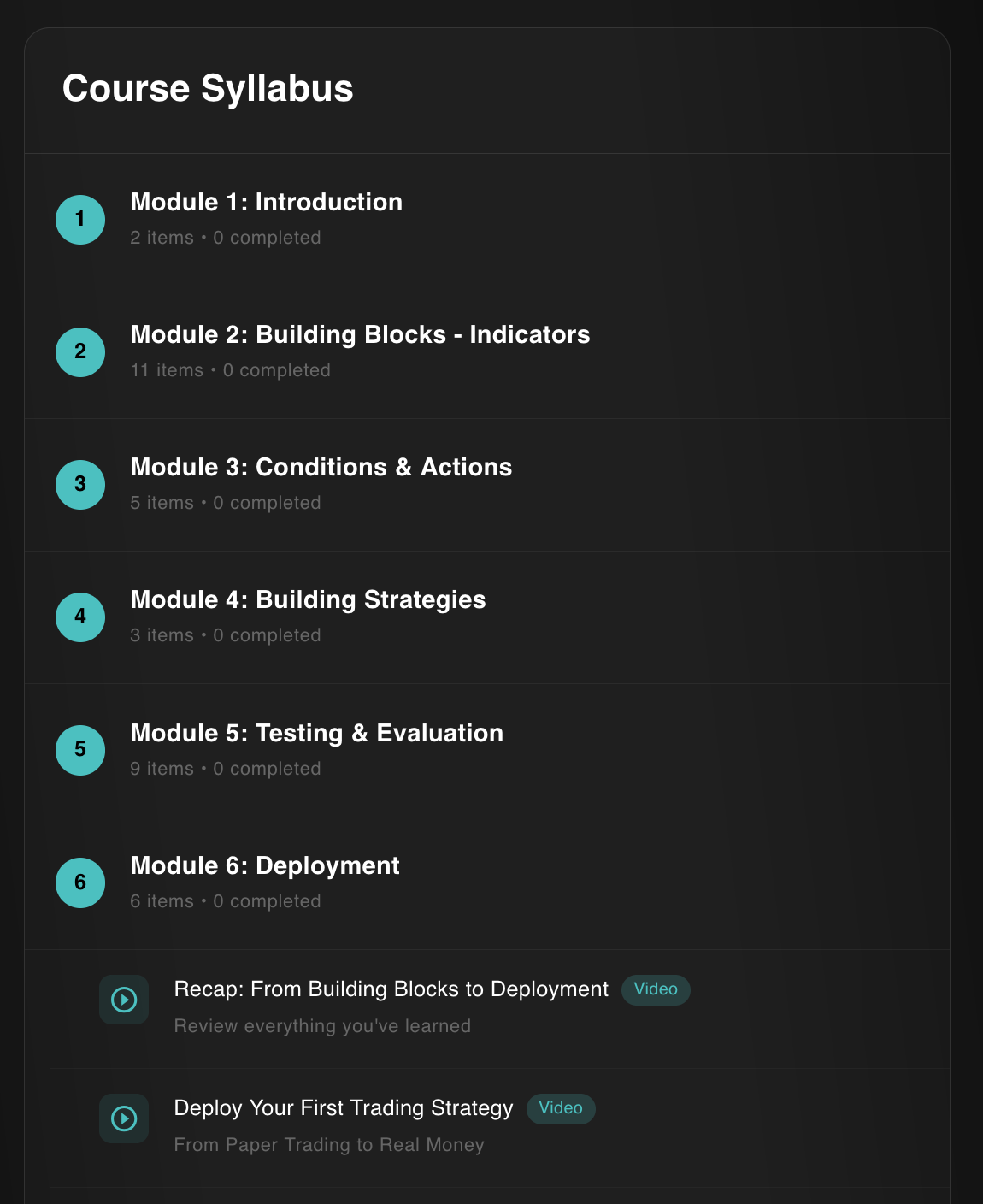
The course covers:
- What algorithmic trading actually is
- Technical, fundamental, and alternative data indicators
- How to build conditions that trigger buy/sell signals
- Backtesting, and how to avoid the mistakes that invalidate your results
- Optimization without overfitting
- Deploying to paper trading, then live
You can see the full curriculum here: nexustrade.io/learn/algorithmic-trading-fundamentals
The Final Barrier
There was still one problem. Because of the infrastructure costs of running AI agents and minute-by-minute backtests, NexusTrade isn’t free. The premium features cost $49.99/month.
I remember being that student at Carnegie Mellon. I remember having the drive but not the budget. It would be hypocritical to say I built this to democratize trading, only to lock it behind a paywall that students can’t afford.
So, I decided to trade access for effort.
I created a scholarship program where, if you are willing to document your learning journey publicly on social media, I’ll cover the cost of the Premium subscription.
I don’t want your money; I want your engagement. I believe that if you actually use the platform to learn, you’ll stick around.
If you have the drive but not the funds, you can apply here: nexustrade.io/scholarship
Algorithmic trading isn’t reserved for hedge funds anymore.
The tools exist. The education exists. The barrier is gone.
Five years ago, I closed my laptop in frustration, convinced that algorithmic trading wasn’t for people like me. I was wrong. It wasn’t for people like me yet.
It is now.
Austin Starks is the Founder & CEO of NexusTrade, an AI-powered algorithmic trading platform. He works at Coinbase and holds degrees from Cornell and Carnegie Mellon.
No comments yet.