I’m using autonomous trading rules to manage over $10,000 in investments. Here are my EXACT strategies.
How I built my trading strategy over the course of a year
 8 min read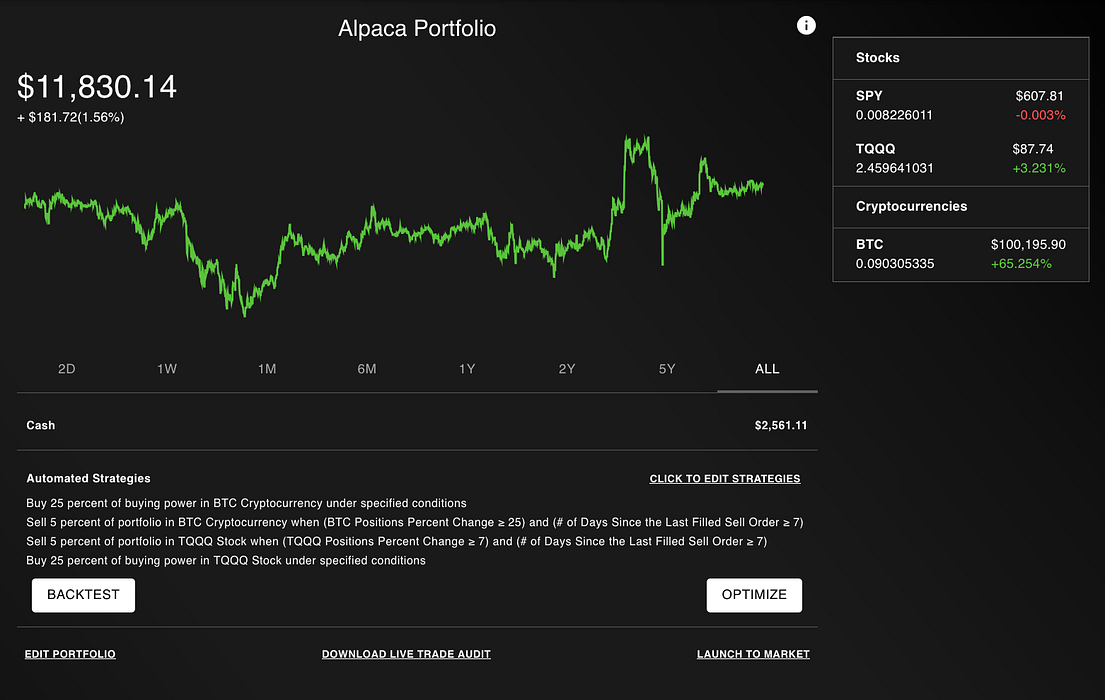
I am launching a no-code fully automated trading platform to the world of retail investing.
I don’t mean a simple app to configure lame, useless price alerts. I mean a highly sophisticated, but easy-to-use algorithmic trading and financial research platform.
To prove its usefulness (and to test the integration with Alpaca, the cloud brokerage used for executing the trades), I’m deploying $11,824 of my own money to be managed by the strategies I’ve created within the platform.
Here are the exact trading rules that I’m using and how I built them.
Background: What is a trading strategy in NexusTrade?
Before I discuss my exact strategies, I want to discuss what precisely I mean by “trading strategy”.
At its simplest form, a trading strategy is a rule for executing actions in the market.
These rules can be extremely simple. For example,
- Buy 10 shares of NVIDIA if its price is below $140/share
- Buy 50% of my buying power in BTC if its price falls 10% in a week
- Sell 40% of my Google positions if its revenue is below its yearly average revenue
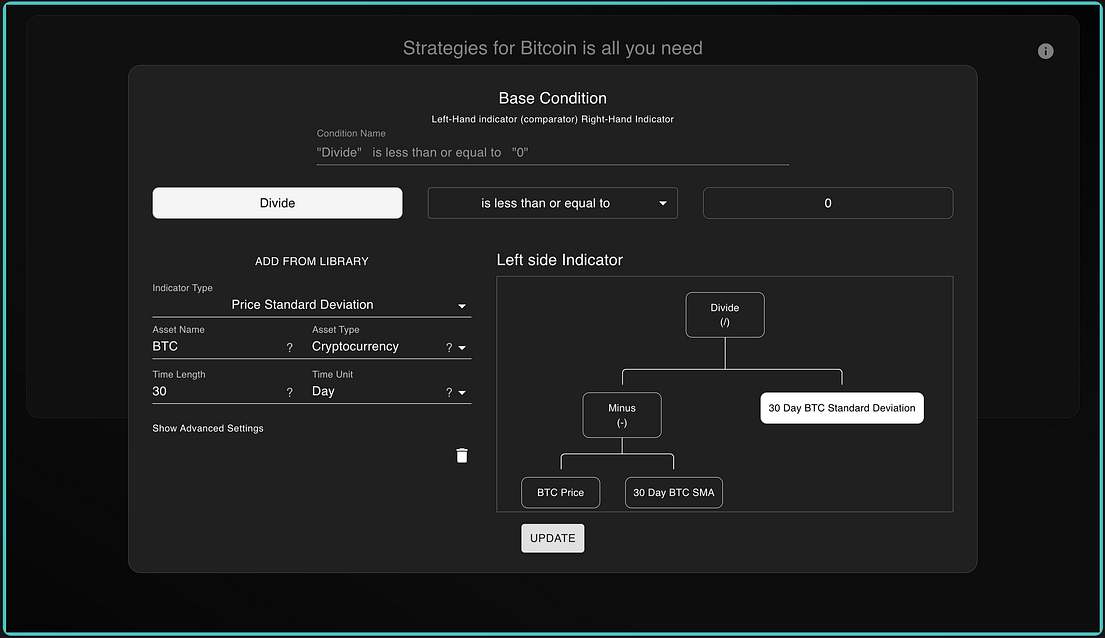
However, strategies can also be more complicated, such as “buy 10% of my buying power in SPY if its price / its 30 day standard deviation is less than 1 and 30 days have passed since I last bought or sold SPY”.
As these examples show, a strategy is composed of an action and a condition.
The actions are currently “Buy” or “Sell”. They include the asset and amount that we want to trade.
The condition can best be described as a true or false market observation. The NexusTrade platform is flexible enough to combine conditions together to create even more sophisticated trading rules.
All of this is possible without one line of code.
How to create a trading strategy?

Making it possible to create these types of trading strategies was tricky, especially as a fully no-code platform. However, I’ve successfully developed three ways of allowing my users to do so. They include:
- Copying a strategy from the strategy library
- Configuring a strategy using plain English and a large language model
- Building a strategy using the no-code UI
The strategy library is simple; simply navigate to the library page and click on any strategy that looks interesting. Then click “Create a new portfolio” and we’re done.
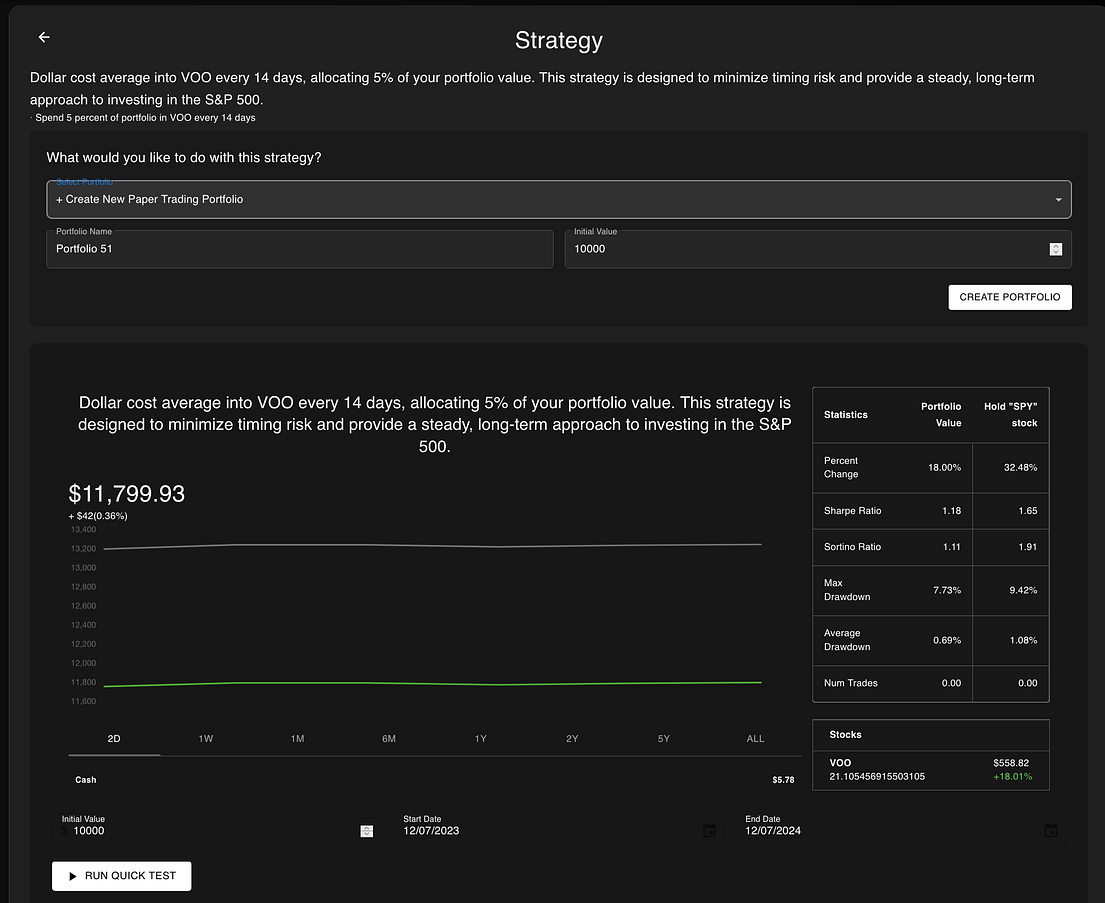
This is useful if we have literally no idea where to get started. They give us an idea of what successful, simple strategies look like.
However, what’s more interesting is creating our own strategies.
The No-Code UI for Creating Strategies
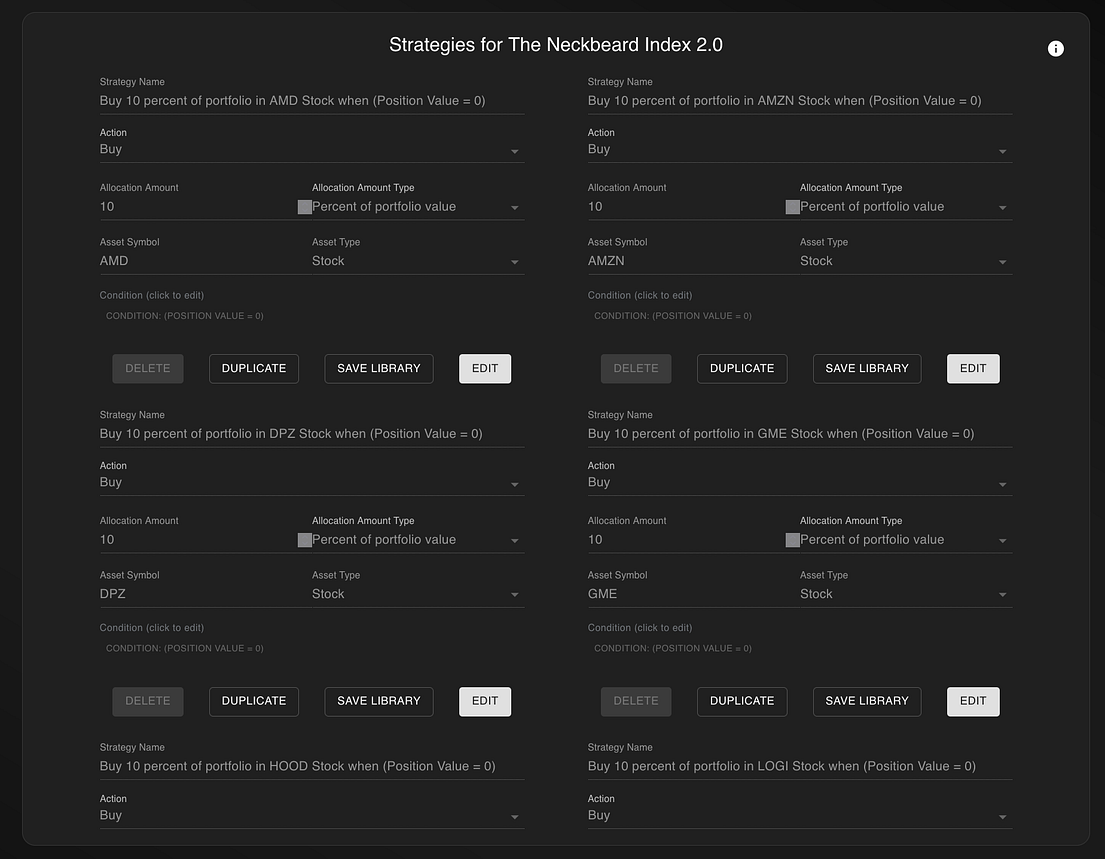
Let’s start with the no-code UI. This page allows us to fill out forms to create our strategies.
You can see that the forms require all of the components I mentioned earlier: an action and a condition. These conditions can be made more sophisticated easily within the UI by using AND and OR operators.
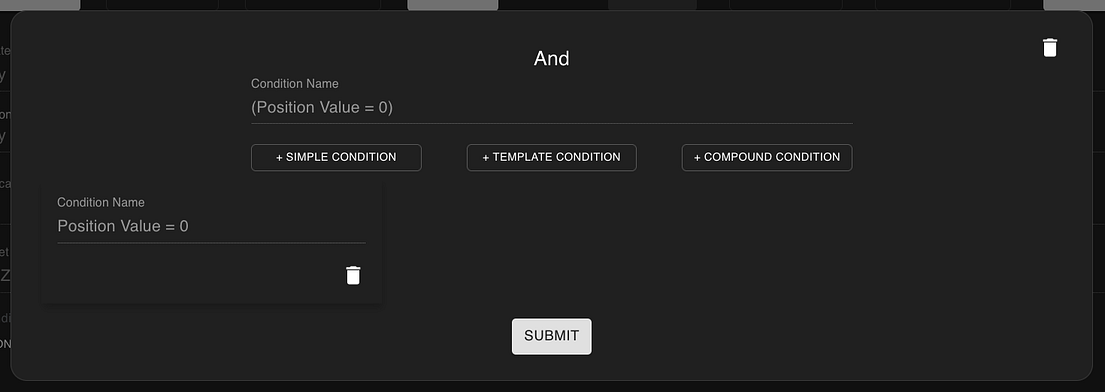
While easier and more straightforward than coding our strategy from scratch, the configuration process still requires quite a bit of work to create strategies this way. That’s why I created an LLM-Powered assistant to streamline this process.
Aurora, the AI Assistant for creating strategies
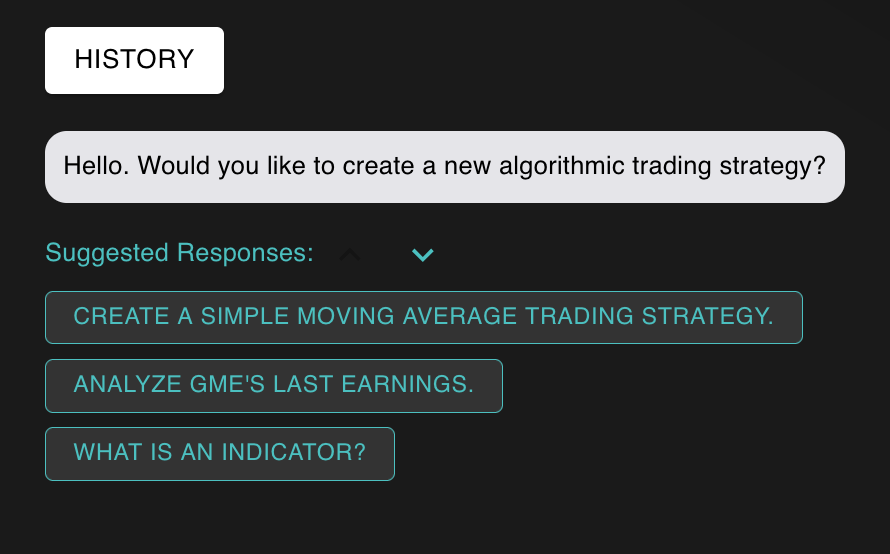
I created Aurora to make it extremely simple for anybody to create their own algorithmic trading strategy.
Aurora fills the same underlying configuration fields from the natural-language request. Inspect the generated conditions and sizes as you would a configuration you entered by hand. The shown convenience is assistance with that workflow.
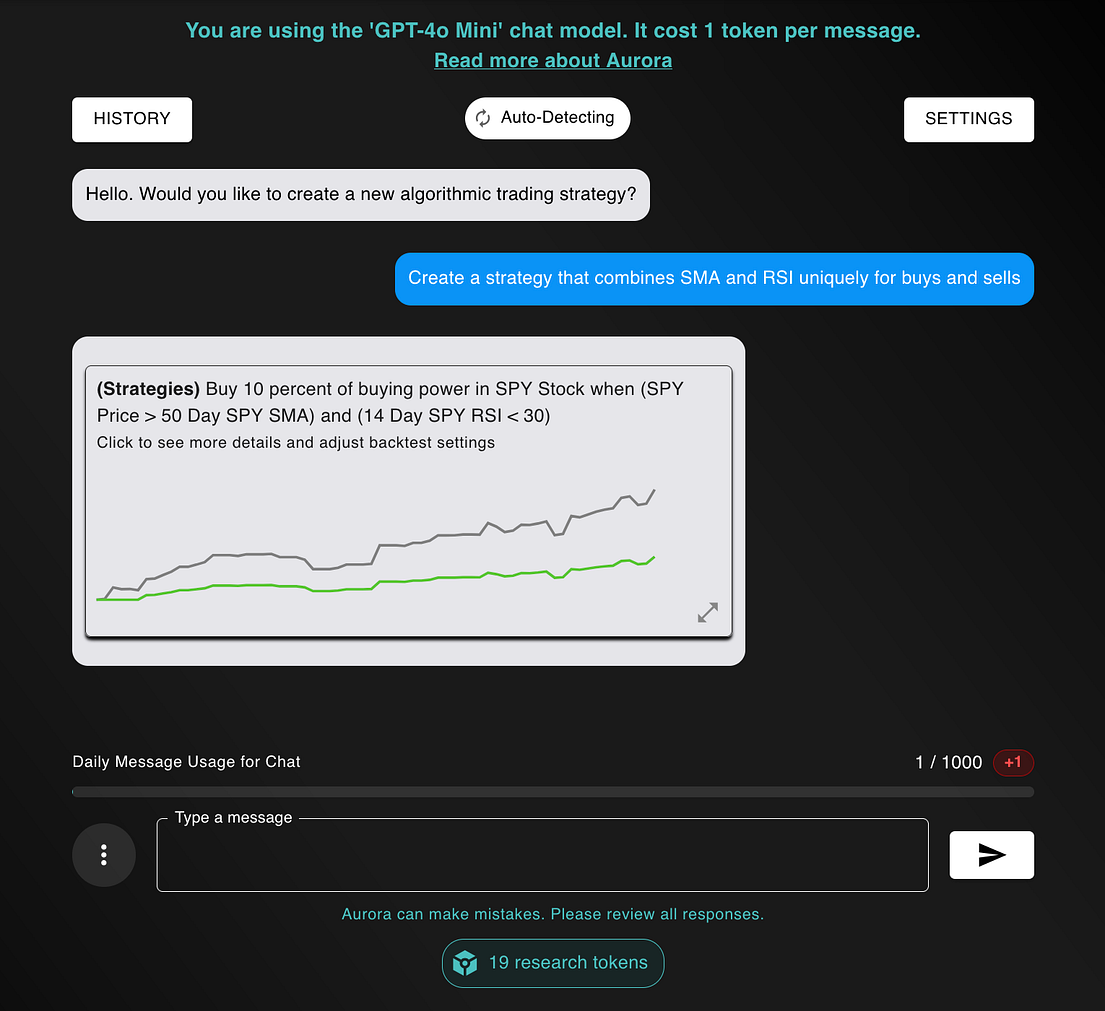
Aurora can propose missing details, and you can iterate on the configuration. Inspect any inferred indicator, threshold, size and time counter before accepting it: the resulting rule must match what you intended.
This concludes the section on creating strategies. While extremely powerful, creating a strategy is only half the battle; we also need to know how to iteratively improve our strategies to be ready for deployment. That’s where Aurora’s other abilities shine.
How to go from “a strategy” to “a genuinely good strategy”?
Testing our strategies on past and present data
To go from “creating any strategy” to “creating a good strategy”, we need tools to evaluate the effectiveness of our strategies and find potential stocks to trade. Aurora can help us with this too.
For example, after creating a strategy, we can test it historical performance — a process called backtesting.
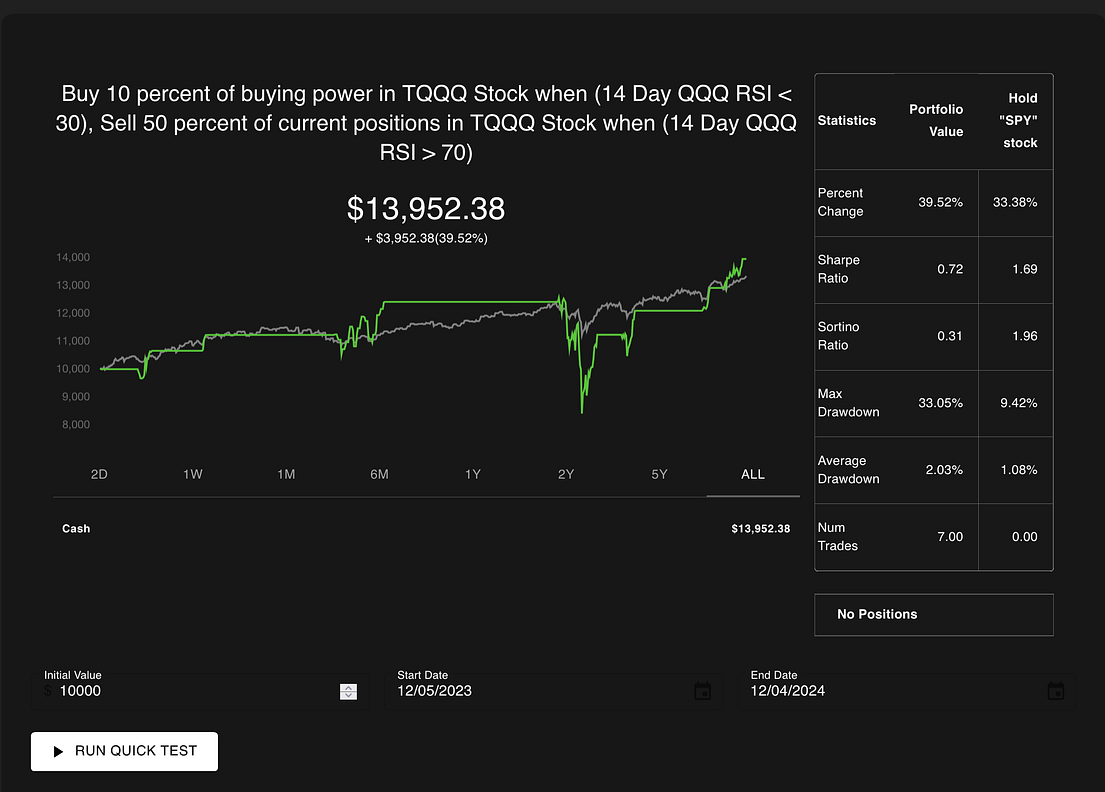
We can inspect a baseline, change one parameter and compare that variant. Reserve a later period before choosing the variant, then keep the selected rules fixed when evaluating it there. Repeatedly checking the same period makes it part of selection rather than an untouched test.
We can even customize the backtest period to iterate on a specific period of time.
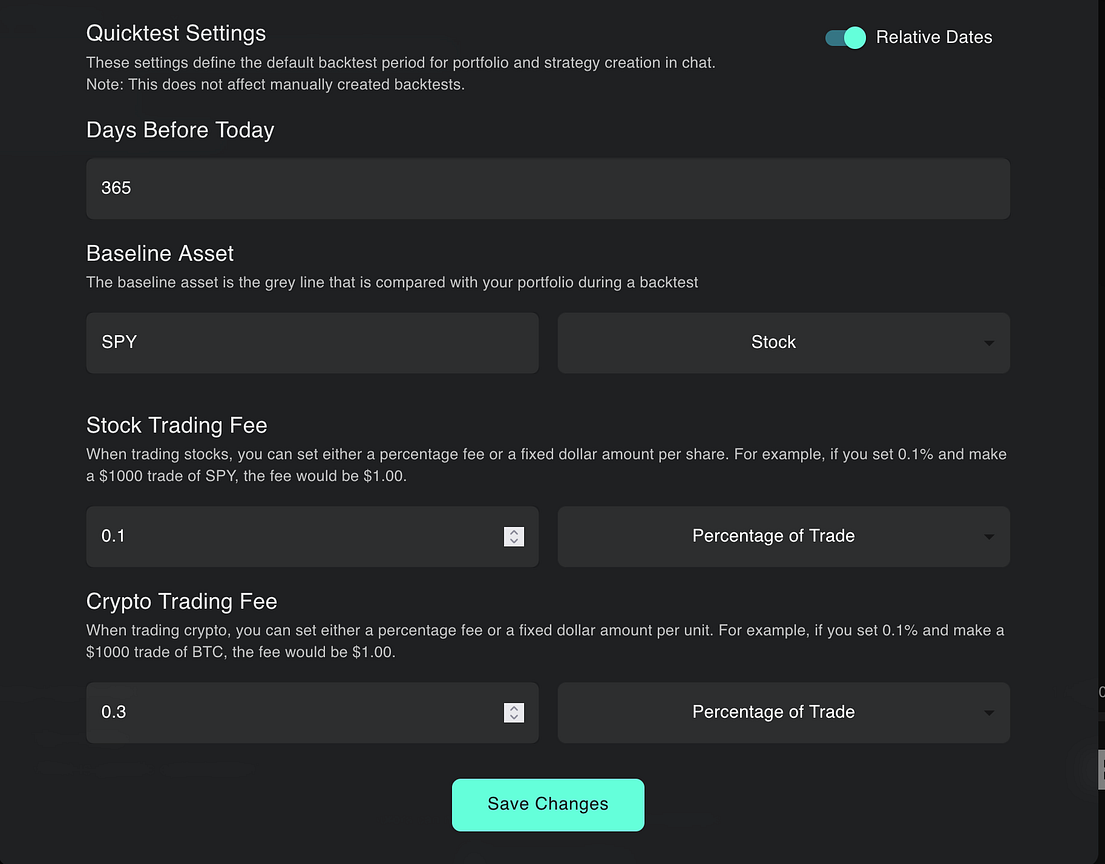
Once we’ve finished this iterative testing on historical data, we can evaluate how our strategies perform in real-time – a process called “paper-trading”. This allows us to get an idea of how our strategy’s performance translates to the real-world.
However, more important than creating our rules is finding the stocks (and cryptocurrencies) that we're going to trade with.
Aurora helps with that too.
How I find good stocks to create strategies with
An asset’s historical performance isn’t the only way to build a good strategy. We can also build strategies by guessing how a stock might do in the future. One way of approaching this is using fundamental data.
Fundamentals tell us a story about a company’s financial health. Generally-speaking, a company that is healthy and growing has a bigger future stock price than a company that is unhealthy and losing money.
We can use Aurora to find fundamentally strong investment opportunities.
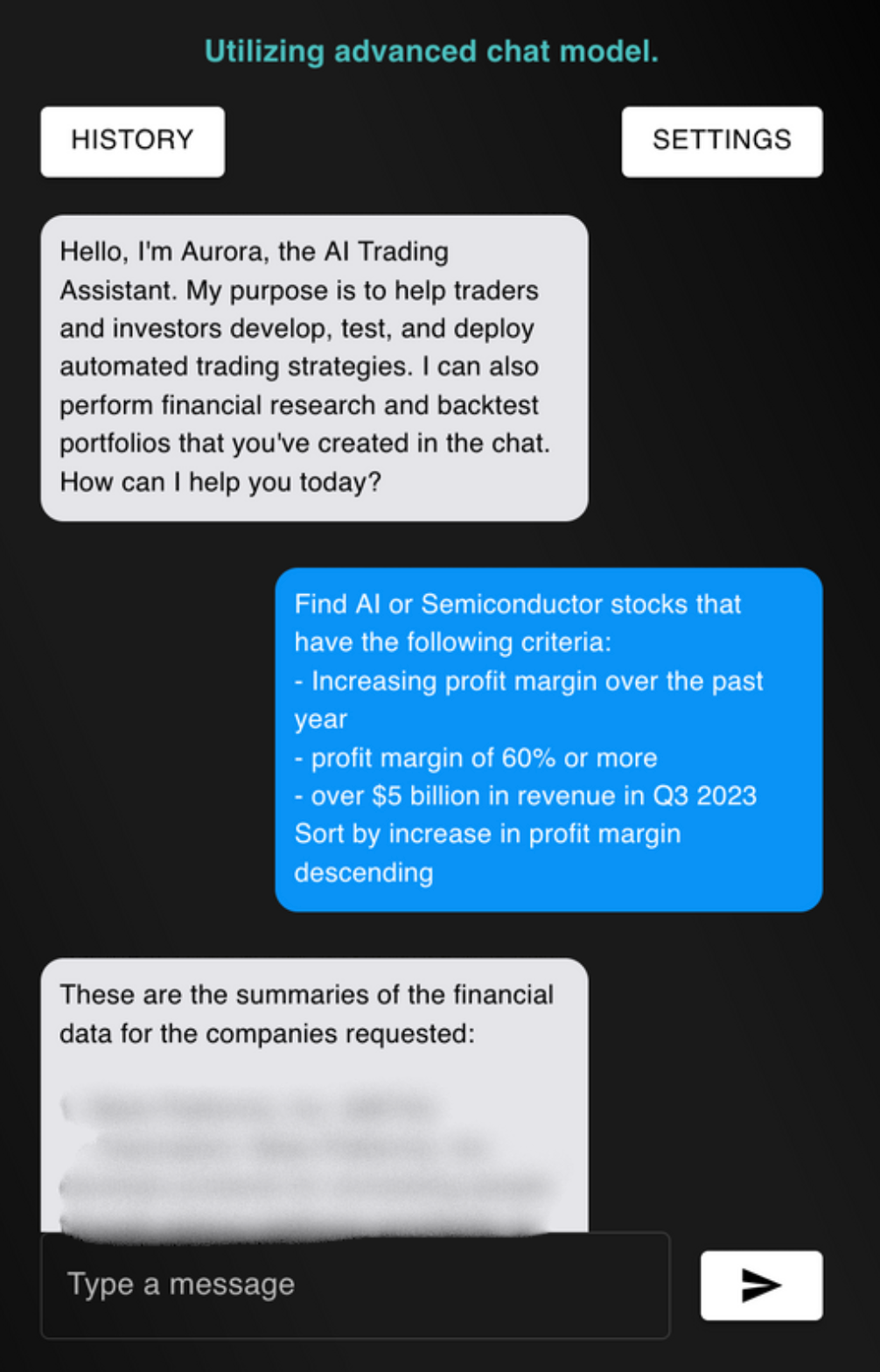
For example, in a previous article, I showed how I found fundamentally strong AI stocks, using Aurora.
Here are 5 Stocks to Look At To Increase Your Exposure to Artificial Intelligence (AI)
ChatGPT popularized modern Artificial Intelligence in November 2022. After being released to the general public, it…
nexustrade.io
This functionality extends beyond finding fundamentally strong stocks and can allow us to find stocks based on arbitrary criteria.
Moreover, Aurora has other capabilities, like the ability to analyze a watchlist and see how the fundamentals of the stocks with it changed over time.
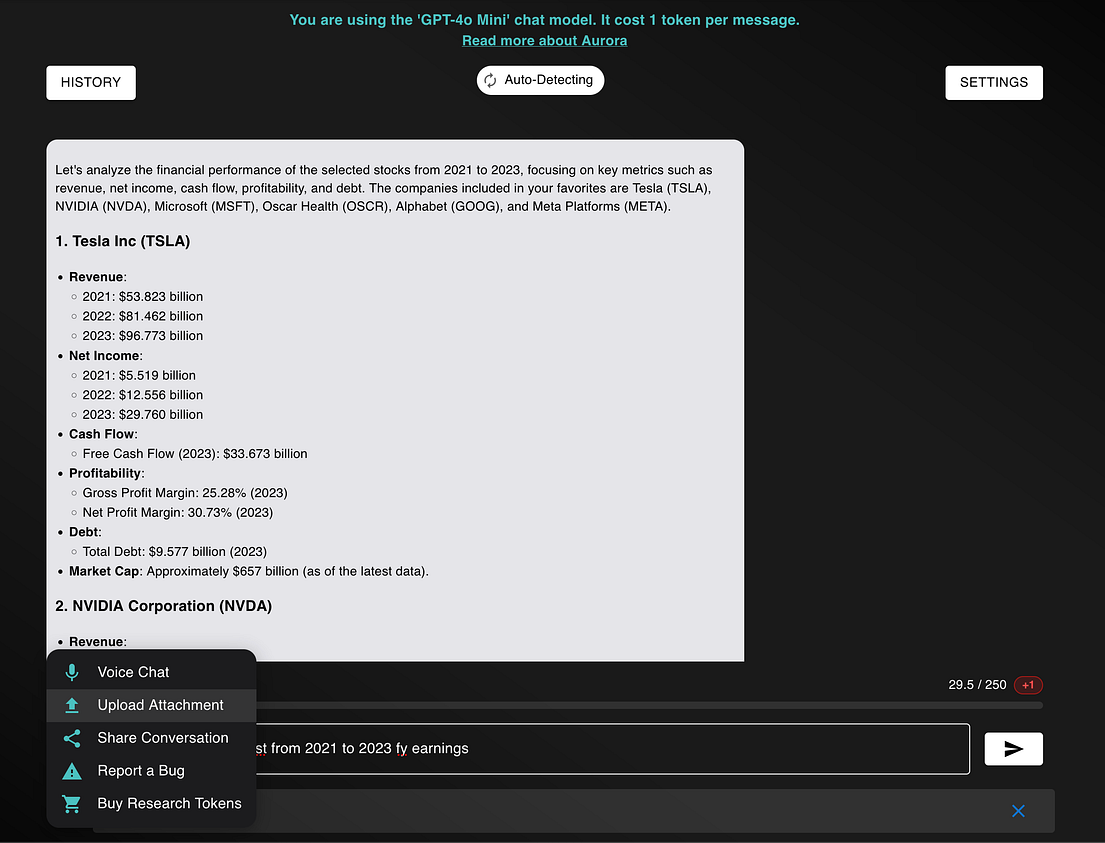
By iterating and improving on these features each day, I’ve slowly developed my investing strategy. It’s based on the results from backtesting, what I’ve noticed about fundamentals, and what I’ve demonstrated from paper-trading.
And now its time to launch real-time trading. To test the integration, I will use over $10,000 of my own cash and see how it performs.
Here are the exact rules I’m using for my trading algorithm.
What are the trading strategies that I’m deploying to the market?
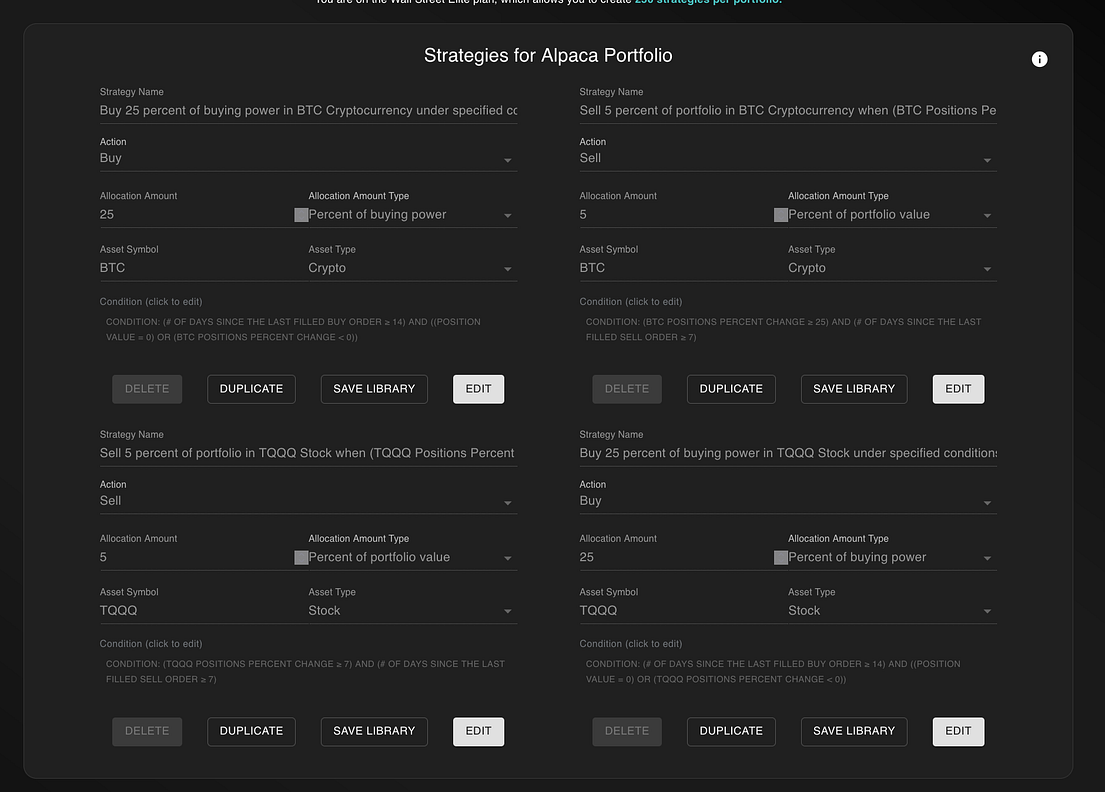
Using my algorithmic trading platform, I have the following rules.
- An initial lump-sum Bitcoin purchase is not pictured, and its amount and execution date are not disclosed here. The recurring buy/sell rules below are exact prose rules; they do not reconstruct the complete starting allocation.
- Buy 25 percent of buying power in BTC if 14 days passed since my last BTC purchase and (I have no Bitcoin or my Bitcoin positions are down)
- Buy 25 percent of buying power in TQQQ if 14 days passed since my last TQQQ purchase and (I have no TQQQ or my TQQQ positions are down)
- Sell BTC worth 5% of total portfolio value when the BTC profit condition is above 7% and at least seven days have passed since the last filled BTC sale. The prose does not supply the saved indicator definition for that 7% test; verify it in the historical configuration before reproducing the rule.
- Sell 5% of my portfolio value in TQQQ when TQQQ positions are up 7% and 7 days have passed since the last TQQQ sell
Hypothetical sizing: total portfolio value $10,000 and BTC holdings worth $2,000 means a 5%-of-portfolio sale targets $500 of BTC, leaving $1,500 at unchanged prices. It is not a 5%-of-BTC sale, which would be $100. If the saved profit indicator uses cost-basis return, a $1,800 BTC cost basis and $2,000 value gives about 11.1%, above the 7% threshold. That cost-basis assumption needs the original indicator configuration; this arithmetic is not a recorded fill.
This strategy is a high-risk, high-reward strategy. It involves leveraged ETFs and cryptocurrencies. So why did I choose it?
Across the past decade, some of the best assets one could’ve bought are Bitcoin and tech stocks. Stocks like NVIDIA, Tesla, and Amazon have dominated the market and have seen outsized returns.
But picking the “right” stock has been a challenge. We all know that past performance for a stock doesn’t guarantee future performance.
TQQQ targets three times the Nasdaq-100 Index’s daily return before fees and expenses. That index is technology-heavy, but TQQQ is a daily leveraged fund with reset and compounding effects; its longer-period return need not equal three times the index’s return. Read the issuer’s objective.
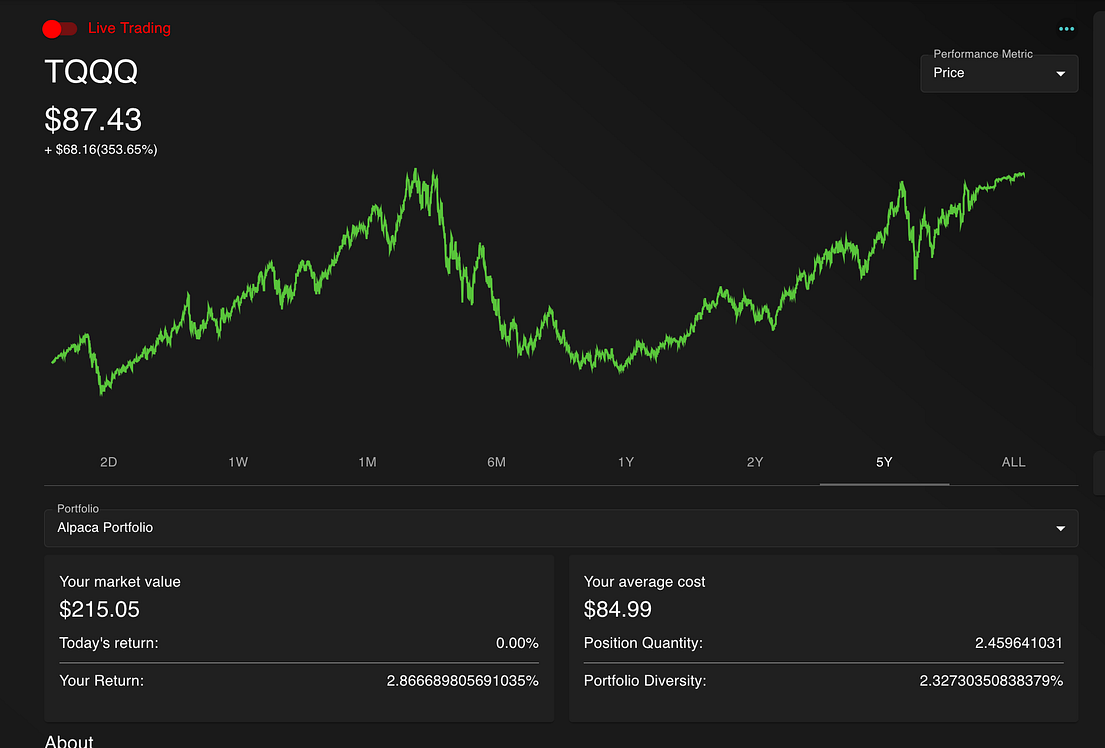
If it does poorly, I can choose to deposit more cash and buy more. Or, I can call this experiment a failure and hold.
I’m using similar logic for Bitcoin, which has seen astronomical gains in the past decade. Across all of my portfolios, my cryptocurrency exposure has been low, and deploying this strategy has given me an excuse to purchase more Bitcoin.
And, it has already started to pay off, with Bitcoin up 65% since I purchased it.
Concluding Thoughts
The purpose of this article isn’t to convince you to copy my trading ideas. In fact, I recommend against that. The purpose is to showcase the value of NexusTrade.
I strongly believe NexusTrade is a must-have for any serious investor. The ability to create customizable trading rules based on technicals and fundamentals is game-changer.
Similarly, having easily accessible tools for financial research, backtesting, and financial analysis makes it versatile and useful for nearly any skill level.
In dozens of articles I’ve written, I’ve shown remarkable paper-trading results for a variety of portfolios. Now I want to show these results for the real-deal.
I hope that this shows you how confident I am with NexusTrade. Algorithmic trading is no longer a buzzword or something only accessible to the global elite.
It’s available to you right now – just one-click away.
NexusTrade - AI-Powered Algorithmic Trading Platform
Learn to conquer the market by deploying no-code algorithmic trading strategies.
nexustrade.io
Follow me: LinkedIn | X (Twitter) | TikTok | Instagram | Newsletter
No comments yet.